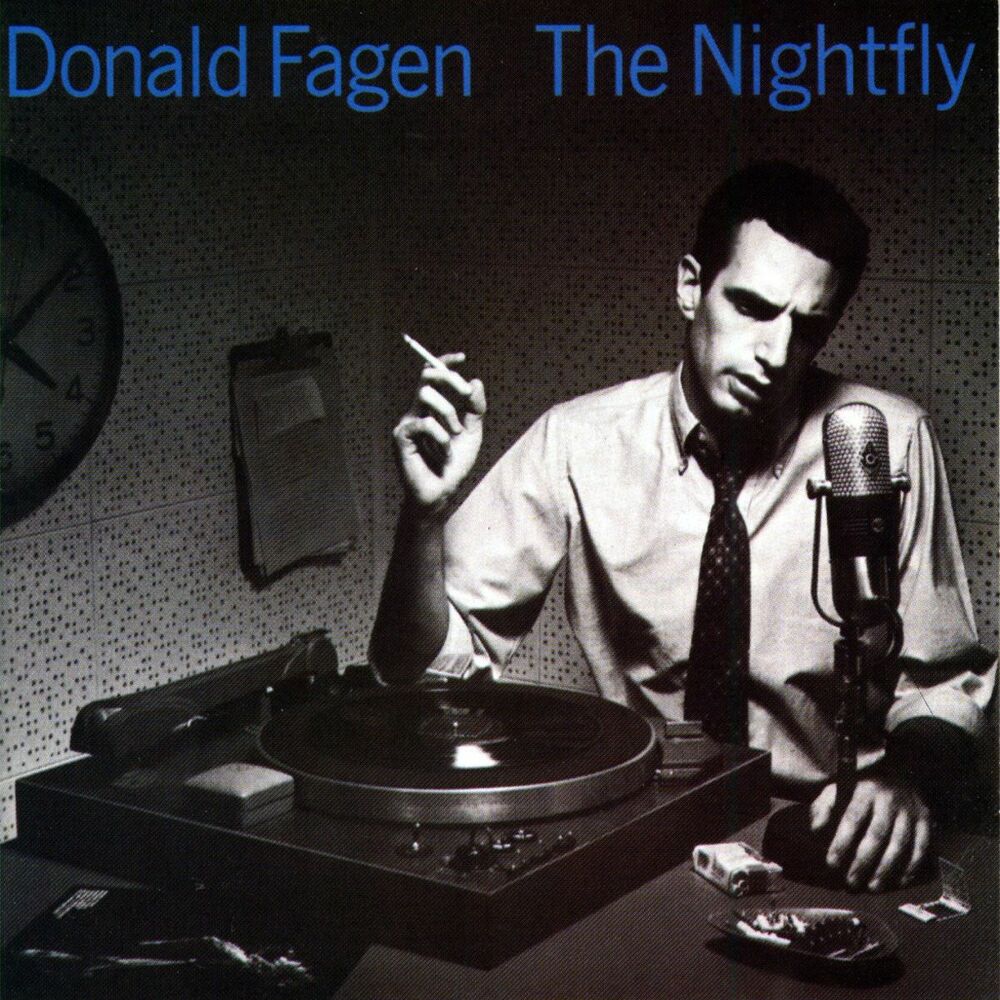
The Nightfly
- Released20 October 1982
- UK peak No. 44
- Weeks on UK chart 16
- Entered UK chart 24 October 1982
- LabelReprise
- Tracks8 · 39 min
2 tracks from it charted as singles. Press a flag to play it in the chart where it peaked.
Tracks
| 1 | I.G.Y. No. 26 · 1982 | 6:03 | |
| 2 | Green Flower Street | 3:42 | |
| 3 | Ruby Baby | 5:39 | |
| 4 | Maxine | 3:49 | |
| 5 | New Frontier No. 70 · 1983 | 6:21 | |
| 6 | The Nightfly | 5:47 | |
| 7 | The Goodbye Look | 4:50 | |
| 8 | Walk Between Raindrops | 2:38 |
About the album
The Nightfly is the debut solo studio album by American singer-songwriter Donald Fagen. Produced by Gary Katz, it was released on October 1, 1982, by Warner Bros. Records. Although The Nightfly includes a number of production staff and musicians who had worked with Fagen's band Steely Dan, it was Fagen's first release without longtime collaborator and bandmate Walter Becker.
Unlike most of Fagen's previous work, The Nightfly is highly autobiographical. Many of the songs relate to the cautiously optimistic mood of his suburban childhood in the late 1950s and early 1960s and incorporate such topics as late-night jazz disc jockeys, fallout shelters, and the Cuban Revolution. Recorded over eight months at various studios in New York City and Los Angeles, the album is an early example of a fully digital recording in popular music. The adoption of this nascent technology, as well as the perfectionistic attitude of the musicians and engineers, made the album difficult to record.
The Nightfly was a critical and commercial success. It was certified platinum in both the US and UK, and generated the top 40 hit "I.G.Y." and the MTV favorite "New Frontier". The album received seven nominations at the 25th Annual Grammy Awards in 1983. The relatively low-key but enduring popularity of The Nightfly led Robert J.
Background
As a child in suburban New Jersey, Donald Fagen enjoyed listening to rock and roll pioneers Chuck Berry and Fats Domino, but felt that as rock music gained popularity, it lost an edge. Fagen, a "lonely" child, then turned to late-night jazz radio shows for the vitality he felt that newer rock music lacked. As he got older, he intended to go to graduate school and pursue literature. Instead, he was "swept up" into the counterculture at Bard College, where he met Walter Becker. They later moved to Los Angeles at the suggestion of their friend Gary Katz and took jobs as staff writers for ABC Records. Together, they formed Steely Dan, releasing their first album, Can't Buy a Thrill, in 1972. Over the course of the decade, the group became successful on the strength of the albums Countdown to Ecstasy (1973), Pretzel Logic (1974), Katy Lied (1975), The Royal Scam (1976), and Aja (1977), the band's best-selling effort and a critical favorite.
Recording and production
The Nightfly was recorded in 1981–82 at Soundworks Digital Audio/Video Recording Studios and Automated Sound in New York City, and at Village Recorders in Los Angeles. Producer Gary Katz, engineer Roger Nichols, and mix engineer Elliot Scheiner had all worked on most of the seven previous Steely Dan albums. Many of the session musicians had also played with Steely Dan, including drummer Jeff Porcaro and guitarists Rick Derringer and Larry Carlton. The album's liner notes credit a total of 31 musicians.
During a radio interview on Off the Record in 1983, Fagen revealed that, though initially the album's songs came to him easily, he began to struggle without the aid of Becker. This turned into a lengthy period of writer's block after the album was finished. His demos for the album were mostly composed on keyboards and a drum machine and remained without lyrics, to allow for alteration when in the studio.
The Nightfly is one of the earliest examples of a fully digital recording in popular music.
Composition
The Nightfly is considered more jazz-influenced than Fagen's previous work, and his lyrics on the album are more wistful and nostalgic than the typically sardonic tone of Steely Dan. Fagen aimed for the lyrics to have "as little irony as possible", and stated that his goal was to make an album that was fun to listen to. As many of the songs came from an adolescent viewpoint, he hoped for them to maintain "a certain innocence". As Walter Becker was responsible for many of the more sarcastic elements in Steely Dan's music, many writers have considered his absence the reason for the album's "warm and nostalgic" tone. Another difference between The Nightfly and his work with Becker is that it maintains a focus on a "certain period [or] motif", according to Fagen. Though Fagen hints at autobiographical aspects of the music in the album's liner notes, he downplayed this notion in a later interview: "It is not me exactly. It is a composite character of myself, what I remember and people I knew.
Artwork
The album's cover artwork features a photo of Donald Fagen as a disc jockey, wearing a collared shirt and tie and speaking into an RCA Type 77-DX microphone. In front of him is a turntable (a 16-inch 1950s model, with a Para-Flux A-16 tonearm), an ashtray, a matchbook, and a pack of Chesterfield King cigarettes. Visible on the table with the record player is the cover of Sonny Rollins and the Contemporary Leaders, one of Fagen's favorite albums. On the wall behind, a clock shows 4:09. An advertisement in Billboard shortly before the album's release set the scene: "At 4:09 a.m., silence and darkness have taken hold of the city. The only sound is the voice of The Nightfly". Fagen appeared on the album cover despite his reclusive nature: "It was an autobiographical album so it seemed like I might as well go public with it." The cover was shot in Fagen's apartment on the Upper East Side of Manhattan by photographer James Hamilton. A second shoot was arranged, as the RCA microphone was facing the wrong direction in the first.
Release
The Nightfly was released on October 1, 1982, on vinyl and cassette. It was also released in its first prerecorded digital form, via half-inch Beta and VHS format cassettes issued by Mobile Fidelity Sound Lab. In addition, a matching folio for the album was released by Cherry Lane Music in February 1983. It was first widely released on compact disc in 1984; a reader's poll conducted by Digital Audio magazine the following year ranked it among the best releases of the time, alongside Peter Gabriel's 1982 self-titled album (another fully digital recording) and Bruce Springsteen's Born in the U.S.A. (1984). Early CD copies of The Nightfly suffered from being manufactured from third and fourth generation masters. Nichols discovered this when he received a call from Stevie Wonder, who told him that his CD copy sounded "funny." Nichols penned an essay in Recording Engineer and Producer criticizing record companies' apparent carelessness in manufacturing the then-nascent format.