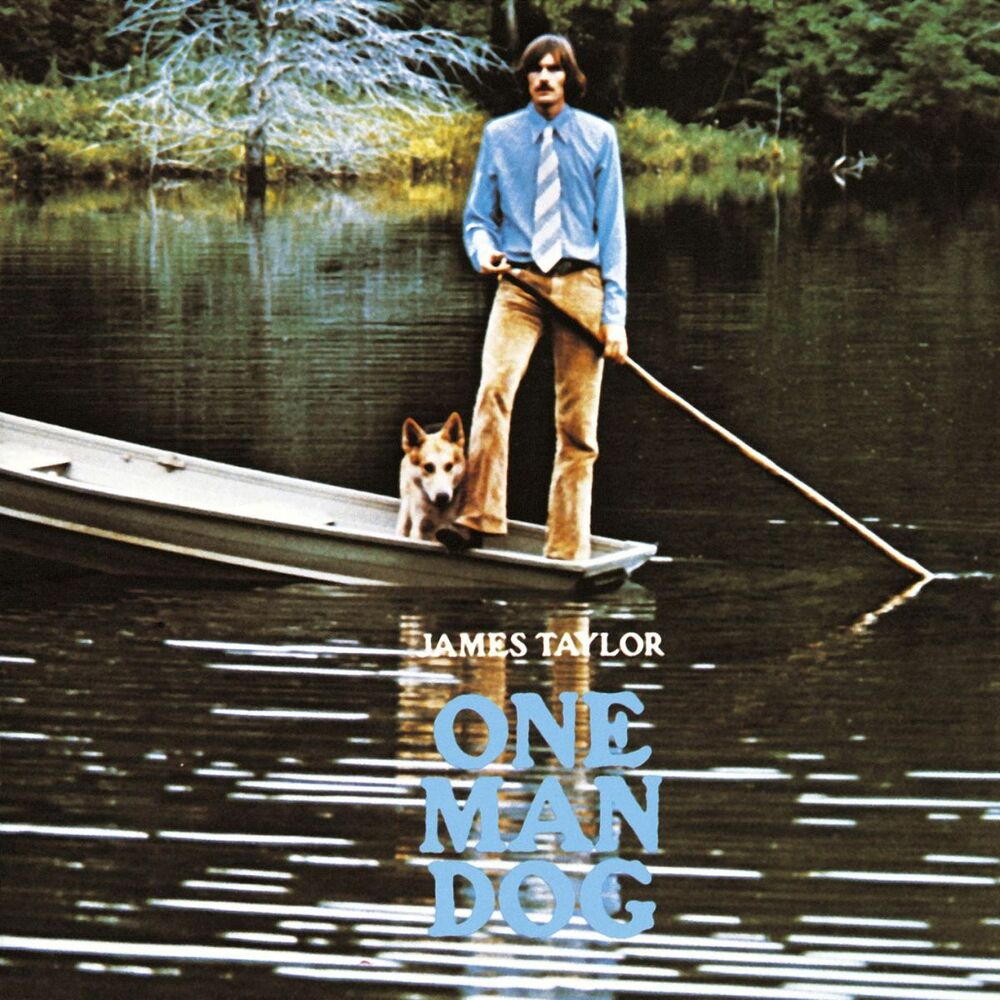
One Man Dog
- Released1 November 1972
- UK peak No. 27
- Weeks on UK chart 5
- Entered UK chart 3 December 1972
- LabelRhino
- Tracks18 · 38 min
2 tracks from it charted as singles. Press a flag to play it in the chart where it peaked.
Tracks
| 1 | One Man Parade No. 67 · 1973 | 3:11 | |
| 2 | Nobody but You | 2:57 | |
| 3 | Chili Dog | 1:35 | |
| 4 | Fool for You | 1:42 | |
| 5 | Instrumental I | 0:54 | |
| 6 | New Tune | 1:36 | |
| 7 | Back on the Street Again | 3:01 | |
| 8 | Don't Let Me Be Lonely Tonight No. 14 · 1973 | 2:35 | |
| 9 | Woh, Don't You Know | 2:11 | |
| 10 | One Morning in May | 2:54 | |
| 11 | Instrumental II | 1:41 | |
| 12 | Someone | 3:36 | |
| 13 | Hymn | 2:24 | |
| 14 | Fanfare | 2:33 | |
| 15 | Little David | 1:00 | |
| 16 | Mescalito | 0:29 | |
| 17 | Dance | 2:06 | |
| 18 | Jig | 1:14 |
About the album
One Man Dog is the fourth studio album by singer-songwriter James Taylor. Released on November 1, 1972, it climbed to number 4 on the US Billboard Top LPs & Tape chart. The album features the hit single "Don't Let Me Be Lonely Tonight", which peaked at number 14 on the Billboard Hot 100 chart on January 13, 1973. The follow-up single, "One Man Parade", also charted, but less successfully, peaking at number 67 in the US, and reaching number 55 on the Canadian Adult Contemporary chart.
The basic tracks for the album's 18 tracks, many of which are relatively short, were primarily recorded in Taylor's home studio. A Quadraphonic mix of the album was produced, which included alternate vocal takes and elongated versions of some songs, compared to the standard stereo release.
Critical reception
Upon the release of the album, Berwyn Life critic Steve Sparacio said that it "is certainly James Taylor's best album." He noted that, "Upon first listening, no song on One Man Dog stands out. But as an entity the album holds together extremely well. It may be paradoxical but only after you're able to view One Man Dog as a whole entity do you realize that some of the songs individually are very good." Sparacio identified the themes of the album to be an "affirmation" of Taylor's life at the time, being newly married to Carly Simon and off drugs, and a realization that, if he was going to cope with his life, he needed to turn inward.
Forest Park Review critic John Griffin praised the album's short songs for avoiding the monotony of similar slow melodies that he felt marred Taylor's previous album, Mud Slide Slim (1971).
Production
Producer – Peter Asher
Engineers – Peter Asher (Tracks 1, 3, 6, 8, 9, 11, 15 & 16); Robert Appère (Tracks 2, 4, 5, 10 & 12); Phil Ramone (Tracks 7, 13, 14, 17 & 18).
Tenor sax solo on Track 8 recorded by Phil Ramone.
Mixed by Robert Appère
Mastered by Bernie Grundman at A&M Studios (Hollywood, CA).
Art Direction – Ed Thrasher
Photography – Peter Simon