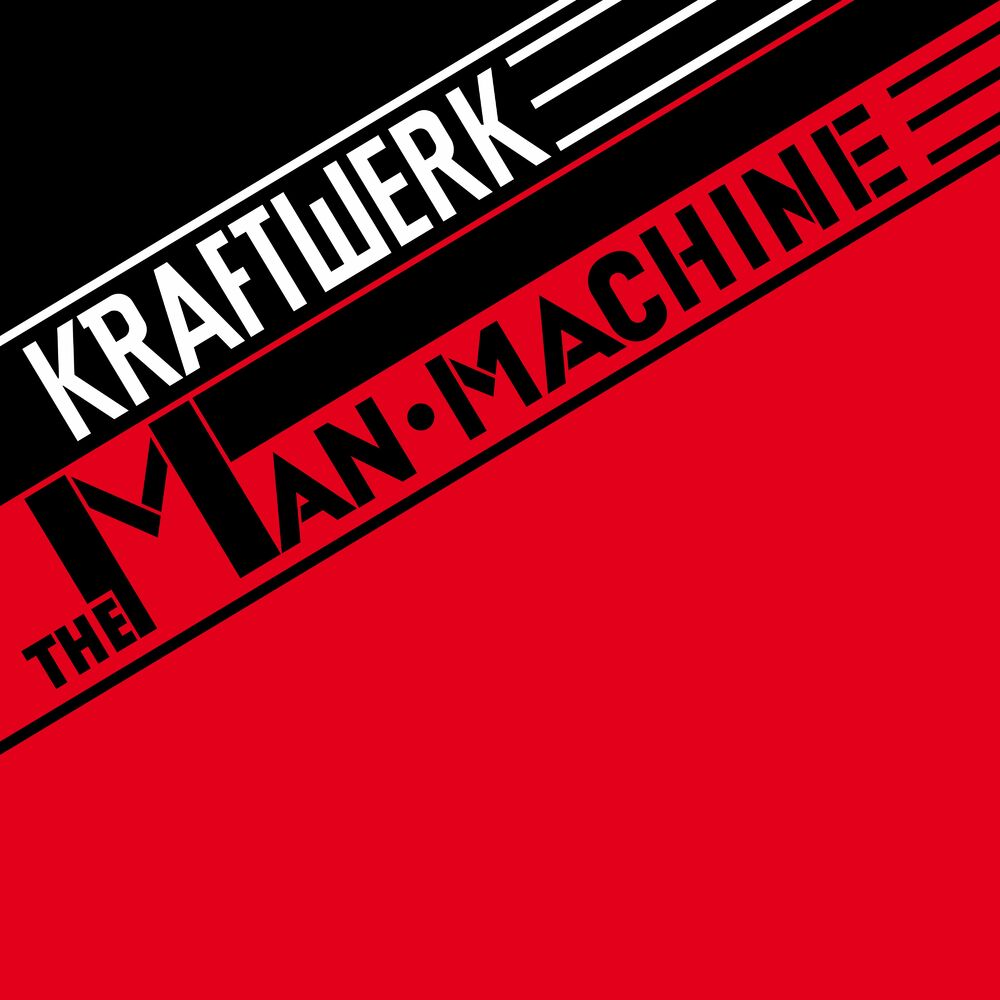
The Man-Machine (2009 Remaster)
- Released12 October 2009
- UK peak No. 9
- Weeks on UK chart 13
- Entered UK chart 14 May 1978
- LabelParlophone UK
- Tracks6 · 36 min
3 tracks from it charted as singles. Press a flag to play it in the chart where it peaked.
Tracks
| 1 | The Robots (2009 Remaster) No. 20 · 1991 | 6:12 | |
| 2 | Spacelab (2009 Remaster) | 5:57 | |
| 3 | Metropolis (2009 Remaster) | 6:01 | |
| 4 | The Model (2009 Remaster) No. 1 · 1982 | 3:40 | |
| 5 | Neon Lights (2009 Remaster) No. 53 · 1978 | 8:52 | |
| 6 | The Man Machine (2009 Remaster) | 5:32 |
About the album
The Man-Machine (German: Die Mensch-Maschine) is the seventh studio album by German electronic music band Kraftwerk. It was released on 19 May 1978 by Kling Klang in Germany and by Capitol Records elsewhere. A further refinement of their mechanical style, the album saw the group incorporate more immediate songwriting and danceable rhythms, while also incorporating elements of political satire. It addresses a wide-range of themes from the Cold War, Germany's fascination with manufacturing, and humankind's increasingly symbiotic relationship with machines. It includes the singles "The Model" and "The Robots".
Although the album peaked at 53 initially on the UK Albums Chart, it reached a new peak position of number nine in February 1982, becoming the band's second highest-peaking album in the United Kingdom after Autobahn (1974).
Music
Matt Mitchell of Paste magazine said that "the album was where Kraftwerk took their mechanical style of old and re-tuned it into a club-worthy aesthetic". The staff of GQ India assessed: "Taking electronic music from the German counterculture – a still influential moment termed Krautrock by UK audiences – across the 1970s and early '80s, [Kraftwerk] sculpted something modernist [...] out of the possibilities of synthesiser music." According to Alex Linhardt of Pitchfork, the band "just sound like robots" on the album. He explained: "While the fast-paced world of Ralf Hütter quotes knows no limits of pretension, this is the only album that conceivably expresses his ideal music: No emotions, no philosophies, no performances, and virtually no humor.
Artwork
The artwork for the cover was produced by Karl Klefisch, based on the work of the Russian suprematist El Lissitzky – the words "Inspired by El Lissitzky" are noted in the album's inner sleeve. The back cover image is an adaptation of a graphic from Lissitzky's book for children About Two Squares: A Suprematist Tale of Two Squares in Six Constructions.
Release
The Man-Machine was released in April 1978. The Man-Machine was certified gold by the British Phonographic Industry (BPI) on 15 February 1982 In October 2009, a remastered edition of the album was released on CD, Vinyl and digital formats by Mute Records, and Astralwerks.
Critical reception and legacy
Reviewing the album in 1978, Andy Gill of NME stated that "The Man-Machine stands as one of the pinnacles of 70's rock music", adding that "the sparsity of the lyrics leaves the emphasis squarely on those robot rhythms, chilling tones and exquisite melodies". Village Voice critic Robert Christgau also reviewed the album that year, saying: "Only a curmudgeon could reject a group that synthesizes the innovations of Environments and David Seville & the Chipmunks, not to mention that it's better make-out music." Mitchell Schneider from Rolling Stone found that the "chilling restraint and relentless sameness" of the lyrics and music are tempered by Kraftwerk's sense of humour and "sheer audacity", which makes for a listening experience that is "strangely pleasant in an otherworldly way".
Tony Clayton wrote in The Irish Times which "they constitute the resilient framework of electro-pop and electronica we hear today.