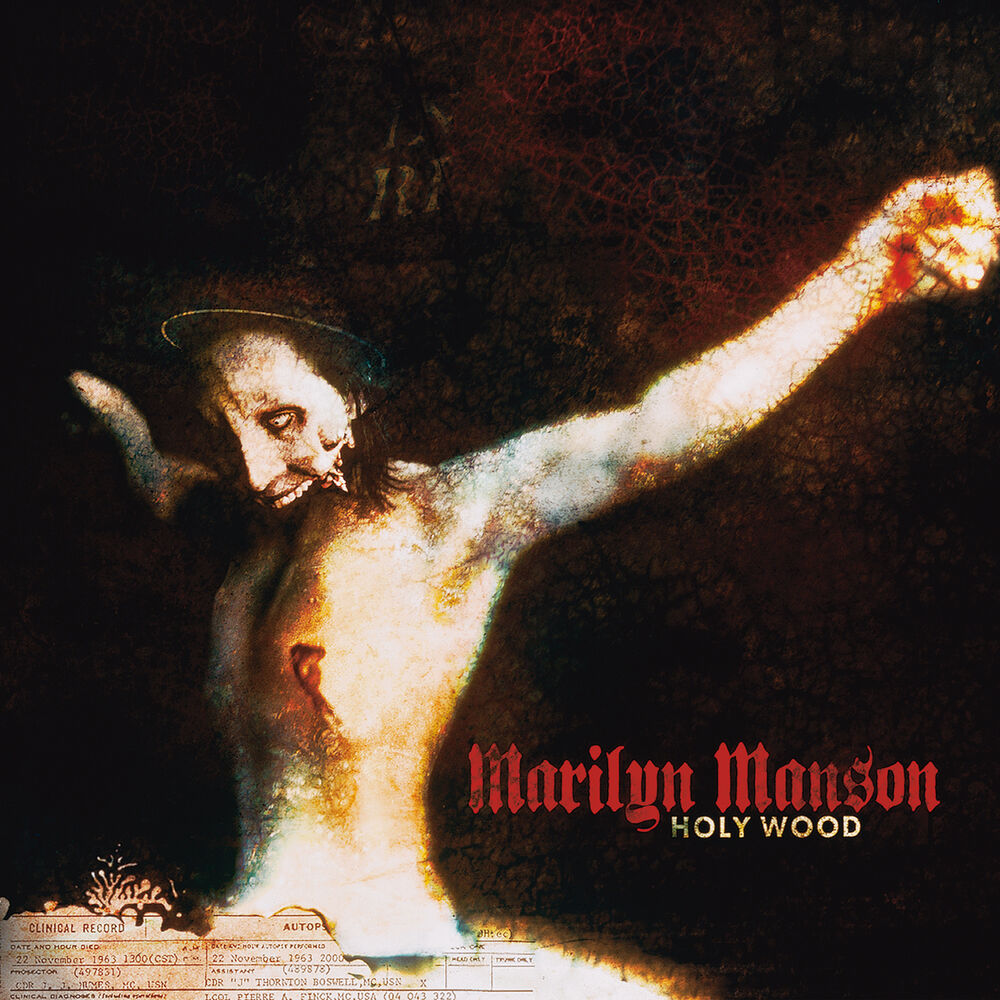
Holy Wood
- Released14 November 2000
- UK peak No. 23
- Weeks on UK chart 4
- Entered UK chart 19 November 2000
- LabelMarilyn Manson / Interscope
- Tracks19 · 68 min
3 tracks from it charted as singles. Press a flag to play it in the chart where it peaked.
Tracks
| 1 | Godeatgod | 2:34 | |
| 2 | The Love Song | 3:07 | |
| 3 | The Fight Song No. 24 · 2001 | 2:56 | |
| 4 | Disposable Teens No. 12 · 2000 | 3:01 | |
| 5 | Target Audience (Narcissus Narcosis) | 4:18 | |
| 6 | "President Dead" | 3:13 | |
| 7 | In The Shadow Of The Valley Of Death | 4:08 | |
| 8 | Cruci-fiction In Space | 4:56 | |
| 9 | A Place In The Dirt | 3:37 | |
| 10 | The Nobodies No. 34 · 2001 | 3:35 | |
| 11 | The Death Song | 3:30 | |
| 12 | Lamb Of God | 4:40 | |
| 13 | Born Again | 3:21 | |
| 14 | Burning Flag | 3:21 | |
| 15 | Coma Black | 5:59 | |
| 16 | Valentine's Day | 3:32 | |
| 17 | The Fall Of Adam | 2:34 | |
| 18 | King Kill 33 | 2:18 | |
| 19 | Count To Six And Die (The Vacuum Of Infinite Space Encompassing) | 3:23 |
About the album
Holy Wood (In the Shadow of the Valley of Death) is the fourth studio album by American rock band Marilyn Manson. It was released on November 11, 2000, by Nothing and Interscope Records. A rock opera concept album, it is the final installment of a triptych that also included Antichrist Superstar (1996), and marked a return to the industrial metal style of the band's earlier work, after the glam rock-influenced production of Mechanical Animals (1998). After its release, the band's eponymous vocalist said that the overarching story within the trilogy is presented in reverse chronological order: Holy Wood, therefore, begins the narrative.
In the aftermath of the Columbine High School massacre on April 20, 1999, national news media reported that the perpetrators were wearing the band's T-shirts during the rampage, and had been influenced by their music, both of which were untrue. As their first release after the massacre, the record was Manson's rebuttal to the accusations leveled against him and the group, and was described by the vocalist as a "declaration of war". It was written in the singer's former home in the Hollywood Hills and recorded in several undisclosed locations, including Death Valley and Laurel Canyon.
Background and development
In the late 1990s, Marilyn Manson and his eponymous band established themselves as a household name, and as one of the most controversial rock acts in music history. Their albums Antichrist Superstar (1996) and Mechanical Animals (1998) were both critical and commercial successes, and by the time of their Rock Is Dead Tour in 1999, the frontman had become a culture war iconoclast and a rallying icon for alienated youth. As their popularity increased, the confrontational nature of the group's music and imagery outraged social conservatives. Numerous politicians lobbied to have their performances banned, citing false and exaggerated claims that they contained animal sacrifices, bestiality and rape. Their concerts were routinely picketed by religious advocates and parent groups, who asserted that their music had a corrupting influence on youth culture by inciting "rape, murder, blasphemy and suicide".
On April 20, 1999, Columbine High School students Eric Harris and Dylan Klebold shot dead 13 students and a teacher and wounded 21 others, before committing suicide.
Recording and production
Several of the tracks that appear on Holy Wood date back to 1995, prior to the release of Antichrist Superstar, although much of this material consisted of "scattered ideas". Manson, the band's vocalist, developed this material into more substantial compositions during his three-month period of seclusion. Following this, the full band worked for a year on re-writing and developing the material. The record is the group's most collaborative effort to date; all members contributed to the songwriting process. Most of the compositional work was done by Manson alongside guitarists Twiggy Ramirez and John 5. The vocalist contrasted his songwriting sessions between the two, calling sessions with the latter "very focused", saying that most of their compositions would be completed before being taken to the rest of the band for consideration. In contrast, his sessions with Ramirez were less demanding, and the pair frequently experimented with absinthe.
Concept and themes
Manson described Holy Wood as a "declaration of war." The album's plot is a parable, which he told Rolling Stone was semi-autobiographical. While it can be viewed on several levels, he said its simplest interpretation is to see it as a story about an idealistic man whose revolution is commercialized, leading him to "destroy the thing he has created, which is himself." It takes place in a thinly veiled satire of modern America called "Holy Wood", which Manson described as a Disney-esque city-sized amusement park where the main attractions are death and violence, and where consumerism is taken to hyperbolic extreme. Its literary foil is "Death Valley", which is used as a "metaphor for the outcast and the imperfect of the world."
The central character is the protagonist Adam Kadmon—a name derived from the Kabbalah which means "original man". The story follows him as he goes in search of a better life out of Death Valley and into Holy Wood.
Composition and style
Holy Wood is primarily an industrial rock, industrial metal and alternative metal album. Manson claimed in a pre-release interview with Kerrang! that the album would contain some of the heaviest material the band had recorded to date. Holy Wood combines the glam rock-influenced production of Mechanical Animals with the industrial rock soundscape of the band's earlier work. He also called the record "arrogant, in an art rock sense" and said that, as a result of the lyrical content, most of the songs contained three or four distinct parts, although the band took great care to avoid being "self-indulgent". He also said that the record was intended to be the "industrial White Album", and that he wrote Holy Wood in the same house where The Rolling Stones wrote their 1970 single "Let It Bleed"—another source of inspiration.
Like Antichrist Superstar before it, Holy Wood uses a song cycle structure, dividing the album into four movements. These movements are titled A: In the Shadow, D: The Androgyne, A: Of Red Earth, and M: The Fallen.
Release and artwork
Manson posted a four-minute video clip on the band's website on December 16, 1999, featuring clips of two previously unreleased songs. The first clip was of a rock song which later became "Disposable Teens", while the second was a rough demo of a cover of Frankie Laine and Jimmy Boyd's 1953 single "The Little Boy and the Old Man" (composed by Wayne Shanklin a year earlier as "Little Child"; it was most popularly performed under the title "Mommy Dear" in the 1964 movie The Naked Kiss). As a Valentine's Day gift for fans, Manson posted a download of the band's cover of Charles Manson's "Sick City", from his 1970 album Lie: The Love and Terror Cult. In August, he announced an October 24 release date for the record, and posted a partial track listing containing 13 song titles, while also indicating that their website would be updated weekly.