Parallel Lines
- Released5 May 2017
- UK peak No. 1
- Weeks on UK chart 114
- Entered UK chart 17 September 1978
- LabelChrysalis\EMI Records (USA)
- Tracks12 · 38 min
5 tracks from it charted as singles. Press a flag to play it in the chart where it peaked.
Tracks
| 1 | Hanging On The Telephone No. 5 · 1978 | 2:22 | |
| 2 | 3:31 | ||
| 3 | Picture This No. 12 · 1978 | 2:56 | |
| 4 | Fade Away And Radiate | 3:57 | |
| 5 | Pretty Baby | 3:16 | |
| 6 | I Know But I Don't Know | 3:53 | |
| 7 | 11:59 | 3:19 | |
| 8 | Will Anything Happen | 2:55 | |
| 9 | Sunday Girl No. 1 · 1979 | 3:06 | |
| 10 | 3:49 | ||
| 11 | I'm Gonna Love You Too | 2:03 | |
| 12 | Just Go Away | 3:21 |
About the album
Parallel Lines is the third studio album by American rock band Blondie, released on September 8, 1978, by Chrysalis Records. An instant critical and commercial success, the album reached No. 1 on the UK Albums Chart in February 1979 and proved to be the band's commercial breakthrough in the United States, where it reached No. 6 on the Billboard 200 in April 1979. In Billboard magazine, Parallel Lines was listed at No. 9 in its top pop albums year-end chart of 1979. The album spawned several successful singles, notably the international hit "Heart of Glass".
Background
Blondie's second studio album, Plastic Letters (1977), was their last album produced by Richard Gottehrer, whose sound had formed the basis of Blondie's new wave and punk output. During a tour of the west coast of the US in support of Plastic Letters, Blondie encountered Australian producer Mike Chapman in California. Peter Leeds, Blondie's manager, conspired with Chrysalis Records to encourage Chapman to work with Blondie on new music. Drummer Clem Burke recalls feeling enthusiastic about the proposition, believing Chapman could create innovative and eclectic records. However, lead vocalist Debbie Harry was far less enthusiastic about Chapman's involvement as she knew him only by reputation; according to Chapman, her animosity towards him was because "they were New York. [He] was L.A.". Harry's cautiousness abated after she played Chapman early cuts of "Heart of Glass" and "Sunday Girl" and he was impressed.
Recording
In June 1978 the band entered the Record Plant in New York to record their third album, and first with Chapman. However, Chapman found the band difficult to work with, remembering them as the worst band he ever worked with in terms of musical ability, although praising Frank Infante as "an amazing guitarist". Sessions with Chris Stein were hampered by his being stoned during recording, and Chapman encouraged him to write songs rather than play guitar. Similarly, according to Chapman, Jimmy Destri would prove himself to be far better at songwriting than as a keyboardist, and Clem Burke had poor timing playing drums. As a result, Chapman spent time improving the band, especially Stein with whom Chapman spent hours rerecording his parts to ensure they were right. Bassist Nigel Harrison became so frustrated with Chapman's drive for perfection that he threw a synthesizer at him during recording. Chapman recalls the atmosphere at the Record Plant in an interview for Sound on Sound:
The Blondies were tough in the studio, real tough.
Music and lyrics
According to music journalist Robert Christgau, Parallel Lines was a pop rock album in which Blondie achieved their "synthesis of the Dixie Cups and the Electric Prunes". Its style of "state-of-the-art pop/rock circa 1978", as AllMusic's William Ruhlmann described it, showed Blondie deviating from new wave and emerging as "a pure pop band". Ken Tucker believed the band had eschewed the "brooding artiness" of their previous albums for more hooks and pop-oriented songs. Chapman later said, "I didn't make a punk album or a New Wave album with Blondie. I made a pop album." The album's eleven pop songs have refined melodics, and its sole disco song, "Heart of Glass", features jittery keyboards, rustling cymbals by drummer Clem Burke, and a circular rhythm.
Title and packaging
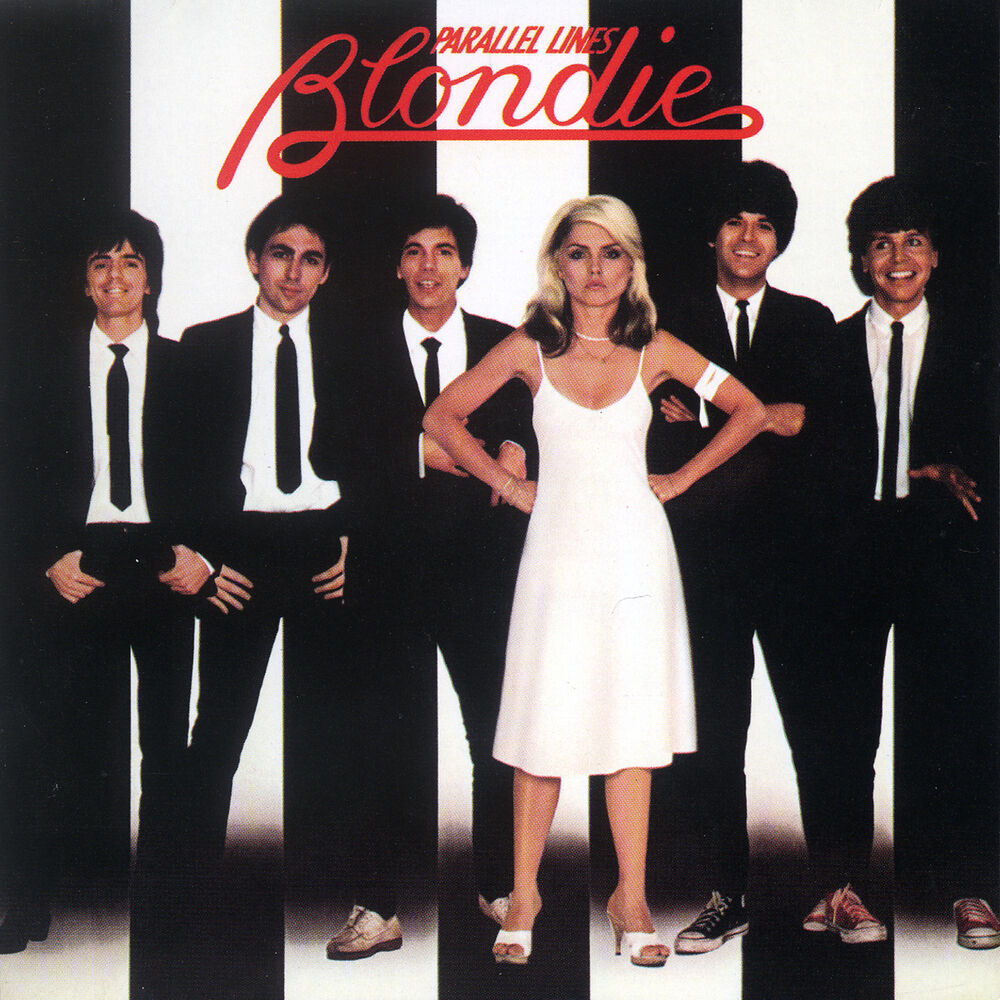
Parallel Lines took its name from an unused track written by Harry, the lyrics of which were included in the first vinyl edition of the album. The cover sleeve image was photographed by Edo Bertoglio and was chosen by Blondie's manager, Peter Leeds, despite being rejected by the band. The photo shows the band in front of a background made up of alternating black and white vertical bars, with the male members of the band posing in matching dress suits and smiling broadly in contrast to Harry who poses defiantly with her hands on her hips while wearing a white dress and high heels. According to music journalist Tim Peacock, the cover became "iconic – and instantly recognisable".
Release and promotion
The album was released by Chrysalis in September 1978, to international success. The album entered the Billboard 200 album chart the week ending September 23, 1978, at No. 186, reflecting retail sales during the survey period ending September 10, 1978. In the United Kingdom, it entered the albums chart at No.13, eventually reaching the no.1 spot in February 1979 after the band had scored hits with the singles "Picture This" (UK #12), "Hanging on the Telephone" (UK #5), and "Heart of Glass" (UK #1). "Sunday Girl" was released in the UK as a fourth single from the album in May 1979 and also reached no.1, and Parallel Lines became the UK's biggest selling album of the year. Blondie embarked on a sold-out tour of the UK and appeared at an autograph signing event for Our Price Records on Kensington High Street; according to Peacock, it "descended into Beatlemania-esque chaos when the band were mobbed by thousands of fans".
Parallel Lines was also a commercial success elsewhere in Europe, Australia, and the United States, where the band had struggled to sell their previous records.
Critical reception
The album was met with universal acclaim from critics. Writing in The Village Voice in 1978, Robert Christgau said although Blondie still could not write a perfect hit single, the record was a consistent improvement over Plastic Letters. Years later, he wrote in Blender that it was "a perfect album in 1978" and remained so with "every song memorable, distinct, well-shaped and over before you get antsy. Never again did singer Deborah Harry, mastermind Chris Stein and their able four-man cohort nail the band's signature paradoxes with such unfailing flair: lowbrow class, tender sarcasm, pop rock." New York Times critic John Rockwell named Parallel Lines the eighth best album of 1978. Daryl Easlea from BBC Music, who felt the record combined power pop and new wave styles, credited Mike Chapman's production and flair for pop songwriting for helping make Parallel Lines an extremely popular album in the United Kingdom, where it was a number-one hit and charted for 106 weeks during the late 1970s.