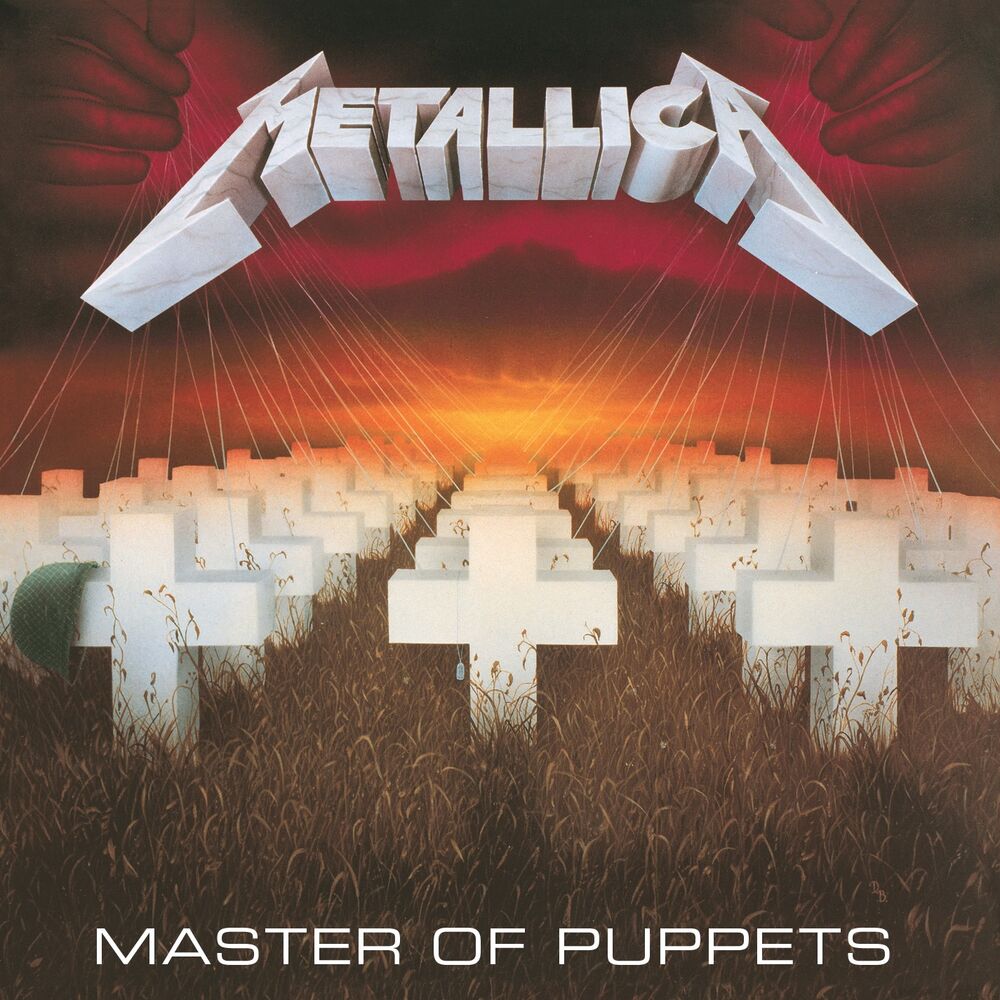
Master of Puppets (Remastered Deluxe Box Set)
- Released3 March 1986
- UK peak No. 41
- Weeks on UK chart 8
- Entered UK chart 9 March 1986
- LabelBlackened Recordings
- Tracks25 · 149 min
One track from it charted as a single. Press a flag to play it in the chart where it peaked.
Tracks
| 1 | Battery (Remastered) | 5:12 | |
| 2 | 8:35 | ||
| 3 | The Thing That Should Not Be (Remastered) | 6:36 | |
| 4 | Welcome Home (Sanitarium) (Remastered) | 6:27 | |
| 5 | Disposable Heroes (Remastered) | 8:16 | |
| 6 | Leper Messiah (Remastered) | 5:39 | |
| 7 | Orion (Remastered) | 8:27 | |
| 8 | Damage, Inc. (Remastered) | 5:32 | |
| 9 | Battery (Live at the Aragon Ballroom, Chicago, IL - May 25th, 1986) | 3:51 | |
| 10 | Master of Puppets (Live at the Aragon Ballroom, Chicago, IL - May 25th, 1986) No. 22 · 2022 No. 35 · 2022 | 8:18 | |
| 11 | For Whom The Bell Tolls (Live at the Aragon Ballroom, Chicago, IL - May 25th, 1986) | 4:14 | |
| 12 | Welcome Home (Sanitarium) (Live at the Aragon Ballroom, Chicago, IL - May 25th, 1986) | 7:06 | |
| 13 | The Thing That Should Not Be (Live at the Aragon Ballroom, Chicago, IL - May 25th, 1986) | 6:14 | |
| 14 | (Anesthesia) - Pulling Teeth (Live at the Aragon Ballroom, Chicago, IL - May 25th, 1986) | 2:57 | |
| 15 | Damage, Inc. (Live at the Aragon Ballroom, Chicago, IL - May 25th, 1986) | 4:25 | |
| 16 | Fade to Black (Live at the Aragon Ballroom, Chicago, IL - May 25th, 1986) | 6:47 | |
| 17 | Seek & Destroy (Live at the Aragon Ballroom, Chicago, IL - May 25th, 1986) | 7:21 | |
| 18 | Creeping Death (Live at the Aragon Ballroom, Chicago, IL - May 25th, 1986) | 6:22 | |
| 19 | The Four Horsemen (Live at the Aragon Ballroom, Chicago, IL - May 25th, 1986) | 5:20 | |
| 20 | Guitar Solo (Live at the Aragon Ballroom, Chicago, IL - May 25th, 1986) | 3:11 | |
| 21 | Am I Evil? (Live at the Aragon Ballroom, Chicago, IL - May 25th, 1986) | 3:42 | |
| 22 | Whiplash (Live at the Aragon Ballroom, Chicago, IL - May 25th, 1986) | 4:44 | |
| 23 | Battery (October 1985, Work in Progress Rough Mix) | 5:09 | |
| 24 | 8:43 | ||
| 25 | The Thing That Should Not Be (December 1985, Work in Progress Rough Mix) | 6:21 |
About the album
Master of Puppets is the third studio album by the American heavy metal band Metallica, released on March 3, 1986, by Elektra Records. Recorded in Copenhagen, Denmark, at Sweet Silence Studios with producer Flemming Rasmussen, it is the band's final album to feature bassist Cliff Burton. While touring in support of Master of Puppets, he died on September 27, 1986, after the band's tour bus was involved in an accident in Dörarp, Sweden.
The album's artwork, designed by Metallica and Peter Mensch and painted by Don Brautigam, depicts a cemetery field of white crosses tethered to strings, manipulated by a pair of hands in a clouded, blood-red sky, with a fiery orange glow on the horizon. The album is the band's most recent to date to feature a runtime of under an hour. Instead of releasing a single or video in advance of the album's release, Metallica embarked on a five-month American tour in support of Ozzy Osbourne. The European leg was canceled after Burton's death in September 1986, and the band returned home to audition a new bassist.
Master of Puppets peaked at number 29 on the Billboard 200 and received widespread acclaim from critics, who praised its music and political lyrics. It is widely regarded to be one of the greatest and most influential metal albums of all time, and is credited with consolidating the American thrash metal scene.
Background and recording
Metallica's 1983 debut Kill 'Em All laid the foundation for thrash metal with its aggressive musicianship and vitriolic lyrics. The album revitalized the American metal underground scene, and inspired similar records by contemporaries. The band's second album Ride the Lightning extended the limits of the genre with its more sophisticated songwriting and improved production. The album caught the attention of Elektra Records representative Michael Alago, who signed the group to an eight-album deal in the fall of 1984. Elektra reissued Ride the Lightning on November 19, and the band began touring larger venues and festivals throughout 1985. After parting with manager Jon Zazula, Metallica began working with Cliff Burnstein and Peter Mensch of Q Prime. During the summer, the band played the Monsters of Rock festival at Castle Donington, alongside Bon Jovi and Ratt to an audience of 70,000.
Metallica was motivated to make an album that would impress critics and fans, and began writing new material in mid-1985.
Music and lyrics
Master of Puppets features dynamic music and thick arrangements. Metallica delivered a more refined approach and performance compared to the previous two albums, with multilayered songs and technical dexterity. This album and its predecessor Ride the Lightning follow a similar track sequencing: both open with an up-tempo song with an acoustic intro, followed by a lengthy title track, and a fourth track with ballad qualities. Although both albums are similarly structured, the musicianship on Master of Puppets is more powerful and epic in scope, with tight rhythms and delicate guitar solos. According to music writer Joel McIver, Master of Puppets introduced a new level of heaviness and complexity in thrash metal, displaying atmospheric and precisely executed songs. Hetfield's vocals had matured from the hoarse shouting of the first two albums to a deeper, in-control, yet aggressive style.
The songs explore themes such as control and the abuse of power. The lyrics describe the consequences of alienation, oppression, and feelings of powerlessness.
Release
Released on March 3, 1986, the album had a 72-week run on the Billboard 200 album charts and earned the band its first gold certification. The album debuted on March 29 at number 128 and peaked at number 29 on the Billboard 200 chart. Billboard reported that 300,000 copies were sold in its first three weeks. More than 500,000 copies were sold in its first year, even with virtually no radio airplay and no music videos. In 2025, Master of Puppets was certified 8× platinum by the Recording Industry Association of America (RIAA), with eight million copies shipped in the United States. Between the beginning of the Nielsen SoundScan era in 1991 and 2023, 7,980,000 copies were sold. The album was less successful on an international level, despite entering the top 5 on the Finnish and the top 40 on the German and Swiss album charts in its inaugural year. In 2004, it peaked within the Top 15 in Sweden. In 2008, the album reached the top 40 on the Australian and Norwegian album charts.
Reception
Master of Puppets was hailed as a masterpiece by critics outside of the thrash metal audience and cited by some as the genre's greatest album. In a contemporary review, Tim Holmes of Rolling Stone asserted that the band had redefined heavy metal with the technical skill and subtlety showcased on the album, which he described as "the sound of global paranoia". Kerrang! wrote that Master of Puppets "finally put Metallica into the big leagues where they belong". Editor Tom King said Metallica was at an "incredible song-writing peak" during the recording sessions, partially because Burton contributed to the songwriting.
Accolades
Master of Puppets has appeared in several publications' best album lists. It was ranked number 167 on Rolling Stone's list of 500 Greatest Albums of All Time, maintaining the rating in a 2012 revised list, and upgrading to number 97 in a 2020 revised list. The magazine would also later rank it second on its 2017 list of "100 Greatest Metal Albums of All Time", behind Black Sabbath's Paranoid. Time included the album in its list of the 100 best albums of all time. According to the magazine's Josh Tyrangiel, Master of Puppets reinforced the velocity of playing in heavy metal and diminished some of its clichés. Slant Magazine placed the album at number 90 on its list of the best albums of the 1980s, saying Master of Puppets is Metallica's best and most sincere recording. The album is featured in Robert Dimery's book 1001 Albums You Must Hear Before You Die. IGN named Master of Puppets the best heavy metal album of all time.
Legacy
Master of Puppets became thrash metal's first platinum album and by the early 1990s thrash metal successfully challenged and redefined the mainstream of heavy metal. Metallica and a few other bands headlined arena concerts and appeared regularly on MTV, although radio play remained incommensurate with their popularity. Master of Puppets is widely accepted as the genre's most accomplished album, and paved the way for subsequent development. The album, in the words of writer Christopher Knowles, "ripped Metallica away from the underground and put them atop the metal mountain". David Hayter from Guitar Planet recognized the album as one of the most influential records ever made and a benchmark by which other metal albums should be judged. MTV's Kyle Anderson had similar thoughts, saying that 25 years after its release the album remained a "stone cold classic".