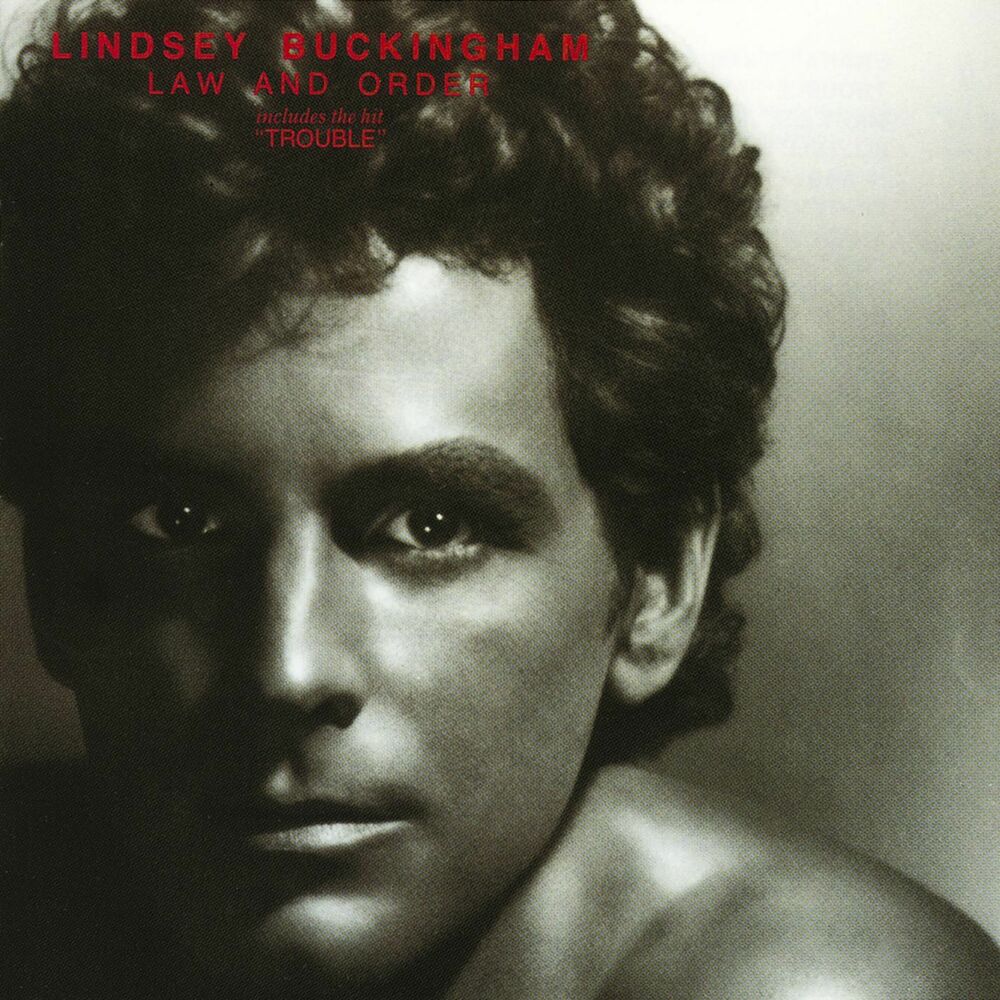
One track from it charted as a single. Press a flag to play it in the chart where it peaked.
Tracks
| 1 | Bwana | 3:08 | |
| 2 | 3:56 | ||
| 3 | Mary Lee Jones | 3:14 | |
| 4 | I'll Tell You Now | 4:21 | |
| 5 | It Was I | 2:42 | |
| 6 | September Song | 3:17 | |
| 7 | Shadow of the West | 3:58 | |
| 8 | That's How We Do It in L.A. | 2:54 | |
| 9 | Johnny Stew | 3:09 | |
| 10 | Love from Here, Love from There | 2:50 | |
| 11 | A Satisfied Mind | 2:49 |
About the album
Law and Order is the first solo album by Fleetwood Mac guitarist/vocalist/songwriter Lindsey Buckingham, released in 1981. The album's lead single "Trouble", featuring drumming by Fleetwood Mac bandmate Mick Fleetwood, reached No. 9 on the US chart; the album itself reached No. 32 on the Billboard 200. With the exception of "Trouble", Buckingham played all of the instruments on "Law and Order". Buckingham appeared on Saturday Night Live on February 6, 1982, and performed "Trouble" and "Bwana" with Mick Fleetwood's Zoo.
Background
Following the release of Fleetwood Mac's Tusk album, where many of the tracks were recorded in Buckingham's home studio, Mick Fleetwood informed Buckingham that the band was not interested in recording subsequent releases in the same manner. This was the impetus for Buckingham to create Law and Order. "In that moment, I realized, 'If I wanna continue to take risks [and] try to define myself as an artist in the long term, I'm gonna have to start making solo albums.'" Buckingham explained that there was desire within Fleetwood Mac, particularly among himself and Stevie Nicks, to work on solo projects after the conclusion of the band's Tusk Tour.
When asked about the title of the album by Jim Ladd, Buckingham explained that it did not pertain to the contemporary context of the term, but was instead about establishing personal laws to abide by. "I think that in order to keep that sense of innocence, you really have to instill a sense of discipline in yourself and a sense of commitment, really. Commitment is a key word too. A sense of order about your life, if you will.
Recording
Around October 1980, Buckingham acquired a recording console that he described as "inexpensive". He also used the same 24-track machine that Fleetwood Mac used at the Village Recorder for their Tusk album. Buckingham then took the equipment to a room in Burbank, California, where he commenced with the recording sessions. Work on Law and Order began in February 1981 at Larrabee Sound Studios.
Buckingham temporarily put his solo album on hold once Fleetwood Mac began their initial Mirage recording sessions. Buckingham resumed progress in June and spent the next few months making final adjustments to Law and Order through August. During the second half of the recording sessions, Richard Dashut became involved as an audio engineer. Buckingham also began to add keyboards to some of the songs, which included an acoustic piano and a Casiotone, which was the only electronic keyboard used on the album.
Since Buckingham recorded most of the instruments on Law and Order himself, he was required to record each instrument individually as an overdub.
Critical reception
Law and Order received mixed to mostly positive reviews from music critics. Record World said that Law and Order was "quite a collection; some of it is lovely, some of it is quirky, and about all of it is appealing." They concluded by saying that "if anyone still wonders who was mainly responsible for making Fleetwood Mac's Tusk so marked and bold a break with the Rumours tradition, Law and Order will lay all doubts to rest." Cashbox declared that Law and Order revealed Buckingham to be "one of rock's major loons." They noted the incorporation of "African and oriental rhythms and a lot of the Beatles and Bonzo Dog Band idosyncrasies" and thought that the album "still manages to stay commercial."
Billboard said that the album balanced Buckingham's "elegant guitars work and deft melodic sense against a newer element of rhythmic playfulness and a more urgent vocal attack." Sam Sutherland of Billboard also thought that Law and Order did not exclusively serve as a vehicle to showcase Buckingham's guitar and vocal abilities, saying that Buckingham was "at least as concerned with the overal
Music promo videos
Two promotional music videos were shot for Law and Order, "Trouble" and "It Was I", both directed by Jerry Watson in Los Angeles. "Trouble" featured friends of Buckingham playing either guitar or drums. They included Mick Fleetwood, Bob Welch, and Bob Weston from Fleetwood Mac and singer-songwriter Walter Egan.