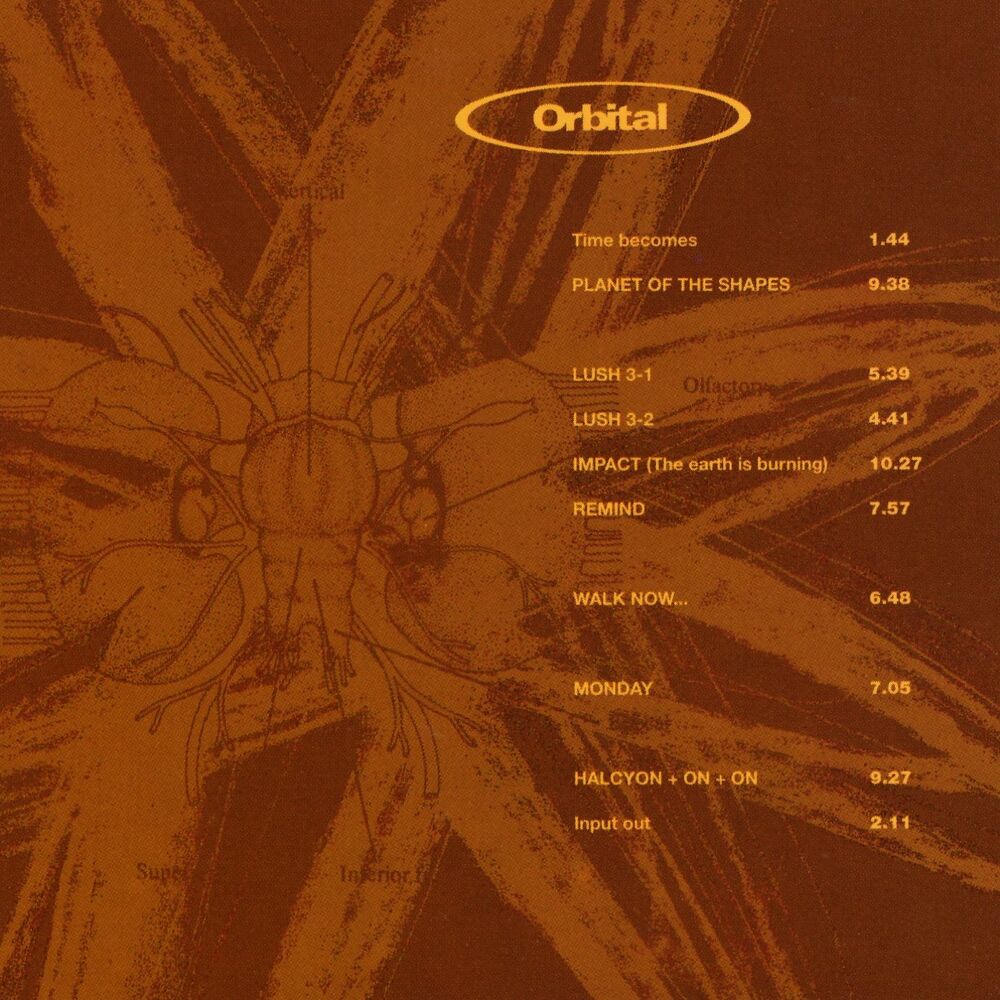
Orbital 2
- Released1 January 1993
- UK peak No. 28
- Weeks on UK chart 4
- Entered UK chart 6 October 1991
- LabelLondon Records (Because Ltd)
- Tracks10 · 66 min
Tracks
| 1 | Time Becomes | 1:43 | |
| 2 | PLANET OF THE SHAPES | 9:36 | |
| 3 | Lush 3.1 | 5:54 | |
| 4 | LUSH 3-2 | 4:40 | |
| 5 | IMPACT (The Earth Is Burning) | 10:27 | |
| 6 | REMIND | 7:57 | |
| 7 | WALK NOW... | 6:48 | |
| 8 | MONDAY | 7:07 | |
| 9 | HALCYON + ON + ON | 9:27 | |
| 10 | Input Out | 2:11 |
About the album
Orbital (also known as Orbital 1 or the Green Album) is the debut studio album by English electronic music duo Orbital, released on 30 September 1991 by FFRR Records. Orbital self-titled their first two albums so the "Green Album" is an unofficial name to distinguish it from the second album. The Mutations EP refers to the album as L.P. C.D. M.C., thus titling the album after the "LP" / "CD" / "MC" on the front cover of the respective format.
Background
Orbital was formed in the late 80s, and consisted of brothers Phil and Paul Hartnoll. Their first track, "Chime", was released in 1989 to much success, reaching #17 on the UK charts. They were signed to FFRR Records after a bidding war for the track, and the group began to work on their first album.
Composition
The idea of making a full album was inspired by bands like Kraftwerk and Cabaret Voltaire. The album was mainly recorded in the Hartnolls' house, which had been left to them by their parents, although "Macro Head" and "Belfast" were recorded at Gee St. and Marcus Studios, respectively.
The original European release includes live versions of Orbital's first and third single, "Chime" and "Midnight", which had been suggested by FFRR's owner, Pete Tong, to be included on the album, along with "Belfast". "Desert Storm" was recorded all in one day, 17 January 1991, the same day as the launch of Operation Desert Storm, which the track was then named after. "Fahrenheit 303" was named after the Roland TB-303, a bass synthesizer used prominently in the track. The name for "Steel Cube Idolatry" came from a bad review of one of the band's performances while supporting Cabaret Voltaire, which suggested the name as a parody of how "boring" they thought the music was. Paul later said, "We thought, right, we don't even know what any of that means but we are definitely having "Steel Cube Idolatry".
Artwork and packaging
The front cover of the LP release shows a diagram of the heart within the star pattern on the front and in detail on the inner sleeves, while the CD only features the diagram on the inner cover. A similar style of artwork is featured on the second Orbital album, Orbital, colloquially known as "The Brown Album" to distinguish it from this album, which pictures a diagram of the kidneys instead. The cover design is different to identify each format of the release, with the red circle in the centre of the cover on the LP, CD, and cassette versions including the text LP, CD, and MC, respectively. In the case of the CD and LP pressing, the circle also appears on the disc and label, respectively. Vinyl pressings had the track listing on the front cover, rather than on the back.