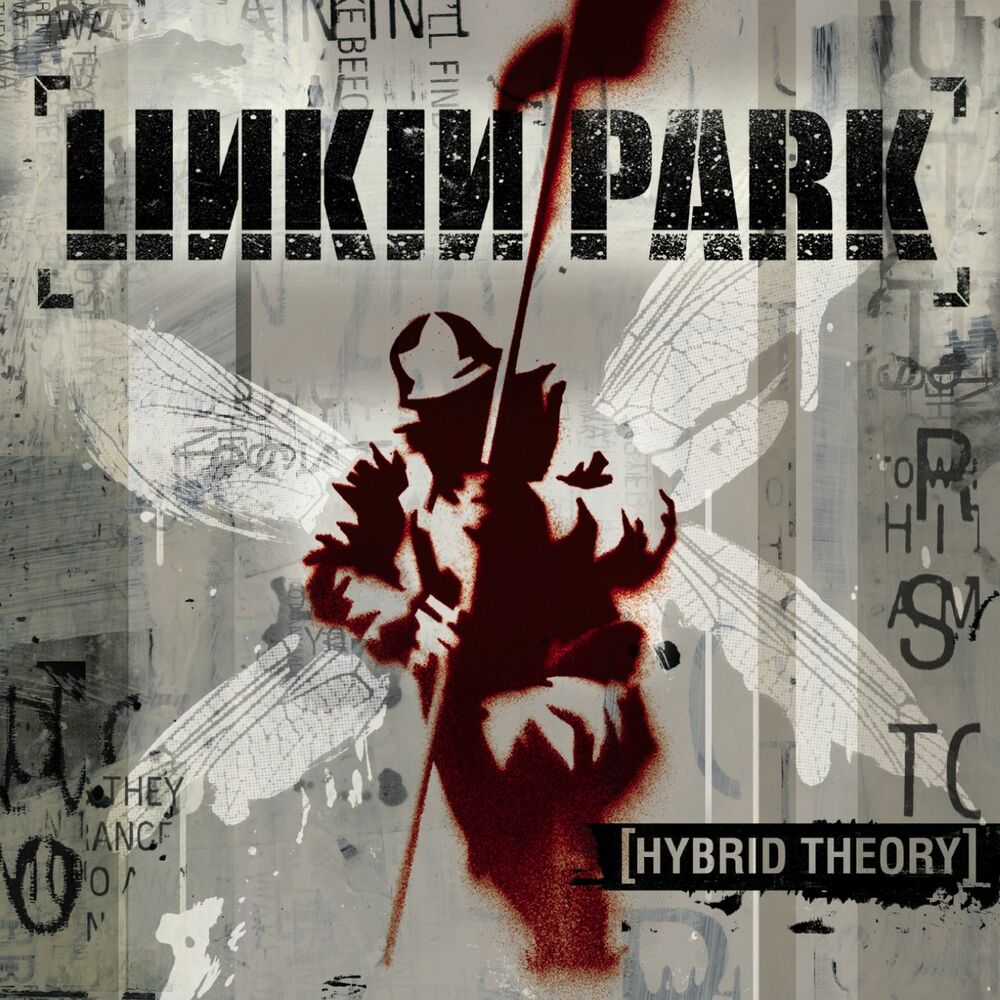
Hybrid Theory
- Released24 October 2000
- UK peak No. 4
- Weeks on UK chart 164
- Entered UK chart 7 January 2001
- LabelWarner Records
- Tracks12 · 38 min
4 tracks from it charted as singles. Press a flag to play it in the chart where it peaked.
Tracks
| 1 | Papercut No. 14 · 2001 | 3:04 | |
| 2 | 2:37 | ||
| 3 | With You | 3:23 | |
| 4 | Points of Authority | 3:20 | |
| 5 | 3:29 | ||
| 6 | Runaway | 3:03 | |
| 7 | By Myself | 3:09 | |
| 8 | 3:36 | ||
| 9 | A Place for My Head | 3:04 | |
| 10 | Forgotten | 3:14 | |
| 11 | Cure for the Itch | 2:37 | |
| 12 | Pushing Me Away | 3:11 |
About the album
Hybrid Theory is the debut studio album by the American rock band Linkin Park, released on October 24, 2000, by Warner Bros. Records. Recorded at NRG Recordings in North Hollywood, California, and produced by Don Gilmore, the album's lyrical themes deal with problems lead vocalist Chester Bennington experienced during his adolescence, including drug abuse and the constant fighting and eventual divorce of his parents. Hybrid Theory takes its title from the previous name of the band as well as the concepts of music theory and combining different styles. It is also the band's only album in which bassist Dave "Phoenix" Farrell does not play, though he was credited as a band member and was a songwriter on two tracks.
Four singles were released from Hybrid Theory: "One Step Closer", "In the End", "Crawling" and "Papercut", all of which launched Linkin Park into mainstream popularity. While "In the End" was the most successful of the four, all of the singles in the album remain some of the band's most successful songs to date.
Background
High school friends Mike Shinoda, Brad Delson and Rob Bourdon formed the rap rock band Xero in 1996. After their graduation, they recruited Joe Hahn, Dave "Phoenix" Farrell and Mark Wakefield to perform in the band. Though limited in resources, the band began recording and producing songs within Shinoda's makeshift bedroom studio in 1996, resulting in a four-track demo album, entitled Xero, released in November 1997. Delson, who by that point was a student at UCLA, then introduced the band to Jeff Blue, the vice president of A&R for Zomba Music, whom he had interned for in college. Blue immediately took interest in the band, but this did not produce a record deal. After watching a Xero performance in 1998, he believed the band needed a different vocalist. Frustrated with the lack of label success, Wakefield and Farrell left the band.
Blue recommended Arizona-based vocalist Chester Bennington, formerly of Grey Daze. Blue called Bennington on March 20, 1999, his 23rd birthday, and sent him tapes of Xero's unreleased recordings the following day.
Writing and recording
The music that would ultimately become the Hybrid Theory album was first produced by Linkin Park in 1999 as a nine-track demo tape. The band sent this tape to various recording companies and played forty-two different showcases for recording industry representatives, including performances for Los Angeles promoter and impresario, Mike Galaxy's showcase at The Gig on Melrose. However, they were initially turned down by most of the major labels and several independent record labels. The band was signed by Warner Bros. Records in 1999, due in large part to the constant recommendations of Blue, who had joined the label after resigning from Zomba.
Despite initial difficulties in finding a producer willing to take charge of the debut album of a newly signed band, Don Gilmore ultimately agreed to head up the project, with Andy Wallace hired as the mixer. Recording sessions, which mostly involved re-recording the songs off the demo tape, began at NRG Recordings in North Hollywood, California in March 2000 and lasted four months.
Composition
The music of Hybrid Theory draws from diverse inspirations. Bennington's singing style is influenced by acts such as Depeche Mode and Stone Temple Pilots, while the riffs and playing techniques of guitarist Brad Delson are modeled after Deftones, Guns N' Roses, U2, and The Smiths. The lyrical content of the songs primarily touches upon the problems that Bennington encountered during his childhood, including constant and excessive drug and alcohol abuse, the divorce of his parents, isolation, disappointments, and the aftermath feelings of failed relationships. Stylistically, the album has mostly been described as nu metal, rap metal, or rap rock, but sometimes also as alternative metal, alternative rock, or hard rock.
The album eventually produced four singles. "One Step Closer", the album's second track and first single, was gradually recorded in increments after Linkin Park struggled with "Runaway", and features a guitar riff and electronic percussion in the introduction transitioning into a bridge with distortion-heavy guitars and aggressive drums.
Artwork
With Hybrid Theory being Linkin Park's first album, Mike Shinoda, who had worked as a graphic designer before becoming a professional musician, has stated that the band had looked through books for inspiration on how to present themselves for the first time. The result was a winged-soldier which Shinoda illustrated himself. According to Chester Bennington, the idea of the soldier with dragonfly wings was to describe the blending of hard and soft musical elements by the use of the jaded looks of the soldier and frail touches of the wings. The art style was largely influenced by stencil graffiti, including early works by Banksy. The cover also features scrambled lyrics of the album's songs within the background, though the lyrics of "One Step Closer" are the most prominent.
Critical reception
Hybrid Theory received generally positive reviews from critics. Mike Ross of Jam! praised the album as an effective fusion of hip-hop and heavy metal music and deemed Linkin Park "one of the finest new rap metal bands". PopMatters reviewer Stephanie Dickison wrote that they are "a far more complex and talented group than the hard rock boy bands of late" and "will continue to fascinate and challenge music's standard sounds." In Q, Dan Silver commented that the band had given "angst-ridden rock... an effective electronic spin". Johan Wippsson from Melodic complimented Don Gilmore's production and described Hybrid Theory as "destructive and angry but always with a well controlled melodic feeling all over." The Village Voice's Robert Christgau gave the album a two-star honorable mention rating and cited "Papercut" and "Points of Authority" as highlights; he quipped, "the men don't know what the angry boys understand".
In a more critical assessment, William Ruhlmann of AllMusic found that on Hybrid Theory, Linkin Park sound "like a Johnny-come-lately to an already overdone musical style."