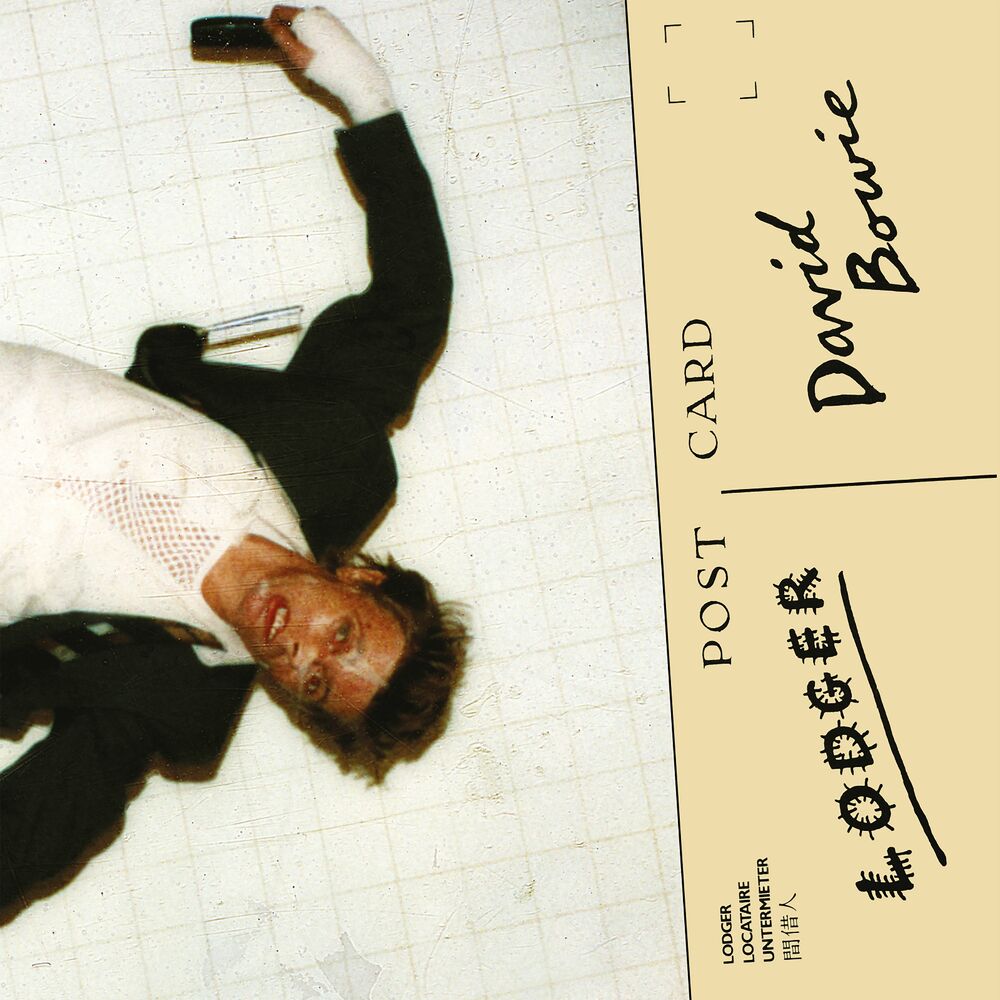
Lodger (2017 Remaster)
- Released20 September 1999
- UK peak No. 4
- Weeks on UK chart 19
- Entered UK chart 3 June 1979
- LabelParlophone UK
- Tracks10 · 35 min
One track from it charted as a single. Press a flag to play it in the chart where it peaked.
Tracks
| 1 | Fantastic Voyage (2017 Remaster) | 2:55 | |
| 2 | African Night Flight (2017 Remaster) | 2:56 | |
| 3 | Move On (2017 Remaster) | 3:20 | |
| 4 | Yassassin (Turkish For: Long Live; 2017 Remaster) | 4:13 | |
| 5 | Red Sails (2017 Remaster) | 3:45 | |
| 6 | D.J. (2017 Remaster) | 4:01 | |
| 7 | Look Back in Anger (2017 Remaster) | 3:08 | |
| 8 | Boys Keep Swinging (2017 Remaster) No. 7 · 1979 | 3:18 | |
| 9 | Repetition (2017 Remaster) | 3:00 | |
| 10 | Red Money (2017 Remaster) | 4:19 |
About the album
Lodger is the thirteenth studio album by the English musician David Bowie, released on 25 May 1979 through RCA Records. Recorded in collaboration with the musician Brian Eno and the producer Tony Visconti, it was the final release of his Berlin Trilogy, following Low and "Heroes" (both 1977). Sessions took place in Switzerland in September 1978 during a break in the Isolar II world tour, and in New York City in March 1979 at the tour's end. Most of the same personnel from prior releases returned, along with newcomer guitarist Adrian Belew. The sessions saw the use of techniques inspired by Eno's Oblique Strategies cards, such as having the musicians swap instruments and playing old songs backwards.
The music on Lodger is based in art rock and experimental rock. It lacks the electronic and ambient styles and the song/instrumental split of its two predecessors, favouring more conventional song structures and exploring styles such as avant-pop, world and new wave music. Lyrically, the album is divided into two major themes: travel (side one) and critiques of Western civilisation (side two). The pop artist Derek Boshier took the cover photo, portraying Bowie as an accident victim across the gatefold sleeve.
Lodger was a modest commercial success, peaking at number 4 in the UK and number 20 in the US. It produced four singles, including the UK top 10 hit "Boys Keep Swinging".
Background
In the second half of 1976, David Bowie and his friend Iggy Pop relocated to the Château d'Hérouville in Hérouville, France, to escape from the drug culture of Los Angeles. There, Bowie produced Pop's debut studio album The Idiot (1977) and recorded his own, Low, in collaboration with the musician Brian Eno and the producer Tony Visconti. Low came to be known as the first in Bowie's Berlin Trilogy. After Low's release in January 1977, Bowie toured with Pop before co-producing his second solo album Lust for Life (1977), at Hansa Tonstudio in West Berlin.
Bowie's productivity continued throughout the rest of 1977. He recorded his second Berlin release with Visconti and Eno, "Heroes", released in October 1977, after which he conducted extensive promotion for the album. These included a collaboration with the singer Bing Crosby on Bing Crosby's Merrie Olde Christmas television special ("Peace on Earth/Little Drummer Boy"), and contributing narration for an adaptation of Sergei Prokofiev's classical composition Peter and the Wolf, released as an album in May 1978.
Recording and production
Recording for Lodger began during the four-month break in the Isolar II world tour during September 1978. Although Lodger is known as the final release of the Berlin Trilogy, it was largely recorded at Mountain Studios in Montreux, Switzerland, with additional recording to finish the album at the Record Plant in New York City. The atmosphere in Montreux was very different from that in Berlin; the studio was built on the site of a previous studio that had burned down. Whereas Hansa Tonstudio was located near the Berlin Wall, Mountain Studios was located in an Alpine retreat. Bowie's longtime guitarist Carlos Alomar described the location as "boring", preferring the "excitement" of Hansa. Additionally, the building acoustics in Mountain were regarded as inferior to Hansa.
Many of the same personnel from Bowie's earlier records returned for the Lodger sessions, including Eno on synthesisers, Visconti as producer, Alomar, drummer Dennis Davis and bassist George Murray.. A new addition was guitarist Adrian Belew, whom Bowie had "poached" while Belew was touring with Frank Zappa.
Lyrics and themes
Though missing the song/instrumental split that characterised Low and "Heroes", Lodger has been interpreted as covering two major themes— travel and critiques of Western civilisation on sides one and two, respectively. In early 1977, Bowie said, "I don't live anywhere, really. I travel 100% of the time," further noting, "The more I travel, the less sure I am about exactly which political philosophies are commendable. All my traveling is done on the basis of wanting to get my ideas for writing from real events rather than from going back to a system from whence it came." Because of this, Lodger is interpreted by some as a concept album. Some songs showcase heavily politicised lyrics, including "Fantastic Voyage", which deals with the "depression" brought on by Cold War leaders and the possibility of nuclear war, and "Repetition", which deals with domestic violence. James E. Perone finds a general theme of political oppression and insanity.
Artwork
Bowie collaborated on the cover design for Lodger with the English pop artist Derek Boshier, who later designed the artwork for Bowie's 15th studio album Let's Dance (1983). The original gatefold album sleeve featured a full-length shot by photographer Brian Duffy of Bowie in a tiled bathroom looking like an accident victim, heavily made up with an apparently broken nose and a bandaged hand. This was inspired by the self-portraits of Egon Schiele. To accomplish the shot, taken in February 1979 at Duffy's London studio, Bowie balanced himself on a steel frame while the photographer captured the image from above. The broken nose and facial morphing were accomplished using prosthetic make-up and nylon threads. Bowie's bandaged hand was genuine; according to Pegg, he had burned it with coffee that morning and decided to incorporate the hand into the photo. At Bowie's request, the image was taken in a low resolution with a Polaroid SX-70 type camera; outtakes from the photoshoot have appeared in the 2014 book Duffy/Bowie – Five Sessions.
Release and promotion
RCA Records released the lead single from Lodger, "Boys Keep Swinging", with "Fantastic Voyage" as the B-side, on 27 April 1979. To promote the song, Bowie had appeared on The Kenny Everett Video Show four days earlier. According to Pegg, he dressed in a "1950s Mod-style suit" that made him look like a "fresh-faced schoolboy". David Mallet, who Bowie chose to direct a promo video for "Boys Keep Swinging", directed the programme. The promo and his Everett performance were filmed back-to-back, although the former featured extra backup dancers who turned out to be Bowie in drag. The Everett performance, along with an appearance as the guest DJ on Radio 1's Star Special, helped "Boys Keep Swinging" reach number seven on the UK Singles Chart, Bowie's highest-charting single since "Sound and Vision". However, due to the song's gender-bending video and lyrics, RCA refused to release the single in the US.
RCA issued Lodger on 25 May 1979, with the catalogue number RCA BOW LP 1.