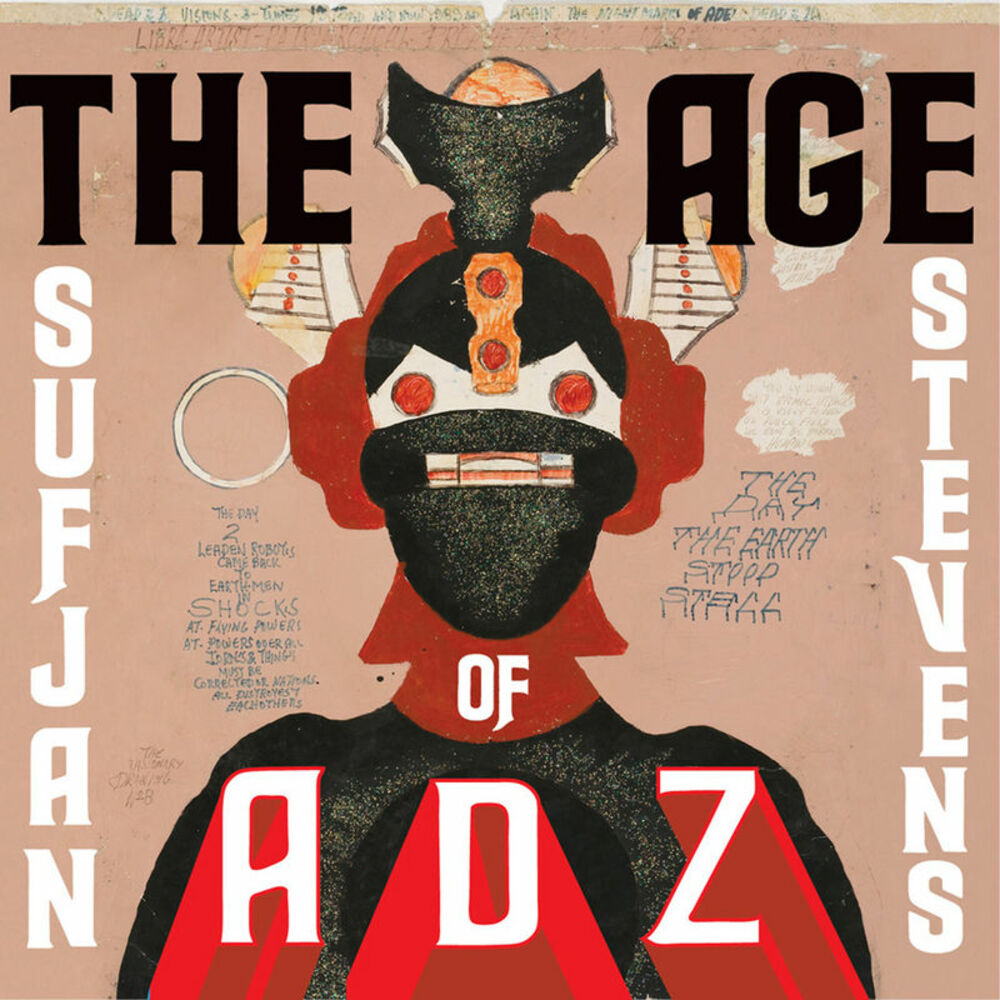
The Age of Adz
- Released1 January 2011
- UK peak No. 30
- Weeks on UK chart 2
- Entered UK chart 17 October 2010
- LabelAsthmatic Kitty
- Tracks11 · 75 min
Tracks
| 1 | Futile Devices | 2:13 | |
| 2 | Too Much | 6:46 | |
| 3 | Age of Adz | 8:02 | |
| 4 | I Walked | 5:03 | |
| 5 | Now That I'm Older | 4:58 | |
| 6 | Get Real Get Right | 5:12 | |
| 7 | Bad Communication | 2:26 | |
| 8 | Vesuvius | 5:28 | |
| 9 | All for Myself | 2:57 | |
| 10 | I Want To Be Well | 6:29 | |
| 11 | Impossible Soul | 25:35 |
About the album
The Age of Adz ( AHDZ) is the sixth studio album by American singer-songwriter Sufjan Stevens, released on October 12, 2010, by Asthmatic Kitty. It was Stevens' first song-based full-length album in five years, since the release of Illinois in 2005.
The album features heavy use of electronics augmented by orchestration and takes inspiration from the apocalyptic artwork of schizophrenic artist Royal Robertson. Stevens' use of electronics marked a radical departure from much of his previous work—most notably from Seven Swans and Michigan. Stevens had previously explored electronics on his album Enjoy Your Rabbit. Unlike Illinois, the lyrics do not explore events, characters or setting, but deal instead with themes and emotions on a personal level.
Critics praised the intimacy of the album, but many were divided over the change in style that Stevens had taken. Nonetheless, it appeared on several "best of 2010" lists, including those of Paste, The New York Times and MTV. Commercially, the album gave Stevens his career's best first-week sales to date and was his highest-charting album to date, peaking at number seven on the Billboard 200.
Background and recording
In 2006, Sufjan Stevens released an album of extra material left over from Illinois (originally conceived as a double album), titled The Avalanche, as well as an album of Christmas music titled Songs for Christmas (produced in parts between 2001 and 2006). Following the release of The Avalanche, Stevens expressed a dissatisfaction with his music, stating in an interview with Pitchfork in 2006: "I'm getting tired of my voice. I'm getting tired of ... the banjo. I'm getting tired of ... the trumpet". In 2009 Stevens admitted that his Fifty States Project—an attempt to write an album for each of the 50 U.S. States—had been a "promotional gimmick" and not something that he had seriously intended to complete. In the same year he released The BQE, an orchestral suite accompanying a home-made film dedicated to the Brooklyn-Queens Expressway. In an interview with BeatRoute magazine in 2010, Stevens stated "[The BQE] kinda sabotaged the mechanical way of approaching my music, which was basically narrative long-form. It really opened things up for me. It also confused things as well.
Artwork
The artwork of Royal Robertson, a self-proclaimed prophet from Louisiana, was used for the album's cover and interior. Will Hermes of Rolling Stone said that Sufjan Stevens uses the artwork "as a springboard for music that evokes a visionary psyche." Stevens became interested in the work of Robertson after recording music for a friend's documentary on the artist and said that "[the more I studied him and his work], the more I felt a weird affinity to this guy and the story of his life." He began to transcribe some of the text that appears in Robertson's artwork, and says this process stayed with him a "long time" and "that some of it started to come up in the lyrics, in the songs I was writing.
Themes
The Age of Adz departs from the geography-based concepts of Stevens' previous albums; until his announcement in 2009 that he had never seriously intended to complete the project, it had been expected that his next work might continue the Fifty States Project that he had begun with Michigan and continued with Illinois. The album contains no "conceptual underpinnings", instead focusing on themes that are personal and intimate to Stevens himself; the label Asthmatic Kitty describes the themes as "personal and primal … love, sex, death, disease, illness, anxiety, and suicide".
A recurrent focus of the album is love, a theme that sometimes overlaps with spirituality as Stevens seems to address both a lover and a divine power.
Release and reception
The Age of Adz debuted at number seven on the Billboard 200, with 36,000 copies sold, giving Stevens his career's best first week sales to date until Carrie & Lowell opened with 51,000 copies in 2015. It was his highest-charting album to date, peaking in the top ten on the Billboard 200. It also placed number one on Billboard's "Rock Albums", "Independent Albums", "Alternative Albums" and "Folk Albums" lists, and placed number two on the "Digital Albums" and "Tastemaker Albums" lists. The album also placed within the "Top 100 Albums" lists in several other countries.
Critical reception
The Age of Adz received positive reviews upon its release. At Metacritic, which assigns a normalised rating out of 100 to reviews from mainstream critics, the album received an average score of 80, based on 33 reviews, indicating "generally favorable reviews". Keith Meatto of the Frontier Psychiatrist described the album as "a musical masterpiece that blends analog and digital sounds as it reflects on love and loss, life and death, humanity and divinity". Entertainment.ie's Jenny Mulligan described Stevens as "a strange one, that's for sure, but he may just be a genius". Uncut commented that the album provides plenty of evidence to argue that he is either "one of the most important songwriters of his generation" or "just an infuriating, neurotic show-off". Alexis Petridis of The Guardian said that although the album "goes a bit barmy and over-the-top" there are some "incredible tune[s]" that are "not only genuinely remarkable, but genuinely enjoyable".