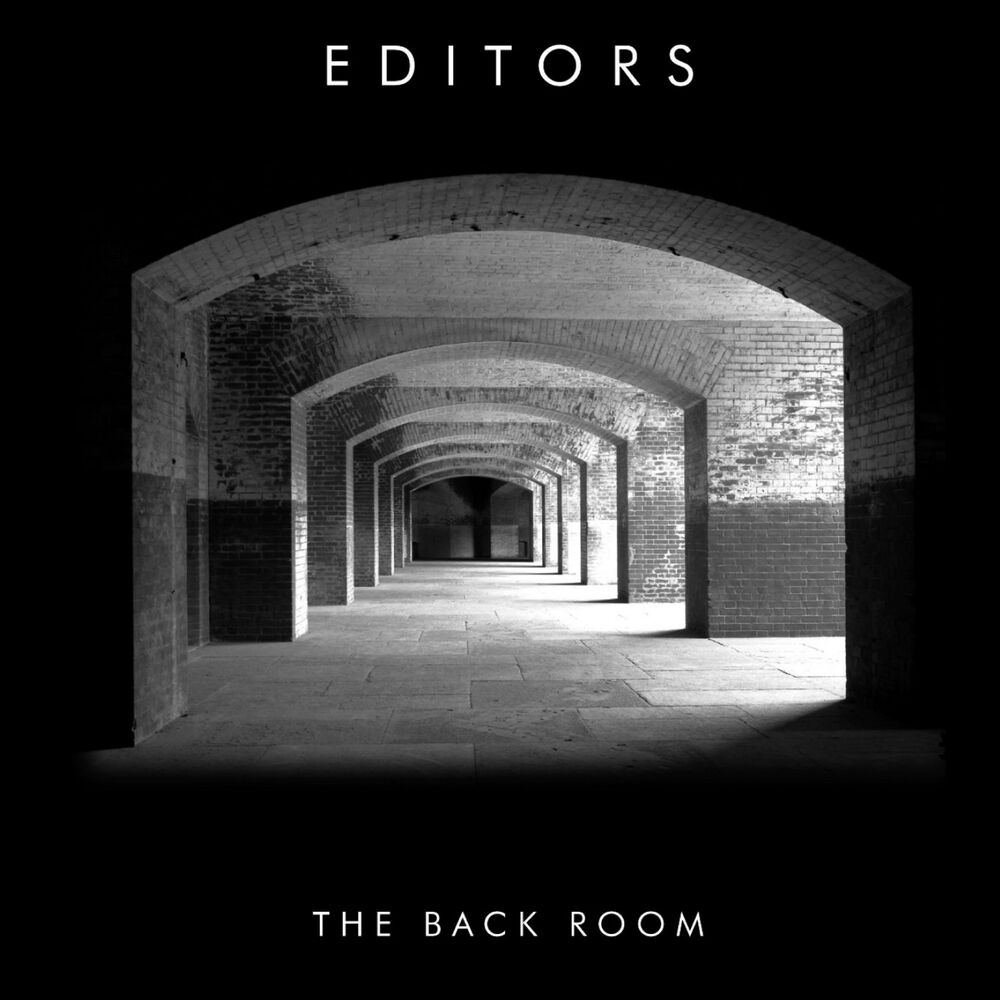
The Back Room
- Released24 July 2005
- UK peak No. 2
- Weeks on UK chart 50
- Entered UK chart 31 July 2005
- LabelPlay It Again Sam
- Tracks17 · 69 min
4 tracks from it charted as singles. Press a flag to play it in the chart where it peaked.
Tracks
| 1 | Lights | 2:31 | |
| 2 | Munich No. 10 · 2006 | 3:46 | |
| 3 | Blood No. 18 · 2005 | 3:29 | |
| 4 | Fall | 5:06 | |
| 5 | All Sparks No. 21 · 2006 | 3:33 | |
| 6 | Camera | 5:02 | |
| 7 | Fingers in the Factories | 4:14 | |
| 8 | Bullets No. 27 · 2005 | 3:09 | |
| 9 | Someone Says | 3:13 | |
| 10 | Open Your Arms | 6:00 | |
| 11 | Distance | 3:38 | |
| 12 | Let Your Good Heart Lead You Home | 4:37 | |
| 13 | You Are Fading | 4:30 | |
| 14 | Crawl Down The Wall | 3:34 | |
| 15 | Colours | 3:52 | |
| 16 | Release | 5:44 | |
| 17 | Forest Fire | 3:03 |
About the album
The Back Room is the debut studio album of British rock band Editors; it was released on 25 July 2005 through Kitchenware Records. The Editors formed while attending university and later moved to Birmingham, where they played club shows and made demos. After signing to Kitchenware in late 2004, the band recorded their debut album at studios in Lincolnshire, London and Wolverhampton. Jim Abbiss produced all but one of the tracks; the exception was produced by Gavin Monaghan. The Back Room is a post-punk revival, gothic rock and indie pop album that has been compared to the works of Echo & the Bunnymen, Elbow and Interpol.
"Bullets" was released as the album's lead single in January 2005; it was followed by a tour of the UK. "Munich" and "Blood" were released as the album's second and third singles in April and June 2005, respectively. The album's release was promoted with a UK tour throughout July 2005; "Bullets" was re-released following their debut US show in September 2005. Editors then supported Franz Ferdinand on their UK tour, leading to Editors' headlining tour at the end of 2005. In early 2006, "Munich" was re-released; they promoted it with tours in the US and the UK. The album's fourth single "All Sparks" was released in March 2006; it was followed by a co-headlining US tour with Stellastarr.
Background and recording
Editors formed in 2003 during the emergence of the post-punk revival under than name Snowfield; the band consisted of Tom Smith on vocals and guitar, Chris Urbanowicz on guitar, Russel Leetch on bass and Ed Lay on drums. The members met in 2000 at Staffordshire University and ended up living together. Urbanowicz said he had grown tired of guitar-centric music following Britpop and that the members bonded over their love of Is This It (2001) by The Strokes and Asleep in the Back (2001) by Elbow. They could all play instruments and shared similar music tastes so they decided to form a band. They were co-students on a music technology course, which allowed them to use practice rooms and recording studios. After graduating, the band members moved to Birmingham, where they earned money to pay rent and worked on the band. They performed at club shows and recorded demos, and later attracted British record labels.
Between late 2003 and mid-2004, the band played three-to-four showcases per week for interested labels.
Composition and lyrics
The sound of The Back Room has been described as post-punk revival, gothic rock and indie pop, and was compared to the work of Echo & the Bunnymen—particularly their album Heaven Up Here (1981)—Interpol and their album Antics (2004), and the works of Elbow. Urbanowicz disregarded some of these comparisons, saying Editors' material had already been written before they had "really listened to any of those bands properly". He credited Editors' choice of music to the Walkmen, to whose music they incessantly listened. Smith said, in comparison to their live setting, the album has synthesisers, which give it a dark electronic nuance. musicOMH writer David Turnbull said The Back Room is "characterised by thick, prominent basslines, insistent drums, twinkling guitar and a baritone voice". Starting with "Camera", synthesisers take a prominent role in the album's second half. Urbanowicz attributed the album's aggressive tone to when they were living together and working jobs.
Release and promotion
Editors' debut single "Bullets" was released on 24 January 2005, with "You Are Fading" and "Dust in the Sunlight". To promote the single, they embarked on their first UK tour the same month. In February 2005, as part of the NME Awards, the band played a one-off show at London Astoria. "Munich" was released as the second single on 18 April 2005; the seven-inch vinyl version included "Disappear" as its B-side. Two versions were released on Compact Disc (CD); the first with "Crawl Down the Wall" and "Colours", while the other includes "Release". "Blood" was released as the album's third single on 11 July 2005; the seven-inch vinyl version includes "Forest Fire" as its B-side. Two versions were released on CD: the first with "Heads in Bags" and a remix of "Blood" by the Freelance Hellraiser, and the second with "Let Your Good Heart Lead You Home".
The Back Room was released on 25 July 2005 through Kitchenware Records. Nick Southall of Stylus Magazine said its artwork is reminiscent of the cover of Turn On the Bright Lights (2002) by Interpol, "only darker, more monochrome".
Critical reception
Music critics gave The Back Room generally favourable reviews. At Metacritic, which assigns a normalised rating out of 100 to reviews from mainstream publications, the album received an average score of 76, based on 23 reviews.
The album's lyrics drew mixed comments. James Jam of NME said The Back Room "hops from hopelessness to hopefulness, often within the space of a chorus". Robert Christgau, writing for The Village Voice, said as Smith "demonstrates, [the lyrics] needn't be morbid or suicidal. His message is often sanely chin-up." Christian Hoard of Rolling Stone said, however, Smith tends to get "lost in his own gloom-addled mind" while trying to change lyrical direction from a negative to a positive one, and arrives at something between the two. Matt Barnes of This Is Fake DIY said Smith's talents are undercut by his "fondness for a hamfisted lyric" and Mxdwn's M. Burns said they could not connect with the album because of the lyrics' "contrived and abstract nature".
Commercial performance and accolades
The Back Room peaked at number two in album charts in the UK and Scotland. In the US, it reached number 14 on the Billboard Heatseekers Albums component chart and number 21 on the Billboard Independent Albums component chart. It also charted at number 23 in Ireland, number 30 in the Netherlands, number 53 in the Flanders region of Belgium, number 74 in the Wallonia region of Belgium and number 107 in France. The album was ranked at number 182 on the 2005 year-end album chart in the UK and number 75 on the 2006 iteration. It was certified platinum in the UK, and gold in Belgium, Ireland and the Netherlands. The Back Room was nominated for the 2006 Mercury Prize.
"Bullets" originally charted at number 54 in the UK but after its reissue, it peaked at number 27. "Munich", which originally charted at number 22 in the UK, peaked at number 10 after its re-release. It also reached number 42 in Ireland and number 97 in the Netherlands. The British Phonographic Industry (BPI) certified "Munich" silver in February 2021.