One track from it charted as a single. Press a flag to play it in the chart where it peaked.
Tracks
| 1 | Reception (Remastered 1993) | 1:06 | |
| 2 | Getting Closer (Remastered 1993) No. 60 · 1979 | 3:20 | |
| 3 | We're Open Tonight (Remastered 1993) | 1:28 | |
| 4 | Spin It On (Remastered 1993) | 2:12 | |
| 5 | Again And Again And Again (Remastered 1993) | 3:32 | |
| 6 | Old Siam, Sir (Remastered 1993) | 4:10 | |
| 7 | Arrow Through Me (Remastered 1993) | 3:36 | |
| 8 | Rockestra Theme (Remastered 1993) | 2:34 | |
| 9 | To You (Remastered 1993) | 3:11 | |
| 10 | After The Ball/Million Miles (Remastered 1993) | 3:58 | |
| 11 | Winter Rose/Love Awake (Remastered 1993) | 4:57 | |
| 12 | The Broadcast (Remastered 1993) | 1:28 | |
| 13 | So Glad To See You Here (Remastered 1993) | 3:18 | |
| 14 | Baby's Request (Remastered 1993) | 2:55 |
About the album
Back to the Egg is the seventh and final studio album by the British-American rock band Wings, released on 24 May 1979 through Columbia Records in North America (their first for the label) and on 8 June through Parlophone in the UK. Co-produced by Chris Thomas, the album reflects band leader Paul McCartney's embracing of contemporary musical trends such as new wave and punk, and marked the arrival of new Wings members Laurence Juber and Steve Holley. Back to the Egg adopts a loose conceptual theme around the idea of a working band, and its creation coincided with a period of considerable activity for the group, which included making a return to touring and work on several television and film projects.
Recording for the album began in June 1978 and lasted for almost a year. The sessions took place at Spirit of Ranachan Studios in Campbeltown, Scotland; Lympne Castle in Kent, London's Abbey Road Studios, and Replica Studio – the last of which McCartney built as an exact replica of Abbey Road's Studio Two when the latter became unavailable.
Background
After the release of the album London Town (1978), Wings band leader Paul McCartney hired two session musicians, drummer Steve Holley and lead guitarist Laurence Juber, to replace former members Joe English and Jimmy McCulloch. With the new line-up – Wings' sixth since its formation in 1971 – McCartney intended to record a raw rock and roll album and return to touring, for the band's first concerts since their successful Wings Over the World tour of 1975–76. McCartney also hoped to realise his longstanding plan of making a film adaptation of the Rupert the Bear cartoon series, for which he owned the commercial rights, and commissioned English playwright Willy Russell to write a feature film starring Wings.
Holley and Juber were recruited by Wings co-founder and guitarist Denny Laine, who had appeared as a guest on The David Essex Show in 1977 when Juber was working as a guitarist in the house band.
Production
The band first rehearsed material for Back to the Egg in London, at the offices of McCartney's company MPL Communications in Soho Square, before carrying out further rehearsals in Scotland, in June 1978. As on his other Wings recordings over 1978–79, Thomas worked with Phil McDonald as his recording engineer, at McCartney's insistence, rather than Bill Price, who was the producer's preferred engineer.
Artwork and promotional videos
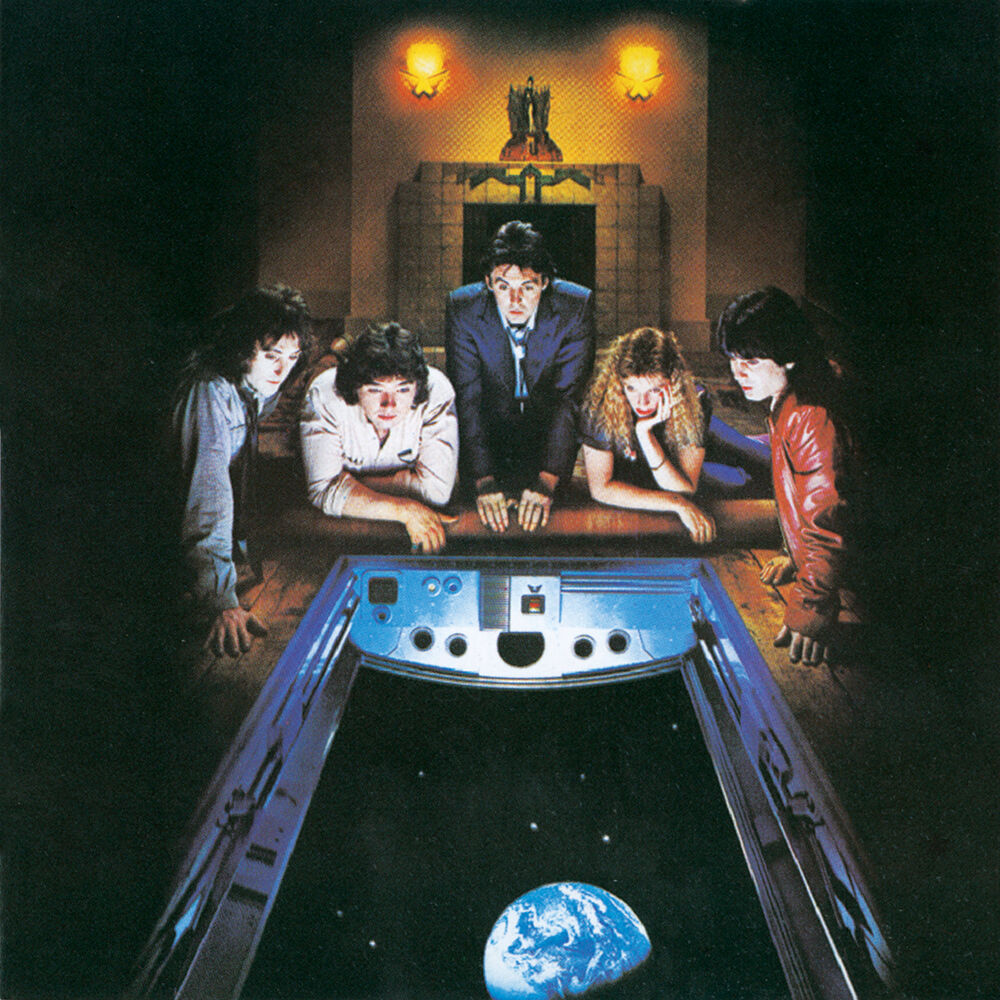
The design for the album's artwork was by Hipgnosis, the company responsible for previous Wings album covers such as Venus and Mars (1975) and the Wings Greatest compilation (1978). The front cover depicts the five members of Wings in a room, looking down through space at Planet Earth through an open hatchway in the floor; the statuette of Semiramis above the mantlepiece behind them is the same that appears in the Wings Greatest artwork. The picture was taken by photographer John Shaw at his London studio. The set was specially constructed using forced perspective, with the floorboards and hatchway artificially tapered, allowing the look of a wide-angle photograph without any distortion to the subjects to either side of McCartney. Photos of the individual band members appeared on the back cover, credited to Linda and Paul McCartney.
Working with film company Keef & Co., Wings filmed seven promotional videos for the album, which would later be compiled into the Back to the Egg TV special.
Release
"Goodnight Tonight" had been issued on Columbia Records in America, marking McCartney's break from EMI-affiliated Capitol Records, although he and Wings remained with EMI's Parlophone label in the UK. McCartney's contract with Columbia made him the highest-paid recording artist in the world. As an incentive for McCartney, Columbia's parent company, CBS, had added to his publishing portfolio by giving him the highly profitable Frank Music catalogue – making McCartney the copyright holder to Guys and Dolls and other popular musicals by Frank Loesser.
Back to the Egg was released on 24 May 1979 in the US (as Columbia FC-36057), and on 8 June in the UK (as Parlophone PCTC 257). In Britain, "Old Siam, Sir" was the album's first single, whereas "Getting Closer" was the choice in America; in both cases, "Spin It On" was the B-side. On 11 June, an album launch party took place inside Abbey Road's Studio Two, which had been blacked-out like a large frying pan, while tables carrying yellow parasols represented fried eggs sitting in the pan.
Reception
Back to the Egg received predominantly negative reviews on release; author Alan Clayson writes of the album receiving "a critical mauling as vicious as that for London Town". In an especially unfavourable critique for Rolling Stone magazine, Timothy White described it as "the sorriest grab bag of dreck in recent memory" and lamented that none of the songs were "the least bit fleshed out", with the listener instead given "an irritating display of disjointed images and unfocused musical snapshots". After opining that, since 1970, "this ex-Beatle has been lending his truly prodigious talents ... to some of the laziest records in the history of rock & roll", White wrote: "Who, one felt compelled to ask, is in charge here? Back to the Egg provides the final, obvious answer: no one." In Sounds magazine, Tony Mitchell called all of the songs easily forgettable and the music "complacent and formula-ridden".
According to Allan Kozinn and Adrian Sinclair, many critics considered the variety of musical styles "diffuse" rather than "varied".
Aftermath and reissues
With the album falling well short of Columbia's and McCartney's expectations commercially, McCartney spent the remainder of the summer of 1979 recording in Peasmarsh and Campbeltown, without Wings, creating his solo album McCartney II (1980). During November and December 1979, US TV stations aired the 31-minute Back to the Egg special, as Wings undertook a nineteen-show UK tour, the first leg of the proposed world tour. Among the songs in the setlist, they performed several tracks from Back to the Egg: "Getting Closer", "Again and Again and Again", "Old Siam, Sir", "Spin It On" and "Arrow Through Me".
The band were scheduled to tour Japan during January and February 1980, but the concerts, together with their tour dates elsewhere in the world, were cancelled after McCartney was arrested for possession of drugs when entering the country. Around this time, "Rockestra Theme" won the Grammy Award for Best Rock Instrumental Performance.