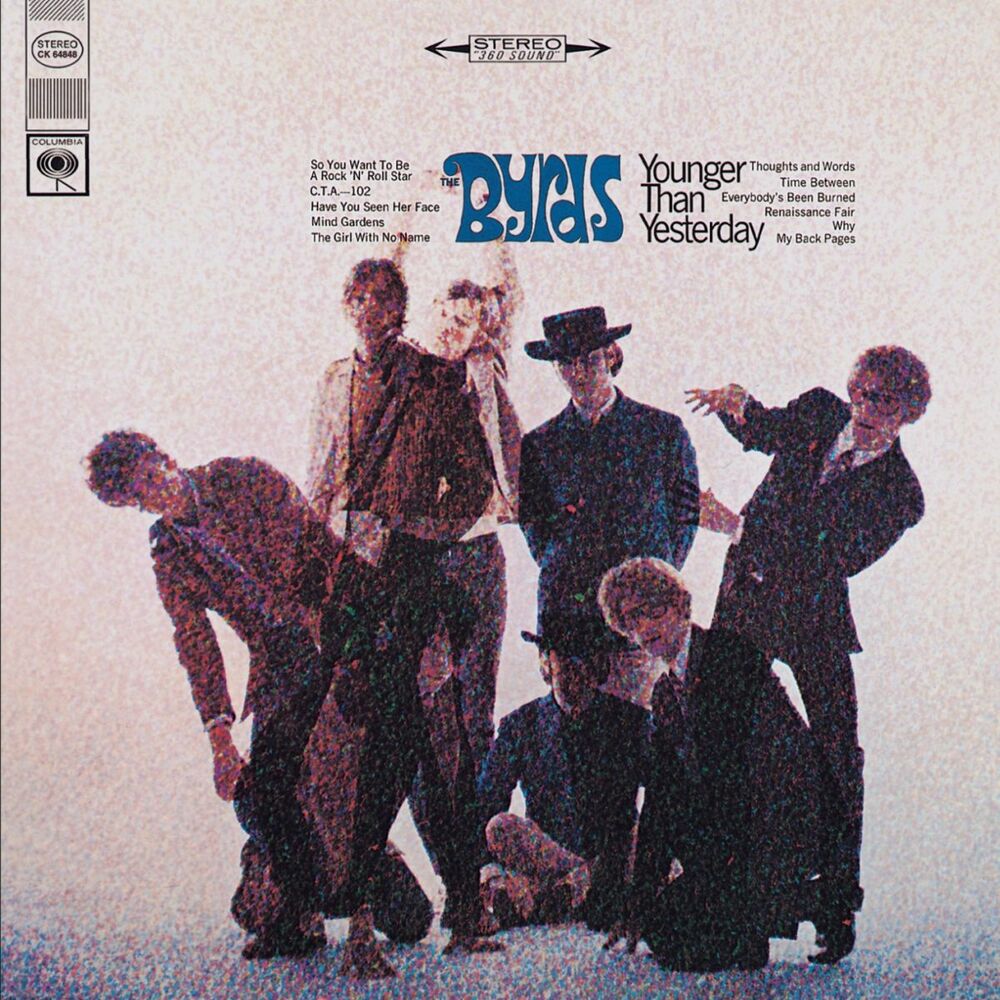
Younger Than Yesterday
- Released21 May 2013
- UK peak No. 37
- Weeks on UK chart 4
- Entered UK chart 16 April 1967
- LabelColumbia/Legacy
- Tracks17 · 46 min
4 tracks from it charted as singles. Press a flag to play it in the chart where it peaked.
Tracks
| 1 | So You Want to Be a Rock 'N' Roll Star No. 29 · 1967 | 2:05 | |
| 2 | Have You Seen Her Face No. 74 · 1967 | 2:40 | |
| 3 | C.T.A. - 102 | 2:28 | |
| 4 | Renaissance Fair (Single Version) | 1:51 | |
| 5 | Time Between | 1:53 | |
| 6 | Everybody's Been Burned (Single Version) | 3:05 | |
| 7 | Thoughts and Words | 2:56 | |
| 8 | Mind Gardens | 3:46 | |
| 9 | My Back Pages No. 30 · 1967 | 3:08 | |
| 10 | The Girl With No Name | 1:50 | |
| 11 | Why | 2:45 | |
| 12 | It Happens Each Day | 2:44 | |
| 13 | Don't Make Waves (Single Version) | 1:37 | |
| 14 | My Back Pages (Alternate Version) No. 30 · 1967 | 2:43 | |
| 15 | Mind Gardens (Alternate Version) | 3:17 | |
| 16 | Lady Friend (Single Version) No. 82 · 1967 | 2:30 | |
| 17 | Old John Robertson (Single Version) | 5:05 |
About the album
Younger Than Yesterday is the fourth studio album by the American rock band the Byrds, released on February 6, 1967, by Columbia Records. It saw the band continuing to integrate elements of psychedelia and jazz into their music, a process they had begun on their previous album, Fifth Dimension. In addition, the album captured the band and record producer Gary Usher experimenting with new musical textures, including brass instruments, reverse tape effects and an electronic oscillator.
The album also marked the emergence of the band's bass player Chris Hillman as a talented songwriter and vocalist. Prior to Younger Than Yesterday, Hillman had only received one shared writing credit with the Byrds, but this album saw him credited as the sole composer of four songs and a co-writer of "So You Want to Be a Rock 'n' Roll Star". Byrds expert Tim Connors has remarked that two of Hillman's compositions on Younger Than Yesterday exhibited country and western influences and thus can be seen as early indicators of the country rock experimentation that would feature—to a greater or lesser degree—on all of the Byrds' subsequent albums.
Upon release, the album peaked at number 24 on the Billboard Top LPs chart and reached number 37 on the UK Albums Chart.
Background
The Byrds had initially come to international prominence in mid-1965, when their folk rock interpretation of Bob Dylan's "Mr. Tambourine Man" reached number 1 on both the U.S. Billboard Hot 100 chart and the UK Singles Chart. Further commercial successes followed, with the band releasing two hit albums and reaching number 1 for a second time in the U.S., with a cover version of Pete Seeger's "Turn! Turn! Turn! (to Everything There is a Season)". Throughout the latter half of 1965, the band enjoyed tremendous popularity among teenage pop fans and their music received widespread airplay on Top 40 radio. In early 1966, the Byrds' principal songwriter, Gene Clark, departed the band, leaving Jim McGuinn, David Crosby, Chris Hillman, and Michael Clarke to complete the band's third album, Fifth Dimension, without him. Upon release, Fifth Dimension received a mixed critical reception and was less commercially successful than the band's earlier albums.
Music
Younger Than Yesterday found the Byrds expanding their musical style in several different directions. Music critic John Harris has described the album as the Byrds' "West Coastified version of the Revolver aesthetic", with reference to the Beatles' 1966 album. Chris Hillman contributed two country rock-flavored songs with "Time Between" and "The Girl with No Name", the latter of which was inspired by a young lady with the unusual moniker of Girl Freiberg. "Time Between", on the other hand, was a Paul McCartney-influenced pop song and the result of Hillman's first ever attempt at writing a song on his own. Both songs featured the country-style guitar playing of session musician Clarence White, who would go on to become a full member of the Byrds' latter-day line-up from 1968 through to 1973. Byrds expert Tim Connors has suggested that the pop-country sound of "Time Between" and "The Girl with No Name"—like "Mr.
Release and reception
Younger Than Yesterday was released on February 6, 1967, in the United States (catalogue item CL 2642 in mono, CS 9442 in stereo) and April 7, 1967, in the UK (catalogue item BPG 62988 in mono, SBPG 62988 in stereo). It peaked at number 24 on the Billboard Top LPs chart, during a stay of 24 weeks, and reached number 37 in the United Kingdom, spending a total of 4 weeks on the UK chart. The album's front cover featured a composite multiple exposure photograph of the band, taken by Frank Bez.
The album was preceded by the "So You Want to Be a Rock 'n' Roll Star" single, which was released on January 9, 1967, and reached number 29 on the Billboard Hot 100, but failed to chart in the UK. Two additional singles taken from the album, "My Back Pages" and "Have You Seen Her Face", reached number 30 and number 74 on the Billboard chart respectively, but again missed the UK chart. The "My Back Pages" single was the last single release by the Byrds to reach the Top 40 of the Billboard Hot 100.
Singles
"So You Want to Be a Rock 'n' Roll Star" b/w "Everybody's Been Burned" (Columbia 43987) January 9, 1967 (US: number 29)
"My Back Pages" b/w "Renaissance Fair" (Columbia 44054) March 13, 1967 (US: number 30)
"Have You Seen Her Face" b/w "Don't Make Waves" (Columbia 44157) May 22, 1967 (US: number 74)