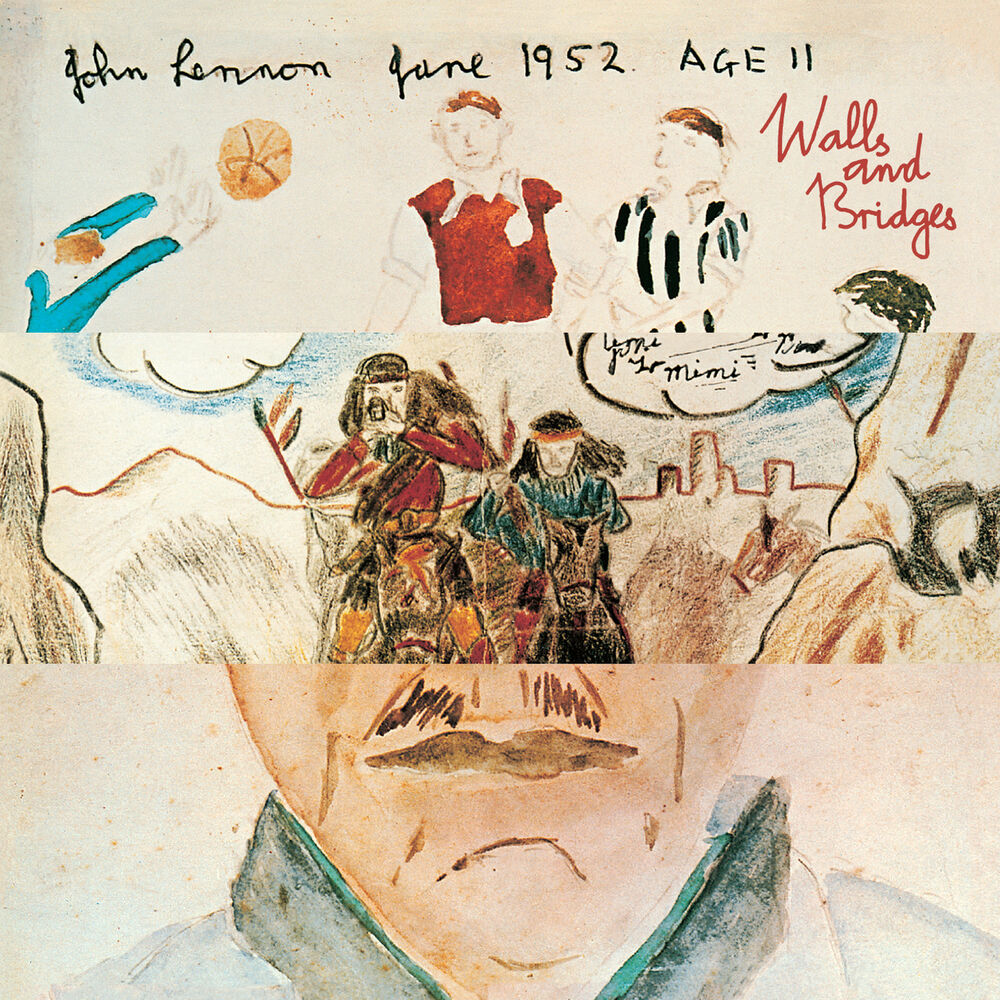
Walls And Bridges
- Released1 October 2010
- UK peak No. 6
- Weeks on UK chart 10
- Entered UK chart 13 October 1974
- LabelEMI Catalogue
- Tracks12 · 46 min
2 tracks from it charted as singles. Press a flag to play it in the chart where it peaked.
Tracks
| 1 | Going Down On Love (Remastered 2010) | 3:54 | |
| 2 | 3:27 | ||
| 3 | Old Dirt Road (Remastered 2010) | 4:10 | |
| 4 | What You Got (Remastered 2010) | 3:07 | |
| 5 | Bless You (Remastered 2010) | 4:37 | |
| 6 | Scared (Remastered 2010) | 4:35 | |
| 7 | #9 Dream (Remastered 2010) No. 9 · 1975 | 4:46 | |
| 8 | Surprise Surprise (Sweet Bird Of Paradox) (Remastered 2010) | 2:54 | |
| 9 | Steel And Glass (Remastered 2010) | 4:36 | |
| 10 | Beef Jerky (Remastered 2010) | 3:28 | |
| 11 | Nobody Loves You (When You're Down And Out) (Remastered 2010) | 5:10 | |
| 12 | Ya Ya (Remastered 2010) | 1:05 |
About the album
Walls and Bridges is the fourth solo studio album by the English musician John Lennon. It was issued by Apple Records on 26 September 1974 in the United States and on 4 October in the United Kingdom. Written, recorded and released during his 18-month separation from Yoko Ono, the album captured Lennon in the midst of his "Lost Weekend". Walls and Bridges was an American number-one album on both the Billboard and Record World charts and included two hit singles, "Whatever Gets You thru the Night" and "#9 Dream". The first of these was Lennon's first number-one hit in the United States as a solo artist, and his only solo chart-topping single in either the US or Britain during his lifetime.
The album was certified silver in the UK, and gold in the US. It was Lennon's last album of self-penned material released solely under his own name during his lifetime.
Background
In June 1973, as Lennon was about to record Mind Games, Ono suggested that she and Lennon should separate. Lennon soon moved to California with his and Ono's personal assistant May Pang with Ono's encouragement and they embarked on an 18-month relationship he would later refer to as his "Lost Weekend". While he and Pang were living in Los Angeles, Lennon took the opportunity to get reacquainted with his son Julian, whom he had not seen in two years.
Lennon had planned to begin recording Rock 'n' Roll with producer Phil Spector, but these sessions became legendary not for the music produced but for alcohol-fuelled antics. Lennon and Pang returned to New York and Spector disappeared with these session tapes. Around this time, Lennon had written several new songs during a stay at The Pierre and started recording a few home demos.
Recording
Lennon began rehearsing his new material with studio musicians at Record Plant East in New York City in June 1974 which included Jim Keltner on drums, Klaus Voormann on bass guitar, Jesse Ed Davis on guitar and Arthur Jenkins on percussion. The core players were billed on the album as the Plastic Ono Nuclear Band, a variation on Plastic Ono Band, the conceptual group to which many of Lennon's solo efforts were credited.
The musicians worked out their own arrangements in a short time, and the recording advanced quickly. Ron Aprea, the saxophonist from the Little Big Horns, said that "Since he had no formal training in arranging, he would sit in the control room and let us make up our own parts. If he liked what we played, he would let us know ... If we thought we could get it better, he would say 'go for it'." Aprea also said that the brass section was recorded over a two-week period. Lennon later said that it had been "an extraordinary year for me personally. And I'm almost amazed that I could get anything out.
Music and lyrics
Walls and Bridges has a variety of musical stylings and many of the lyrics make it clear that Lennon both enjoyed his new-found freedom and also missed Ono. The album title refers to the barriers that Lennon had constructed between himself and others and his hope that those barriers could be surmounted. Lennon said, "Walls keep you in either protectively or otherwise, and bridges get you somewhere else."
"Going Down on Love", the album's opening track, incorporates a sexual pun and the lyrics reflect Lennon's feelings about his separation from Ono. The second track, "Whatever Gets You thru the Night" was issued as the album's first single. The inspiration for the lyrics came from late-night television. In December 2005, May Pang told Radio Times: "At night he loved to channel-surf, and would pick up phrases from all the shows.
Release and promotion
Unsure of which track should be the album's lead single, Lennon enlisted the help of Al Coury, the vice-president of marketing for Capitol Records. Lennon had been impressed with the "magic" that Coury displayed in the commercial success of McCartney's Band on the Run album. Coury chose "Whatever Gets You thru the Night" as the first single. Walls and Bridges was released on 26 September 1974 in the US, and on 4 October 1974 in the UK. The release was accompanied by an advertising campaign, created by Lennon, called "Listen To This ..." (button, photo, sticker, ad, poster or T-shirt). The backs of 500 New York City buses were plastered with the slogan "Listen To This Bus". Television commercials depicted the LP jacket with its many "Lennon" faces; as with the radio segments promoting the album, these commercials had a voiceover from Ringo Starr. Lennon returned the favour by supplying the voiceover in commercials for Starr's Goodnight Vienna album, which he had also helped record.
Legacy
Writing in The All-Music Guide to Rock (1995), William Ruhlmann described Walls and Bridges as "craftsmanlike pop-rock" with "some lovely album tracks". Uncut gave it four stars and asserted that "Whatever Gets You Through the Night" "remains one of Lennon's best post-Beatles achievements". AllMusic senior editor Stephen Thomas Erlewine finds the album "decidedly uneven", "containing equal amounts of brilliance and nonsense", with the lesser tracks "weighed down by weak melodies and heavy over-production". In The New Rolling Stone Album Guide of 2004, "#9 Dream" was singled out for praise as "a heavily atmospheric number boasting cool cellos and fine singing". Lennon biographer Philip Norman wrote in 2008 that "Most of the tracks had an upbeat, brassy feel, strangely at odds with John's recurrent, often desperate admissions of longing for Yoko", and that the chord sequences used often echoed those from his previous work with Ono. In 2022, Listverse described Lennon's process as necessary, before proclaiming it the "last of the essential" Lennon albums.
Aftermath and reissues
Walls and Bridges was the last album to feature original songs by Lennon until 1980's Double Fantasy, although a follow-up to Walls and Bridges, to be titled Between the Lines, was planned for late 1975. Tony King, an Apple vice-president, confirms this. King also says that Carlos Alomar was to hire a group of black musicians, and that Lennon had written the song "Tennessee" for the album. In a 1975 interview for the Old Grey Whistle Test, Lennon indicated he was planning a new album and a TV special.
Walls and Bridges was first re-released on vinyl in the US in 1978, then again in 1982, and 1989, on Capitol. After Lennon's death, the album, along with seven other Lennon albums, was reissued by EMI as part of a box set, which was released in the UK on 15 June 1981. It was re-released on vinyl in the UK in 1985, on the Parlophone label. Walls and Bridges was first released on CD on 20 July 1987 in the UK, and nearly a year later in the US, on 19 April 1988.