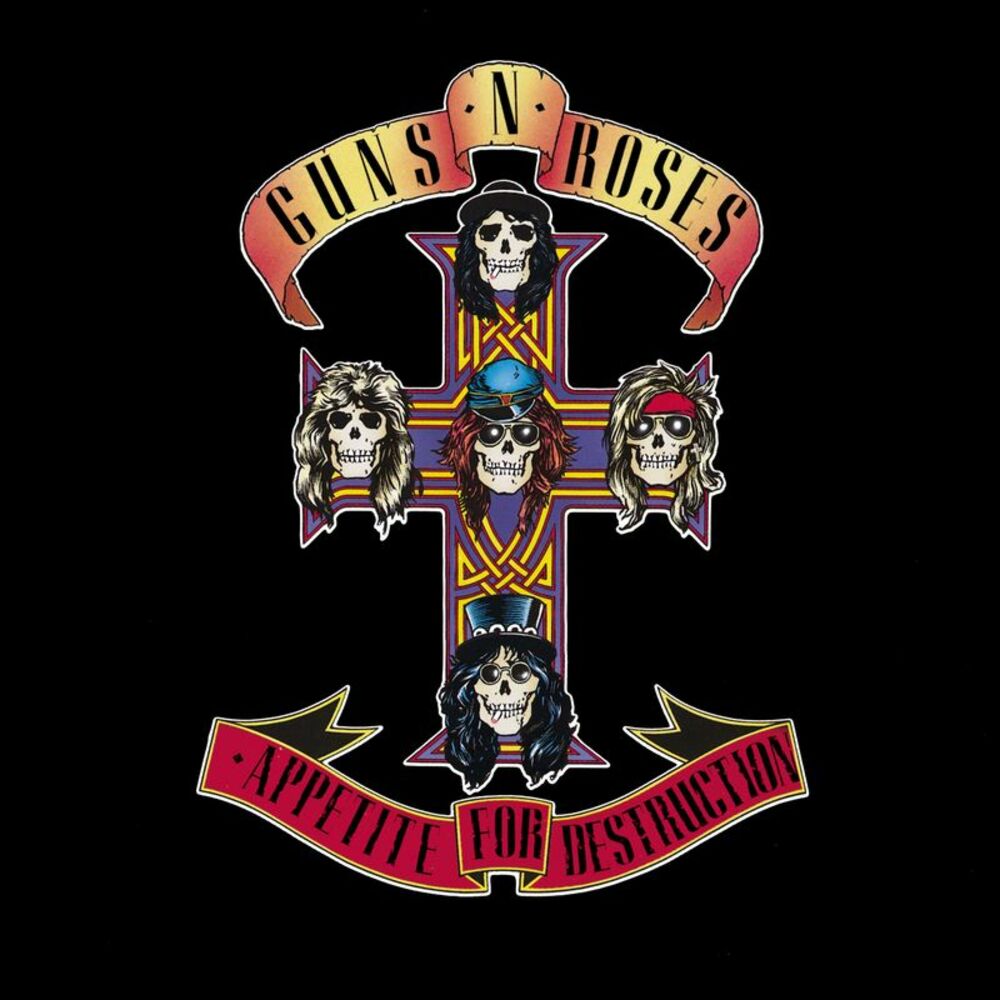
Appetite For Destruction
- Released29 June 2018
- UK peak No. 5
- Weeks on UK chart 286
- Entered UK chart 26 July 1987
- LabelGuns N Roses P&D
- Tracks12 · 53 min
5 tracks from it charted as singles. Press a flag to play it in the chart where it peaked.
Tracks
| 1 | 4:31 | ||
| 2 | It's So Easy No. 84 · 1987 | 3:21 | |
| 3 | 4:26 | ||
| 4 | Out Ta Get Me | 4:20 | |
| 5 | Mr. Brownstone | 3:46 | |
| 6 | 6:46 | ||
| 7 | My Michelle | 3:39 | |
| 8 | Think About You | 3:50 | |
| 9 | 5:55 | ||
| 10 | You're Crazy | 3:17 | |
| 11 | Anything Goes | 3:25 | |
| 12 | Rocket Queen | 6:13 |
About the album
Appetite for Destruction is the debut studio album by American hard rock band Guns N' Roses, released on July 21, 1987, by Geffen Records. The album was recorded from January 18 to June 23 in 1987, and was produced by Mike Clink. Most of the album's themes reflect the band's personal experiences and daily life, including their youth.
Appetite for Destruction initially received little mainstream attention, and it was not until the following year that the album became a commercial success, after the band had toured and received significant airplay with the singles "Welcome to the Jungle", "Paradise City", and "Sweet Child o' Mine". The album went on to reach number one on the US Billboard 200 and spend four non-consecutive weeks there. It became certified 18× platinum, making it among the top 10 best-selling albums in the United States, as well as the best-selling debut album in the country.
In total, five singles were released from Appetite for Destruction: "It's So Easy" with "Mr. Brownstone", "Welcome to the Jungle", "Sweet Child o' Mine", "Paradise City", and "Nightrain".
Background
Guns N' Roses' first recordings were for a planned EP in March 1985, shortly after the band formed, with "Don't Cry", a cover of "Heartbreak Hotel", "Think About You" and "Anything Goes". However, plans for the release fell through, as original guitarist Tracii Guns left the band, being replaced by Slash. Shortly afterward, the classic lineup of Axl Rose, Duff McKagan, Slash, Steven Adler, and Izzy Stradlin was finalized.
After heavy touring of the Los Angeles club scene, the group signed with Geffen Records in March 1986. In December of that year, the group released the four-song EP Live ?!*@ Like a Suicide, which was designed to keep interest in the band alive while the group withdrew from the club scene to work in the studio. The EP release was also designed to soothe the label, which believed the band did not have enough songs to record a full-length album.
Writing and recording
Rose stated many of the songs on the album were written while the band was performing on the Los Angeles club circuit, and a number of songs that were ultimately featured on later Guns N' Roses albums were considered for Appetite for Destruction, such as "Back Off Bitch", "You Could Be Mine", "November Rain", and "Don't Cry". It is said that the reason for not putting "November Rain" on Appetite for Destruction was that the band had already agreed to put "Sweet Child o' Mine" on the album, and thus already had a "ballad" on the track list.
Producer Spencer Proffer was hired to record "Nightrain" and "Sweet Child o' Mine" to test his chemistry with the band. The band eventually recorded nine songs with Proffer during these sessions, including "Heartbreak Hotel", "Don't Cry", "Welcome to the Jungle", and "Shadow of Your Love". In mid- to late-1986, the band recorded demos with Nazareth guitarist Manny Charlton, which were released in 2018 (see below for more info).
Artwork
The album's original cover art was based on Robert Williams' painting Appetite for Destruction. It depicted a robotic rapist about to be punished by a metal avenger. After several music retailers refused to stock the album, some Geffen executives compromised and put the controversial cover art inside, replacing it with an image depicting a Celtic cross and skulls representing each of the five band members (top skull: Izzy Stradlin, left skull: Steven Adler, center skull: Axl Rose, right skull: Duff McKagan, and bottom skull: Slash). In a 2016 interview, Billy White Jr., who designed the tattoo with the cross and skulls upon which the album artwork was based, explained: "The cross and skulls that looked like the band was Axl's idea, the rest was me. The knot work in the cross was a reference to Thin Lizzy, a band Axl and I both loved." The original cover was supposed to be on the 2008 vinyl reissue of the album, though executives replaced it with the "skulls" art at the last minute.
Marketing and sales
When Appetite for Destruction was released by Geffen Records on July 21, 1987, it received little notice from American press and radio, apart from some airplay in California. Music journalist Stephen Davis later attributed this to competing rock music in the mainstream at the time, including Aerosmith's comeback hit album Permanent Vacation, Def Leppard's presence on radio with their Hysteria album, and the dominance of U2's spiritual rock over MTV's prime-time viewership. The album debuted at number 182 on the Billboard 200 the week of August 29, but it only sold 200,000 copies in the first several months of its release, and Geffen planned on "walking away" from the record.
Radio stations originally did not want to play "Welcome to the Jungle", and MTV did not want to air the song's music video. However, after several months of lobbying the network, Geffen general manager Al Coury convinced MTV to play the video just once a night for three nights.
Reception and legacy
The album was not well received by contemporary American critics, many of whom complained that its massive success with consumers was fostered by the taboo of "sex, drugs and rock & roll" during the 1980s, when much of the cultural atmosphere in the US became informed by the Reagan-Bush Administration, the AIDS crisis, and the popularity of MTV. Writing in 1987, Dave Ling of Metal Hammer dismissed the album as an inferior mix of elements from bands such as Aerosmith, Hanoi Rocks, and AC/DC. Critics in the UK were more positive, and Kerrang! claimed that "rock is at last being wrestled from the hands of the bland, the weak, the jaded, the tired, the worn, and being thrust back into the hands of the real raunch rebels." However, the album was voted the 26th best album of the year in The Village Voice's 1988 Pazz & Jop, an annual poll of American critics nationwide. Robert Christgau, the poll's supervisor, was qualified in his praise when reviewing the album for his 1990 book Christgau's Record Guide: The '80s.
Accolades
In 1989, Rolling Stone ranked the album as the 27th best album of the 1980s. In 2012, it was ranked #62 on Rolling Stone's updated list of "The 500 Greatest Albums of All Time"; it maintained that rank on the 2020 update of the list.
In 2001, Q magazine listed the album as one of "The 50 Heaviest Albums of All Time". In 2004, Q named it one of "The Greatest Classic Rock Albums Ever". In 2006, Q placed the album at #10 on its list of "The 40 Best Albums of the '80s".
In 2002, Pitchfork ranked the album at #59 on their list of "The Top 100 Albums of the 1980s".