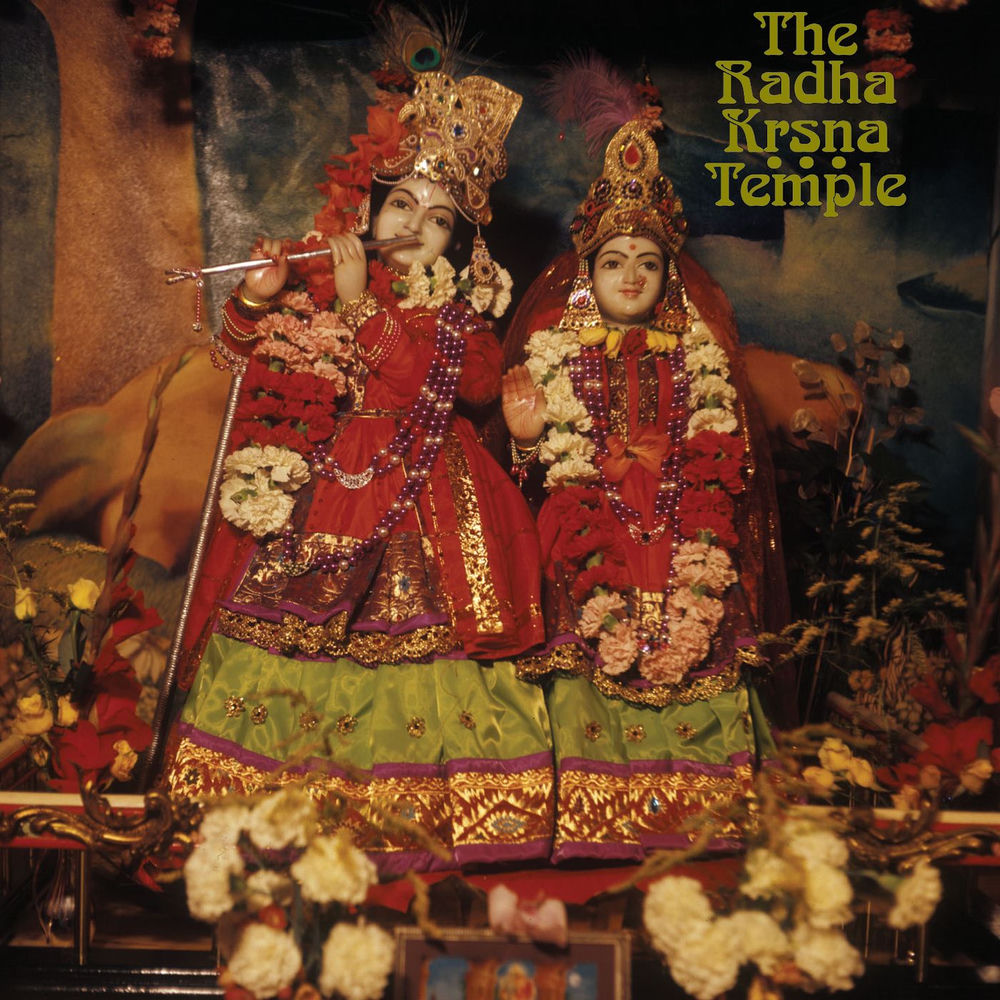
The Radha Krsna Temple (Remastered 2010)
- Released22 October 2010
- LabelBMG Rights Management (US) LLC
- Tracks9 · 48 min
Tracks
| 1 | Govinda | 4:44 | |
| 2 | Sri Guruvastak | 3:11 | |
| 3 | Bhaja Bhakata / Arotrika | 8:25 | |
| 4 | Hare Krsna Mantra | 3:34 | |
| 5 | Sri Isopanisad | 4:04 | |
| 6 | Bhaja Hure Mana | 8:52 | |
| 7 | Govinda Jai Jai | 5:57 | |
| 8 | Prayer To The Spiritual Masters | 3:58 | |
| 9 | Namaste Saraswati Devi | 4:57 |
About the album
The Radha Krsna Temple is a 1971 album of Hindu devotional songs recorded by the UK branch of the Hare Krishna movement – more formally, the International Society for Krishna Consciousness (ISKCON) – who received the artist credit of "Radha Krishna Temple (London)". The album was produced by George Harrison and released on the Beatles' Apple record label. It compiles two hit singles, "Hare Krishna Mantra" and "Govinda", with other Sanskrit-worded mantras and prayers that the Temple devotees recorded with Harrison from July 1969 onwards.
The recordings reflected Harrison's commitment to the Gaudiya Vaishnava teachings of the movement's leader, A. C. Bhaktivedanta Swami Prabhupada, who had sent devotees from San Francisco to London in 1968. The success of the Temple's first single, "Hare Krishna Mantra", helped popularise the Hare Krishna movement in the West, and inspired Harrison's more overtly religious songs on his 1970 triple album All Things Must Pass. Among the Temple members, former jazz musician and future ISKCON leader Mukunda Goswami provided the musical arrangements on the recordings.
After its initial release, the album was reissued on the Spiritual Sky label and by Prabhupada's Bhaktivedanta Book Trust.
Background
In 1968, A.C. Bhaktivedanta Swami Prabhupada, founder and acharya (leader) of the International Society for Krishna Consciousness (ISKCON), sent six of his devotees to London to establish a new centre there, the Radha Krishna Temple, and so expand on the success of ISKCON's temples in New York and San Francisco. The group was led by Mukunda Das, formerly a pianist with jazz saxophonist Pharoah Sanders, and Shyamsundar Das. With the acharya's blessing, they decided to seek out George Harrison of the Beatles, whose interest in Hindu philosophy, meditation and Indian classical music had done much to promote these causes among Western youth. In December 1968, Shyamsundar met Harrison at the Beatles' Apple Corps headquarters in central London, after which Harrison began visiting the devotees at their warehouse accommodation in Covent Garden.
Harrison had first experienced kirtan, or communal chanting, while in the Indian city of Vrindavan with Ravi Shankar, in 1966.
Recording
The recording for "Hare Krishna Mantra" took place at EMI Studios in July 1969, shortly before a session for the Beatles' Abbey Road album. Harrison worked through a musical arrangement for the piece on guitar, with Mukunda playing piano. For the recording, Harrison decided on joint vocalists over the verses, Yamuna and Shyamsundar, with the other devotees joining in on the choruses. The engineer on the recording was Ken Scott.
Harrison played harmonium during the initial taping, which required three takes to perfect. He then added Leslie-effected electric guitar at the start of the track, and also overdubbed a bass guitar part. Harrison later recalled that he "had someone beat time with a pair of kartals and Indian drums", and that the other devotees were brought in afterwards to overdub the chorus singing and other contributions.
In addition to various Temple members on mridangam and kartal, a recent American recruit played trumpet. Malati (Shyamsundar's wife) sounded the closing gong, after the track had built to what author Simon Leng describes as a "dervishlike climax".
Release
Apple Records issued the single, which was credited to "Radha Krishna Temple (London)", on 22 August 1969 in the United States (as Apple 1810) and on 29 August in the United Kingdom (as Apple 15). On 28 August, Harrison joined the devotees at Apple's press launch, held in the gardens of a large property in Sydenham, south London. Straight after the launch, Harrison drove down to the Isle of Wight to rejoin Bob Dylan, who was due to make his highly publicised return to live performance at the island's music festival. On 31 August, just before Dylan took to the stage, "Hare Krishna Mantra" was played over the venue's PA. Mukunda later identified this exposure, together with the song's airing during halftime at a Manchester United football game, as being indicative of how the ancient Maha Mantra "penetrated British society" via the Harrison-produced recording.
In the UK, the single's picture sleeve featured a photograph of the devotees taken by Ethan Russell.
Recording
Among the new pieces was "Govinda", a musical adaptation of what is considered to be the world's first poem, consisting of Govindam prayers. Gurudas described it to a reporter as a song that "comes from the Satya Yuga or Golden Era of the universe and was passed down through the ages by a chain of self-realized gurus". Author Bruce Spizer writes that Harrison "went all out" with his production of the track, creating an "exciting and hypnotic arrangement".
The recording session took place in January 1970, at Trident Studios in central London. Harrison had already created the backing track, which featured rock instrumentation such as acoustic guitar, organ, bass and drums, before the devotees' arrival. Yamuna was the sole lead vocalist. Also among those attending the session, in Greene's recollection, were Billy Preston and singers Donovan and Mary Hopkin, some of whom joined the devotees on the song's choruses.
Release
Backed with "Govinda Jai Jai", "Govinda" was issued by Apple on 6 March 1970 in Britain (as Apple 25) and 24 March in the United States (as Apple 1821). The single made the UK top 30, peaking at number 23. Apple's press officer, Derek Taylor, later recalled that his department placed print advertisements stating that "Govinda" was "the best record ever made". Prabhupada first heard the recording in Los Angeles; moved to tears, he asked for it to be played every morning while ISKCON devotees offered prayers in honour of the deities. In their book documenting the first 40 years of the Hare Krishna movement, Graham Dwyer and Richard Cole write that with "Hare Krishna Mantra" and "Govinda" "[becoming] hits across Europe, in Japan, in Australia, and even in Africa … the chanting of Hare Krishna had become world famous".