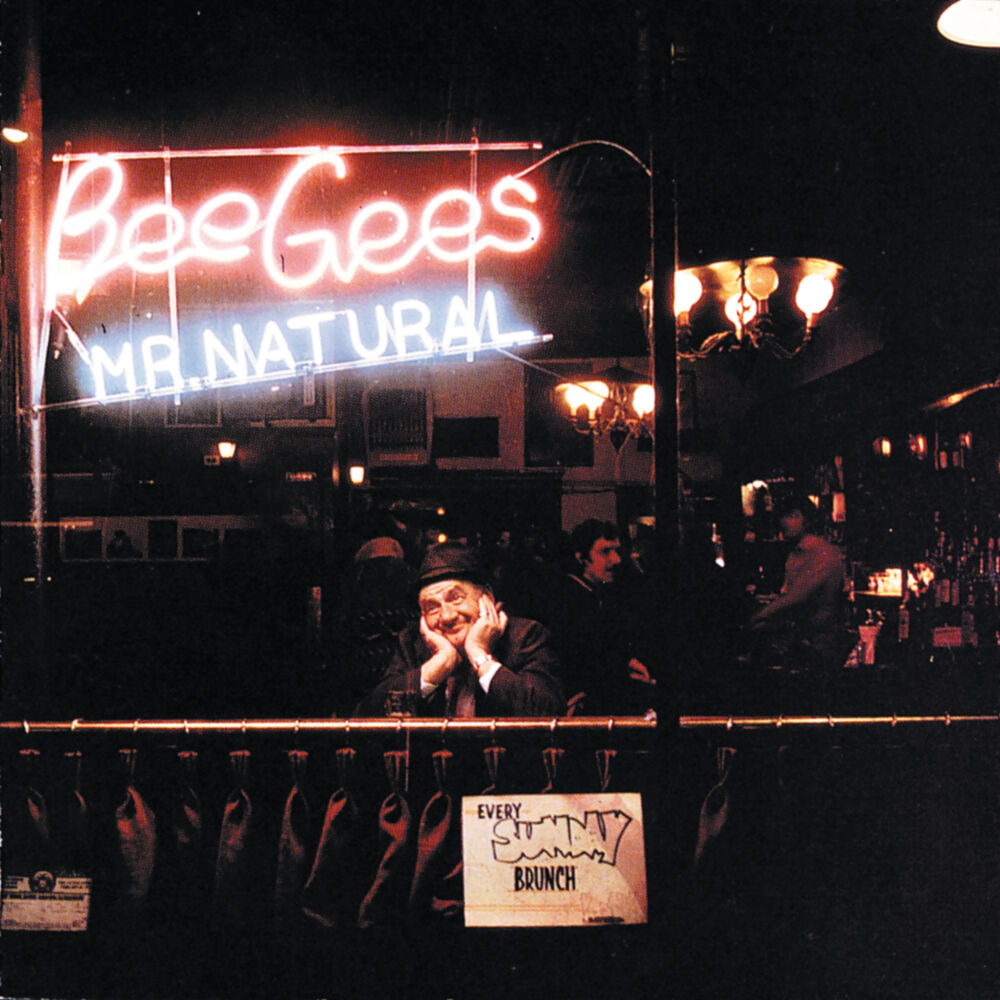
One track from it charted as a single. Press a flag to play it in the chart where it peaked.
Tracks
| 1 | Charade | 4:13 | |
| 2 | Throw A Penny | 4:49 | |
| 3 | Down The Road | 3:25 | |
| 4 | Voices | 4:50 | |
| 5 | Give A Hand Take A Hand | 4:45 | |
| 6 | Dogs | 3:43 | |
| 7 | Mr. Natural No. 93 · 1974 | 3:48 | |
| 8 | Lost In Your Love | 4:37 | |
| 9 | I Can't Let You Go | 3:45 | |
| 10 | Heavy Breathing | 3:26 | |
| 11 | Had A Lot Of Love Last Night | 4:08 |
About the album
Mr. Natural is the twelfth studio album (tenth internationally) by the Bee Gees, released in 1974. It was the first Bee Gees release produced by Arif Mardin, who was partially responsible for launching the group's later major success with the follow-up album Main Course. The album's rhythm and blues, soul, funk, and hard rock sounds initiated the group's reinvention as a disco and blue-eyed soul act, which would solidify on subsequent albums. However, Barry Gibb has said that the album was "whiter" than Main Course. The cover photograph was taken at 334 West 4th Street, Greenwich Village, New York City by Frank Moscati, which is today known as The Corner Bistro tavern.
The LP was the Bee Gees' poorest charting album at the time, reaching No. 178 on the Billboard 200, but failing to chart elsewhere, including in Europe where the group had previously enjoyed their most consistent popularity. However, it was a moderate success in the group's adopted home of Australia where it reached No. 20.
Background
The decision to work with Mardin came after the RSO label rejected the brothers' post-Life in a Tin Can album, which had been provisionally entitled A Kick in the Head Is Worth Eight in the Pants. Robert Stigwood was not ready to give up on the Bee Gees, but he did not believe in the musical direction they were taking. At the suggestion of Jerry Wexler and Ahmet Ertegun of Atlantic, Stigwood sent them to work with Atlantic producer and arranger Arif Mardin, who began to draw out their love of rhythm and blues music. Mardin brought the band's attention to the dance scene unfolding at the time and the brothers Gibb in turn adapted their songwriting and arrangements to a more upbeat style.
Recording
Recording began in November 1973 and although they were self-conscious about doing a really black sound, their first goal was to record songs in a way that they could reproduce on stage. They made more use of Alan Kendall's lead guitar and added a keyboardist, which resulted in less recording for Maurice who had long overdubbed many instrumental and backing vocal parts; he would now focus almost exclusively on playing bass and singing backing vocals during the trio's R&B/disco era. The new sound was more electric than much of what they had done since regrouping in 1970.
With Mardin at the helm, the Bee Gees returned to IBC Studios in London where they had recorded much of their pre-Life in a Tin Can output. The first two songs recorded were harder rock ("Heavy Breathing" and "I Can't Let You Go"), both written in Los Angeles. This was a deliberate attempt to record a new sound compared to the acoustic sounds found on Life in a Tin Can.
Reception
In a retrospective review, Bruce Eder of AllMusic said it was the "sultriest and most soulful record" from the group. He added that Mr. Natural was the "liveliest, most invigorating body of music to come from the group." He noted the "extraordinary sensuality" of the songs "Charade" and "Had a Lot of Love Last Night." At the end of his review, Eder concluded the although album generated had no hits, it was their best album since Odessa.