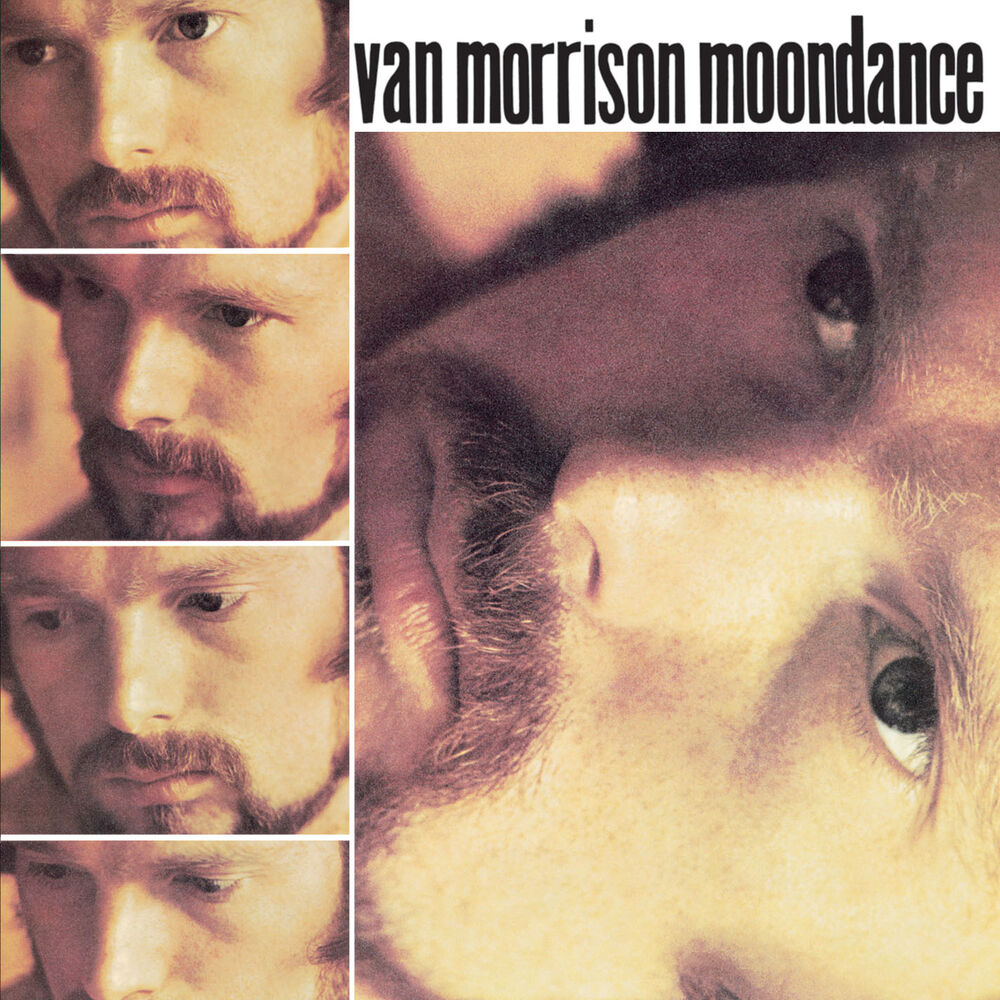
Moondance
- Released18 October 2013
- UK peak No. 32
- Weeks on UK chart 3
- Entered UK chart 12 April 1970
- LabelWarner Records
- Tracks10 · 39 min
2 tracks from it charted as singles. Press a flag to play it in the chart where it peaked.
Tracks
| 1 | And It Stoned Me (2013 Remaster) | 4:32 | |
| 2 | Moondance (2013 Remaster) No. 92 · 1977 | 4:34 | |
| 3 | Crazy Love (2013 Remaster) | 2:35 | |
| 4 | Caravan (2013 Remaster) | 5:00 | |
| 5 | Into the Mystic (2013 Remaster) | 3:25 | |
| 6 | Come Running (2013 Remaster) No. 39 · 1970 | 2:31 | |
| 7 | These Dreams of You (2013 Remaster) | 3:51 | |
| 8 | Brand New Day (2013 Remaster) | 5:10 | |
| 9 | Everyone (2013 Remaster) | 3:32 | |
| 10 | Glad Tidings (2013 Remaster) | 3:40 |
About the album
Moondance is the third studio album by Northern Irish singer-songwriter Van Morrison. It was released on 27 January 1970 by Warner Bros. Records. After the commercial failure of his first Warner Bros. album Astral Weeks (1968), Morrison moved to upstate New York with his wife and began writing songs for Moondance. There, he met the musicians who would record the album with him at New York City's A & R Studios in August and September 1969.
The album found Morrison abandoning the abstract folk jazz compositions of Astral Weeks in favour of more formally composed songs, which he wrote and produced entirely himself. Its lively rhythm and blues/rock music was the style he would become most known for in his career. The music incorporated soul, jazz, pop, and Irish folk sounds into songs about finding spiritual renewal and redemption in worldly matters such as nature, music, romantic love, and self-affirmation.
Moondance was an immediate critical and commercial success. It helped establish Morrison as a major artist in popular music, while several of its songs became staples on FM radio in the early 1970s. Among the most acclaimed records in pop/rock history, Moondance frequently ranks in professional listings of the greatest albums. In 2013, the album's remastered deluxe edition was released to similar acclaim.
Background
After leaving the rock band Them, Morrison met record producer Bert Berns in New York City and recorded his first solo single, "Brown Eyed Girl", in March 1967 for Berns' Bang Records. When the producer unexpectedly died later that year, Morrison was offered a record deal by Warner Bros. Records executive Joe Smith, who had seen the singer perform at Boston's Catacombs nightclub in August 1968. Smith bought out Morrison's Bang contract, and he was able to record his first album for Warner Bros., Astral Weeks, that year. Although it was later acclaimed by critics, its collection of lengthy, acoustic, revelatory folk jazz songs was not well received by consumers at the time and the album proved to be a commercial failure.
After recording Astral Weeks, Morrison moved with his wife, Janet Planet, to a home on a mountain top in the Catskills near Woodstock, a hamlet in upstate New York with an artistic community. According to Planet, he was influenced by Bob Dylan, who had just moved out of town when Morrison arrived. "Van fully intended to become Dylan's best friend", Planet recalled.
Recording and production
Morrison began recording sessions for Moondance at Century Sound in New York, accompanied by most of the musicians from Astral Weeks and its engineer Brooks Arthur. Lewis Merenstein—Moondance's executive producer—had brought in Astral Weeks session musicians Richard Davis, Jay Berliner, and Warren Smith, Jr. for the first session, but Morrison—according to Platania—"sort of manipulated the situation" and "got rid of them all. For some reason he didn't want those musicians." In place of these jazz-influenced musicians were a horn section and chorus enlisted by Morrison, who Merenstein recalled had grown more confident, outspoken, and independent of the producer. Around this time, the singer made it known to Warner Bros. that he would lead production duties for all his future recordings, which forced producers recruited by the label into assisting roles. It also led to frequent enlisting and dismissal of musicians to meet Morrison's creative vision.
Morrison went on to record Moondance at the Studio A penthouse of A & R Studios in New York from August to September 1969.
Music and lyrics
For Moondance, Morrison abandoned the abstract folk compositions of Astral Weeks in favour of rhythm and blues sounds, formally composed songs, and more distinct arrangements that included a horn section and chorus of singers as an accompaniment. The album found Morrison using more traditional melodic figures, which VH1 editor Joe S. Harrington said lent the songs a "rustic and earthy" quality. In Robert Christgau's opinion, Moondance showed the singer integrating his style of Irish poetry into popular song structure while expanding on Astral Weeks' "folk-jazz swing" with lively brass instruments, innovative hooks, and a strong backbeat. The songs were generally arranged around Morrison's horn section; music journalist John Milward called it "that rare rock album" on which the solos were performed by the saxophonist rather than the guitarist. In The Rolling Stone Album Guide (1992), Paul Evans observed upbeat soul music, elements of jazz, and ballads on what he considered a "horn-driven, bass-heavy" record.
Packaging
The album's cover photo was shot at Morrison's home by Elliot Landy, who had previously done the cover for Dylan's 1969 album Nashville Skyline. Landy captured Morrison's face closely and framed the shot to conceal a sizeable pimple the singer had on his forehead the day of the shoot.
Planet wrote the album's liner notes, drawing on the style of fairy tales in narrating Morrison's story; the notes began, "Once upon a time, there lived a very young man who was, as they say, gifted". According to Planet, Warner Bros. encouraged her to help promote him, believing "that my image, precisely because it was so enigmatic, was the perfect visual to describe what was going on musically". In retrospect, she found that "being a muse is a thankless job, and the pay is lousy."
Release and reception
Moondance was released by Warner Bros. on 27 January 1970 in the United Kingdom and on 28 February in the United States, receiving immediate acclaim from critics. Reviewing for The Village Voice in 1970, Robert Christgau gave the album an "A" and claimed that Morrison had finally fulfilled his artistic potential: "Forget Astral Weeks—this is a brilliant, catchy, poetic, and completely successful LP." Greil Marcus and Lester Bangs jointly reviewed the album in Rolling Stone, hailing it as a work of "musical invention and lyrical confidence; the strong moods of 'Into the Mystic' and the fine, epic brilliance of 'Caravan' will carry it past many good records we'll forget in the next few years." Fellow Rolling Stone critic Jon Landau found the singer's vocals overwhelming: "Things fell into place so perfectly I wished there was more room to breathe. Morrison has a great voice and on Moondance he found a home for it." Ralph J.