There's A Riot Goin' On (Expanded Edition)
- Released16 January 2007
- UK peak No. 31
- Weeks on UK chart 2
- Entered UK chart 30 January 1972
- LabelEpic/Legacy
- Tracks16 · 65 min
3 tracks from it charted as singles. Press a flag to play it in the chart where it peaked.
Tracks
| 1 | Luv N' Haight (Single Version) | 4:01 | |
| 2 | Just Like a Baby | 5:12 | |
| 3 | Poet | 3:01 | |
| 4 | 3:05 | ||
| 5 | Africa Talks to You ("The Asphalt Jungle") | 8:43 | |
| 6 | There's a Riot Goin' On (silent) | 0:04 | |
| 7 | Brave & Strong (Single Version) | 3:30 | |
| 8 | (You Caught Me) Smilin' (Single Version) No. 42 · 1972 | 2:53 | |
| 9 | Time | 3:00 | |
| 10 | Spaced Cowboy | 3:55 | |
| 11 | 2:56 | ||
| 12 | Thank You for Talkin' to Me, Africa | 7:15 | |
| 13 | 2:42 | ||
| 14 | My Gorilla Is My Butler (Instrumental) | 3:10 | |
| 15 | Do You Know What? (Instrumental) | 7:14 | |
| 16 | That's Pretty Clean (Instrumental) | 4:12 |
About the album
There's a Riot Goin' On is the fifth studio album by the American funk and soul band Sly and the Family Stone. It was released on November 1, 1971, by Epic Records. The recording was dominated by band frontman-songwriter Sly Stone during a period of escalated drug use and intra-group tension. Recording sessions took place from 1970 to 1971 at Record Plant Studios in Sausalito, California and in Stone's home studio in Bel Air.
With the album, Sly and the Family Stone departed from the optimistic sound of their previous music and explored a darker, more challenging sound featuring edgy funk rhythms, a primitive drum machine, extensive overdubbing, and a dense mix. Conceptually and lyrically, There's a Riot Goin' On embraced apathy, pessimism, and disillusionment with both Stone's fame and 1960s counterculture amid a turbulent political climate in the United States at the turn of the 1970s, influenced by the decline of the civil rights movement and the rise of the Black Power movement. The album's title was originally planned to be Africa Talks to You, but it changed in response to Marvin Gaye's album What's Going On (1971), released six months before Riot.
A commercial success, There's a Riot Goin' On topped the Billboard Pop Album and Soul Album charts, while its lead single "Family Affair" reached number one on the Pop Singles chart.
Background
Having achieved great success with their 1969 album Stand! and performance at Woodstock, Sly & the Family Stone were due to have submitted an album of new recordings to Epic Records by 1970. However, Sly Stone missed several recording deadlines, worrying CBS executive Clive Davis, and a Greatest Hits album was released in an eighteen-month stretch during which the band released no new material, except for the single "Thank You (Falettinme Be Mice Elf Agin)". Relationships within the band were deteriorating, with friction between the Stone brothers and bassist Larry Graham.
Jewish-American manager David Kapralik claimed that the Black Panther Party was urging Stone to replace him with a black manager. After moving to Los Angeles, California, in late 1969, Stone and his bandmates began to use cocaine and PCP heavily rather than recording music. During this time Sly & the Family Stone released only one single, "Thank You (Falettinme Be Mice Elf Agin)" / "Everybody Is a Star", issued in December 1969.
Recording and production
Sly Stone mostly worked on There's a Riot Goin' On alone in a studio that he had built for himself at The Plant Studios, also known as The Record Plant, in Sausalito, California, or at his home studio in the loft of his Bel Air mansion. He would often lie down in the bed and record his vocals with a wireless microphone system. According to the other Family Stone members, most of the album was performed by him alone, overdubbing and sometimes using a drum machine to lay down beats, namely the Maestro Rhythm King MRK-2, which featured preset rhythms. Stone felt that the rhythm box made unrealistic sounds if used as designed, so he resorted to overdubbing the drum sounds manually, contributing to the dense mix.
Other band members contributed by overdubbing alone with Sly instead of playing together as before. For "Family Affair" and some other tracks Stone enlisted several other musicians including Billy Preston, Ike Turner, and Bobby Womack instead of his bandmates, and several female vocalists mostly omitted from the final mix.
Music and lyrics
There's a Riot Goin' On has been described as psychedelic funk, avant-soul, avant-pop, deep funk, and psychedelic soul.
The album departs from the optimistic psychedelic soul sound of the group's 1960s records, instead embracing a darker sound featuring filtered drum-machine tracks. Songs such as "Luv 'n Haight", "Thank You for Talking to Me Africa", and "Spaced Cowboy" are characterized by edgier, unrelenting grooves with rhythmic sounds resembling murmuring noises. Conceptually, Riot embraces apathy as a source for deriving rhythmic and emotional energy, departing from the more welcoming sentiments of songs like "Dance to the Music" (1968).
Artwork
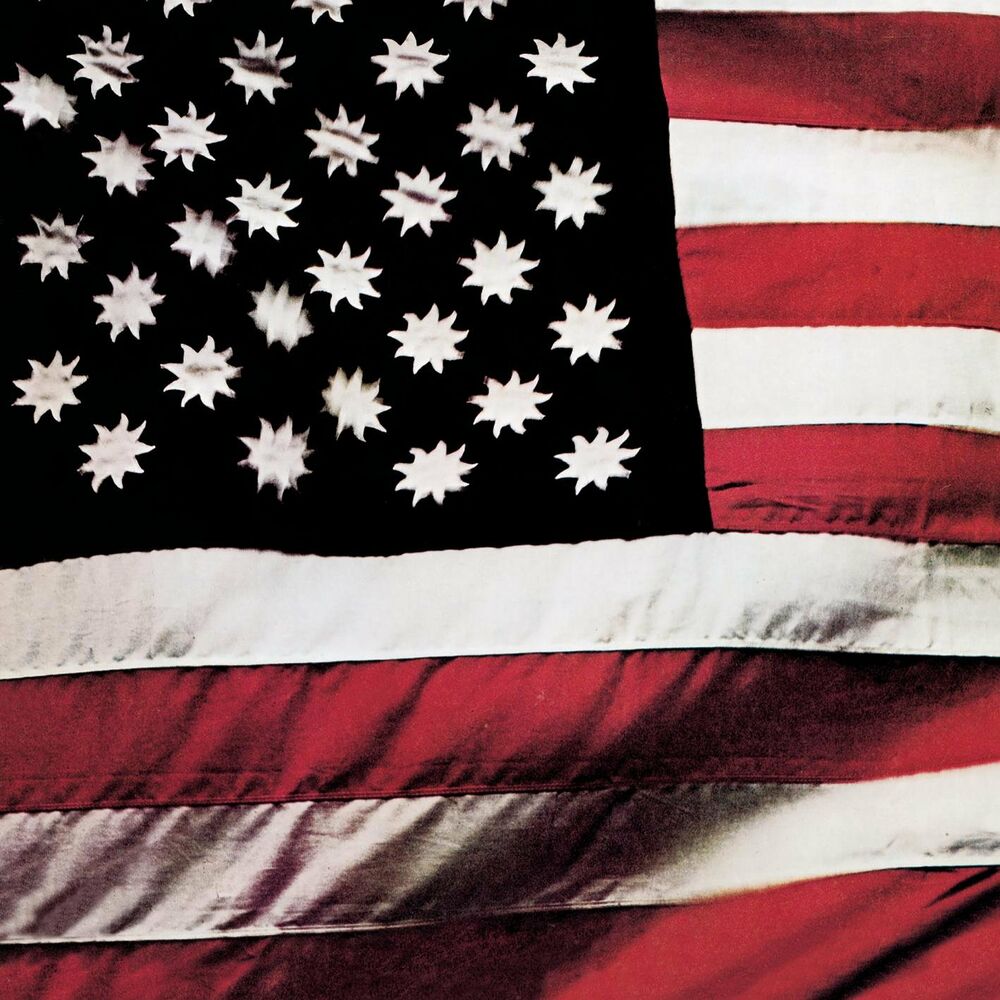
The original cover art for Riot featured a modified version of the flag of the United States, featuring a black canton with nine-point suns in place of a blue canton with five-point stars. No other text or titles appear on the cover, although Epic executives added a "Featuring the Hit Single 'Family Affair'" sticker to the LP for commercial viability and identification purposes. Family Stone A&R director Steve Paley took the photograph. Three of the custom flags were created: one for Sly, one for Epic Records, and one for Paley.
In an interview with Jonathan Dakss, Stone explained the album cover's concept, stating "I wanted the flag to truly represent people of all colors. I wanted the color black because it is the absence of color. I wanted the color white because it is the combination of all colors. And I wanted the color red because it represents the one thing that all people have in common: blood. I wanted suns instead of stars because stars to me imply searching, like you search for your star. And there are already too many stars in this world.
Reception and legacy
There's a Riot Goin' On was met with a divided response from professional critics and general listeners, who found its production and lyrical content particularly challenging. Reviewing in November 1971 for the Los Angeles Times, Robert Hilburn disapproved of the Family Stone's stylistic change from "soulflavored" songs such as "Everyday People" and "Hot Fun in the Summertime", while saying that "there is little on the album that is worth your attention". Fellow critic Greil Marcus called the record "Muzak with its finger on the trigger." Others were more overt in their praise. Rolling Stone reviewer Vince Aletti wrote that, "At first I hated it for its weakness and its lack of energy and I still dislike these qualities. But then I began to respect the album's honesty". Aletti cited it as "one of the most important fucking albums this year" and "the new urban music... not about dancing to the music, in the streets. It's about disintegration, getting fucked up, nodding, maybe dying.