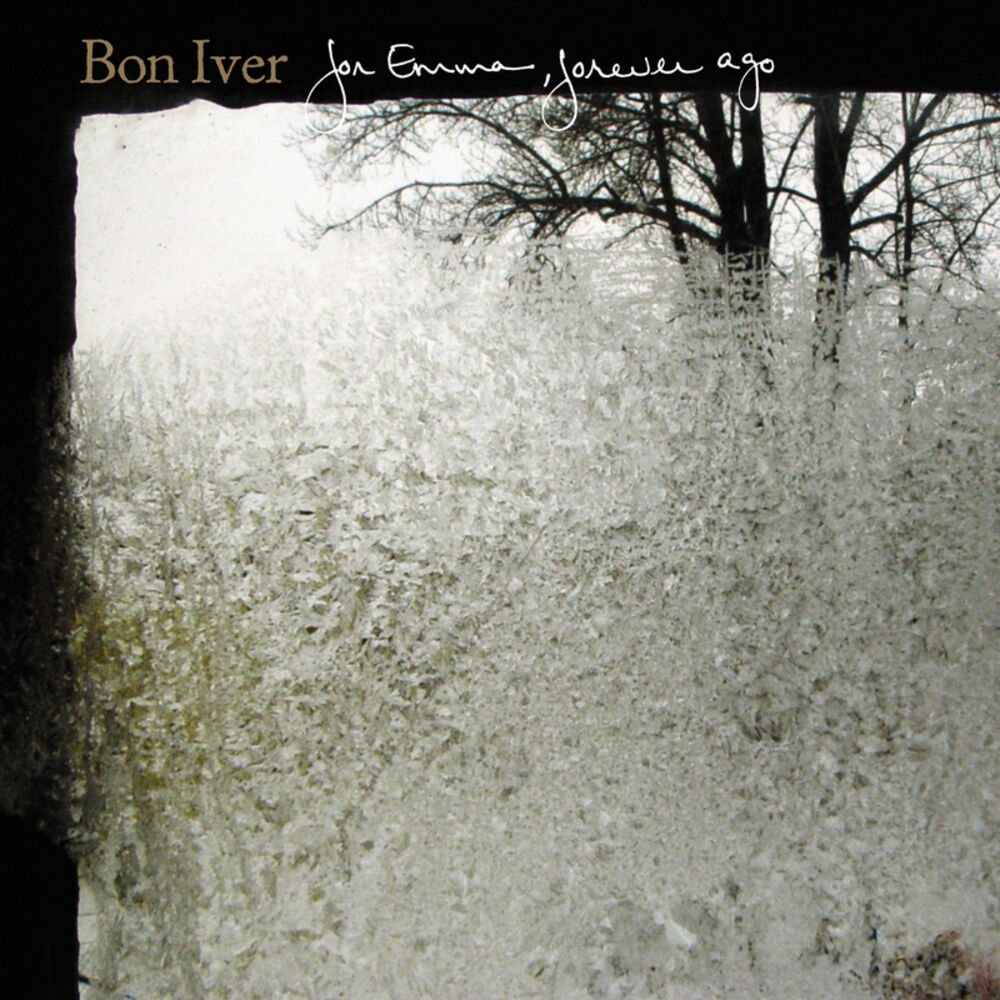
For Emma, Forever Ago
- Released19 February 2008
- UK peak No. 42
- Weeks on UK chart 12
- Entered UK chart 18 May 2008
- LabelJagjaguwar
- Tracks9 · 37 min
Tracks
| 1 | Flume | 3:39 | |
| 2 | Lump Sum | 3:21 | |
| 3 | Skinny Love | 3:59 | |
| 4 | The Wolves (Act I and II) | 5:22 | |
| 5 | Blindsided | 5:29 | |
| 6 | Creature Fear | 3:06 | |
| 7 | Team | 1:57 | |
| 8 | For Emma | 3:41 | |
| 9 | Re: Stacks | 6:41 |
About the album
For Emma, Forever Ago is the debut studio album by American indie folk band Bon Iver. It was first self-released in July 2007, and later saw wide release on the Jagjaguwar label in February 2008. The album is principally the work of singer-songwriter Justin Vernon. While living in Raleigh, North Carolina, Vernon fell ill with mononucleosis and a liver infection, and grew frustrated with his songwriting and life. He left Raleigh and drove to his father's remote hunting cabin an hour northwest of his hometown, Eau Claire, Wisconsin, hoping to be alone.
The album was recorded at the cabin between late 2006 to early 2007. Vernon abandoned his old songwriting methods and instead focused on wordless melodies that he later set to words, which he felt evoked a more subconscious meaning. The record's lyrical subjects include lost love and mediocrity. His folk-infused songs include heavy choral arrangements, featuring Vernon's falsetto, and horns. He hunted his own food and spent much of his time isolated. Though he did not intend to make an album, he received strong encouragements from friends and decided to self-release For Emma, Forever Ago in July 2007.
Background
Justin Vernon was born in Eau Claire, Wisconsin, and grew up pursuing music. He saw the folk duo Indigo Girls in concert in middle school and it proved formative on his life. He attended the University of Wisconsin–Eau Claire (UW–Eau Claire), where he played in a number of bands. One such group, Mount Vernon, consisted of ten members, including saxophonist Sara Jensen, who became his first love. He and Jensen broke up in the middle of his college years, but would remain friends. He studied music theory for a time, as well as jazz, but ended up with a degree in religious studies. DeYarmond Edison became his next musical project, as he graduated from college and relocated to Raleigh, North Carolina, in August 2005. The group chose Raleigh hoping for an adventure and a more vibrant musical scene.
Over the course of his time in Raleigh, he became frustrated with his songwriting as well as his personal life. He worked at a local sandwich shop that he felt took too much time from him.
Recording and production
Vernon drove to his father's hunting cabin, roughly an hour's drive northwest of his hometown. He and his father had often spent weekends at the 80-acre rural property—an area they dubbed "the land"—when he was growing up. In an interview, he described it as "a little Alpine style, timber-frame cabin." The cabin was not necessarily ramshackle; his father had replaced its dirt floor and installed plumbing years before. For roughly three weeks, Vernon sat alone in the shack, drinking beer and watching television. He mulled over thoughts about his relationship with Jensen, a break-up he had struggled to get over. He hunted his food, a practice that he had learned from his father. He killed two deer in his period at the property, which lasted the entire three months "and then some," according to Vernon. At one point, he faced a wild bear that entered the cabin late one night, enticed by his stew. His father would drop by "every 10 days or so," supplying his son with beer, eggs, and cheese. Vernon completed tasks for him, such as stripping wood, clearing brush, and stacking lumber.
Composition and music
For Emma, Forever Ago is a summation of Vernon's life events at the time, ranging from "lost love and longing" to mediocrity. His lyrics on the album aspire to tell stories, which was inspired by musician Bruce Springsteen, and the song structures are unorthodox. He discarded his old method of songwriting, both metaphorically and literally: on one occasion, an old PowerBook crashed, losing dozens of unfinished old songs. Vernon buried the laptop in the snow, later remarking, "They were taken from me but it was good that they were, as it really gave me a new face." Music came first, after which he would create wordless vocal lines. He felt this process brought forth "weird, subconscious melodies and sounds." He considered this method a "back-door way," as they fit more to his unintelligible syllables than words.
He expanded upon this process in a 2008 interview:
I'd go back and record a melody, and then if I liked the first line but didn't like the second line, I'd go back and record syllables of a melody. So I'd have the melody, then I'd double that with the new syllables.
Release
After completing the recordings, Vernon returned to North Carolina to play guitar on tour with The Rosebuds, who toured through that spring. It took several months for him to have thoughts on his recordings, which he viewed as potential demos that he would later re-record. However, Ivan Howard of The Rosebuds convinced him to leave them as is, commenting "This is your record." He consulted friends to listen first before deciding to self-release it. He mixed his recordings himself and with Nick Peterson of Track & Field studios in Chapel Hill, NC then hoping to send them out to labels who would give him an advance to record a "real" album. While at the cabin, Vernon had written to Kelly Crisp of The Rosebuds, concluding his letter with "bon iver," a misspelling of "bon hiver," which is French for "good winter." Its origins lie in an episode of Northern Exposure, wherein two characters greet one another. Crisp encouraged him to name the project Bon Iver.
Critical reception
For Emma, Forever Ago received widespread acclaim from critics. It scored an 88 on review aggregate site Metacritic, based on 27 critics. One of the earliest reviews came from Pitchfork's Stephen M. Deusner, who praised Vernon's "soulful performance," describing the record as "a ruminative collection of songs full of natural imagery and acoustic strums—the sound of a man left alone with his memories and a guitar." Rob Sheffield for Rolling Stone christened it a "quiet marvel," praising Vernon's "light touch, with zero interest in narrative or confessional lyrics." The Guardian's Jude Rogers praised Vernon's restraint, noting, "nothing is overplayed, but nothing feels throwaway either." Steven Hyden of The A.V. Club characterized it as "quietly startling," opining, "The power is in how these songs sound rather than what the opaque lyrics don't quite spell out." Tim Sendra of AllMusic wrote that "For Emma captures the sound of broken and quiet isolation, wraps it in a beautiful package, and delivers it to your door with a beating, bruised heart.