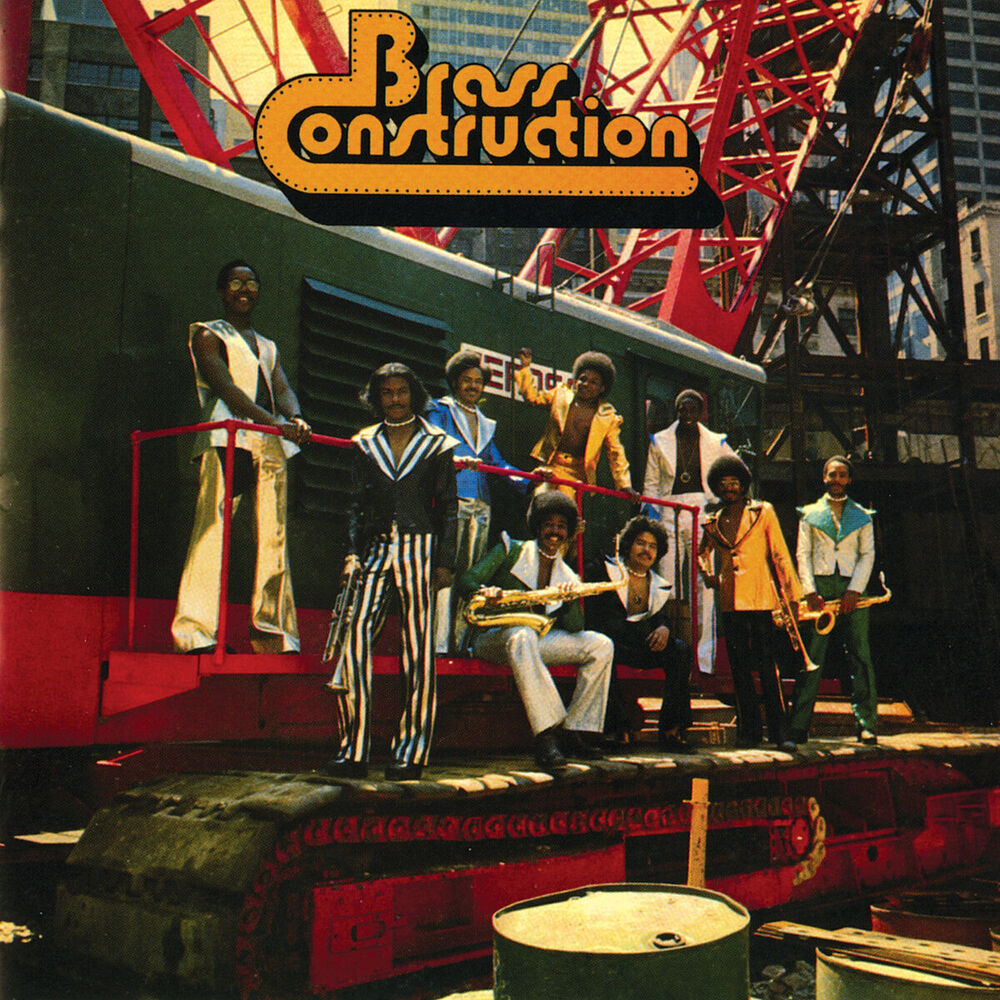
Brass Construction
- Released28 September 2018
- UK peak No. 9
- Weeks on UK chart 11
- Entered UK chart 14 March 1976
- LabelCAPITOL CATALOG MKT (C92)
- Tracks6 · 41 min
One track from it charted as a single. Press a flag to play it in the chart where it peaked.
Tracks
| 1 | 8:41 | ||
| 2 | Peekin' | 3:58 | |
| 3 | Changin' | 8:14 | |
| 4 | Love | 6:37 | |
| 5 | Talkin' | 4:04 | |
| 6 | Dance | 9:43 |
About the album
Brass Construction is the self-titled debut album by the American funk band Brass Construction, released in autumn 1975 by United Artists Records. Recorded with producer Jeff Lane, the album weaves different influences, including Latin music and jazz, into the band's rhythmic funk style, and emphasises the group's brass section. The album's songs, all of which are named using a single verb, feature simplistic, repetitive lyrics, reflecting the group's desire for audiences to interpret the songs as they wish. Critics noted themes of social awareness in the lyrics.
The album's release was delayed due to other projects involving lead member Randy Muller, but proved to be a surprise success, reaching the top ten of the US Billboard albums chart and the UK Albums Chart, where it was the first disco album to do so. It also reached number one on the US Soul chart, while the singles "Movin'" and "Changin'" also proved commercially successful. Music critics acclaimed the album for its tight sound and lyrical simplicity, and it went on to influence the Britfunk movement of the late 1970s and early 1980s. Soul Brothers Records re-released the album in 2010.
Background and recording
Brass Construction formed in Brooklyn, New York under the name The Dynamic Soul in 1967. Originally a rock/R&B quartet under the leadership of Randy Muller, the group gradually expanded until they had become a nine-piece by 1972, with new members bringing influences of jazz and Latin music. Muller felt the enlarged personnel necessitated a name change, so the group renamed themselves Brass Construction, chosen because he believed the group placed a strong emphasis on their brass section "though we keep a tight rhythm going." The group's first single, "Two Timin' Lady", was released in 1972 by Docc, a record label owned by producer Jeff Lane.
Lane was impressed with Muller's musical arranging skills and asked him to provide string arrangements for B.T. Express, a group he had begun producing. Two of the group's songs to feature Muller's arrangements, "Do It ('Til You're Satisfied)" and "Express", became major hits and club favourites, and Muller's innovative arrangements helped the songs pioneer disco music. The success of B.T.
Composition
All six songs on Brass Construction were written by the group, with Muller primarily responsible for five of them. A highly rhythmic album of funk and disco music, the record is dominated by the brass section, while the James Brown-influenced guitar work of Joseph Arthur Wong provides a rhythmic centre. Influences from American, African and Caribbean music, reflecting the diverse nationalities of the band members, are woven into the music. While comparisons were drawn between the disco songs on Brass Construction and B.T. Express, who Muller describes as "a solid funk band," the musician highlighted the influence of other styles of music on Brass Construction, including Latin music and jazz.
Muller originally intended the group to be instrumental, having favoured the horn sections of Kool & the Gang, Chicago and Blood, Sweat & Tears, but the group's label insisted on Muller adding lyrics, so wrote what he described as "some very simple, abstract vocal chants to go with the music." The group described the album's lyrics – the repetition of simple words – as "high abstractions", with M
Release and reception
Due to the lengthy delay that followed recording Brass Construction, the group became sceptical of releasing the album, fearing it would now sound "stale". The album was ultimately released in autumn 1975, and was advertised in the music press by United Artists with the tagline "New York Funk," saying "there's nobody who can ignore the power of the Construction." It proved to be a surprise success, peaking at number ten on the Billboard Top LPs & Tape chart, and spending three weeks at number one on the Billboard Top Soul Albums chart in May 1976, lasting thirteen weeks in the chart overall. The album was not originally released in the United Kingdom, but quickly became a very popular import, to the point where James Hamilton of Record Mirror & Disc called it "possibly the biggest-selling import album of all time." Thus, United Artists rush-released Brass Construction in the UK on March 5, 1976, and it reached number nine on the UK Albums Chart, becoming the first disco album to make the Top 10. The record also peaked at number 55 on the Canadian RPM charts.