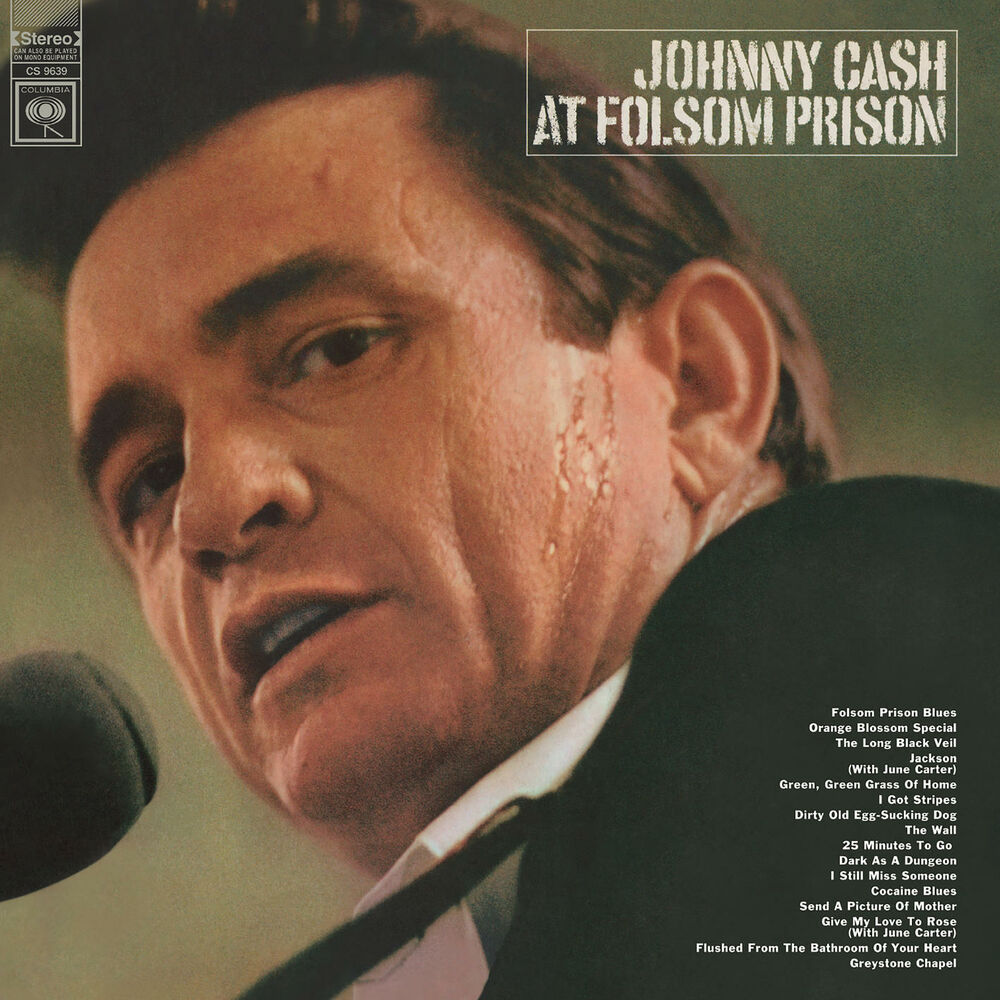
At Folsom Prison
- Released4 March 2014
- UK peak No. 7
- Weeks on UK chart 43
- Entered UK chart 18 August 1968
- LabelColumbia/Legacy
- Tracks16 · 45 min
3 tracks from it charted as singles. Press a flag to play it in the chart where it peaked.
Tracks
| 1 | Folsom Prison Blues (Live at Folsom State Prison, Folsom, CA - January 1968) No. 32 · 1968 | 2:42 | |
| 2 | Dark as the Dungeon (Live at Folsom State Prison, Folsom, CA - January 1968) | 3:04 | |
| 3 | I Still Miss Someone (Live at Folsom State Prison, Folsom, CA 1st Show - January 1968) | 1:38 | |
| 4 | Cocaine Blues (Live at Folsom State Prison, Folsom, CA - January 1968) | 3:03 | |
| 5 | 25 Minutes to Go (Live at Folsom State Prison, Folsom, CA 1st Show - January 1968) | 3:31 | |
| 6 | Orange Blossom Special (Live at Folsom State Prison, Folsom, CA 1st Show - January 1968) No. 80 · 1965 | 3:01 | |
| 7 | The Long Black Veil (Live at Folsom State Prison, Folsom, CA 1st Show - January 1968) | 3:58 | |
| 8 | Send a Picture of Mother (Live at Folsom State Prison, Folsom, CA - January 1968) | 2:10 | |
| 9 | The Wall (Live at Folsom State Prison, Folsom, CA - January 1968) | 1:54 | |
| 10 | Dirty Old Egg-Suckin' Dog (Live at Folsom State Prison, Folsom, CA 1st Show - January 1968) | 1:09 | |
| 11 | Flushed from the Bathroom of Your Heart (Live at Folsom State Prison, Folsom, CA - January 1968) | 2:41 | |
| 12 | Jackson (Live at Folsom State Prison, Folsom, CA - January 1968) | 2:56 | |
| 13 | Give My Love to Rose (Live at Folsom State Prison, Folsom, CA - January 1968) | 2:41 | |
| 14 | I Got Stripes (Live at Folsom State Prison, Folsom, CA 2nd Show - January 1968) No. 43 · 1959 | 1:43 | |
| 15 | Green, Green Grass of Home (Live at Folsom State Prison, Folsom, CA - January 1968) | 3:02 | |
| 16 | Greystone Chapel (Live at Folsom State Prison, Folsom, CA - January 1968) | 5:45 |
About the album
At Folsom Prison is the first live album by American singer-songwriter Johnny Cash, released by Columbia Records on May 6, 1968. It was recorded at Folsom State Prison, California, on January 13, 1968.
After his 1955 song "Folsom Prison Blues", Cash had been interested in recording a performance at a prison. His idea was delayed until 1967, when personnel changes at Columbia Records saw Bob Johnston placed in charge of producing Cash's material. Cash had controlled his drug-abuse problems and was seeking to resuscitate his career after several years of limited success. Backed by June Carter, Carl Perkins and the Tennessee Three, Cash performed two shows at Folsom State Prison.
Despite little initial promotion by Columbia, At Folsom Prison reached number one on the Top Country Charts and the top 15 of the national album chart. The lead single, a performance of "Folsom Prison Blues", was Cash's first top-40 hit since 1964's "Understand Your Man". At Folsom Prison received positive reviews and revitalized Cash's career. At the 11th Annual Grammy Awards in 1969, it won for Best Album Notes, and "Folsom Prison Blues" won for Best Country Vocal Performance, Male.
Cash recorded three more live albums in prisons: At San Quentin (1969), På Österåker (1973) and A Concert Behind Prison Walls (1976).
Background
Johnny Cash became interested in Folsom State Prison, California, while serving in the United States Air Force Security Service. In 1953, his unit watched Crane Wilbur's 1951 film Inside the Walls of Folsom Prison. The film inspired Cash to write a song that reflected his perception of prison life. The result was "Folsom Prison Blues", Cash's second single on Sun Records. The song became popular among inmates, who would write to Cash, requesting him to perform at their prisons. Cash's first prison performance was at Huntsville State Prison in 1957. Satisfied by the favorable reception, he performed at several other prisons in the years leading up to the Folsom performance in 1968.
A few years after attaining commercial success from songs such as "I Walk the Line", "Understand Your Man", and "Ring of Fire", Cash's popularity began to wane, due in part to his increasing dependence on drugs. In 1967, Cash sought help for his escalating drug problems and by the end of the year, began turning his career around.
Recording
On January 10, 1968, Cash and his future wife, singer June Carter, registered at the El Rancho Motel in Sacramento, California. They were later accompanied by the Tennessee Three, Carl Perkins, the Statler Brothers, Johnny's father Ray Cash, Reverend Floyd Gressett, pastor of Avenue Community Church in Ventura, California (where Cash often attended services), who counseled inmates at Folsom and helped facilitate the concert and producer Johnston. The performers rehearsed for two days, an uncommon occurrence for them, sometimes with two or more songs rehearsed concurrently by various combinations of musicians.
One focus of the sessions was to learn "Greystone Chapel", a song written by inmate Glen Sherley. Sherley had previously recorded a version of the song that he sent to Rev. Gressett via the prison's recreation director. During the rehearsals on January 12, California governor Ronald Reagan, who was at the hotel for an after-dinner speech, visited the band and offered his encouragement.
Reception
The album release of At Folsom Prison was prepared in four months. Despite the recent success of "Rosanna's Going Wild", a Cash single released just before the Folsom concerts that reached number two on the Top Country Charts, Columbia initially invested little in the album or its single "Folsom Prison Blues". This was partly because Columbia focused its promotional efforts on pop stars rather than on country artists. However, the single charted on the Billboard Hot 100 on May 25, 1968 and entered the Hot Country Singles chart one week later.
Following the assassination of Robert F. Kennedy on June 5, 1968, some radio stations stopped playing the single because of the line "I shot a man in Reno / Just to watch him die". Columbia withdrew the original single and demanded that Johnston edit out the line. In spite of protests by Cash, the single was edited and reissued with the new version reaching number one on the Hot Country Singles chart and the top 40 on the Hot 100.
Legacy
The success of the album revitalized Cash's career. According to Cash, "That's where things really got started for me again." Sun Records remixed Cash's previous B-side "Get Rhythm" with applause similar to that heard on the album and it reached the Hot 100. Cash returned to the prison scene in 1969 when he recorded At San Quentin at San Quentin State Prison. At San Quentin became Cash's first album to reach number one on the pop chart and produced the number-two hit "A Boy Named Sue". The ensuing popularity from the Folsom concert also prompted ABC to give Cash his own television show.
The album was rereleased on October 19, 1999 including three extra tracks excluded from the original LP: "Busted", "Joe Bean" and "The Legend of John Henry's Hammer". Stephen Thomas Erlewine of AllMusic praised the new version, calling it "the ideal blend of mythmaking and gritty reality." On May 27, 2003, At Folsom Prison was certified triple platinum for shipping more than three million copies.
At Folsom Prison has been cited as one of the greatest albums by several sources.