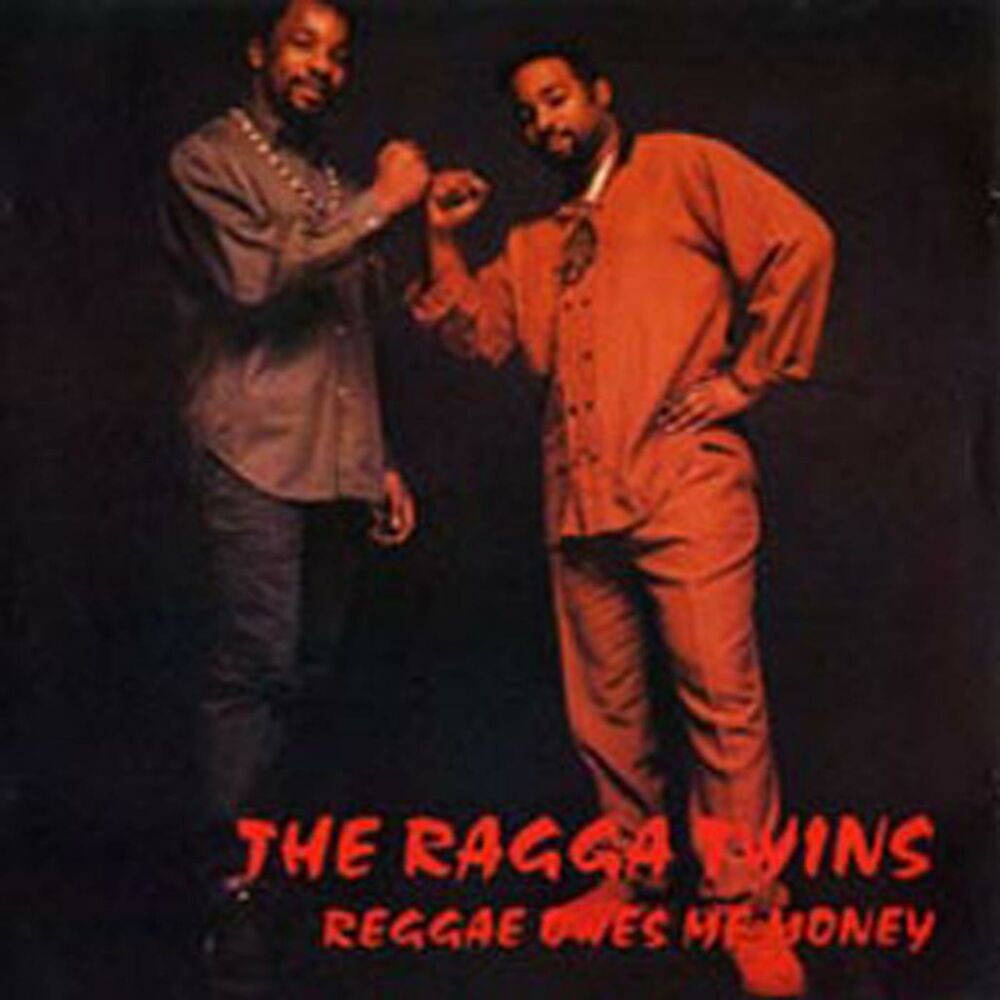
Reggae Owes Me Money
- Released10 April 1991
- UK peak No. 26
- Weeks on UK chart 2
- Entered UK chart 26 May 1991
- LabelShut Up And Dance Music
- Tracks10 · 40 min
4 tracks from it charted as singles. Press a flag to play it in the chart where it peaked.
Tracks
| 1 | The Homeless Problem | 4:01 | |
| 2 | Illegal Gunshot No. 51 · 1990 | 4:05 | |
| 3 | Love Talk | 3:43 | |
| 4 | Hooligan 69 No. 56 · 1991 | 4:08 | |
| 5 | Spliffhead Remix | 4:09 | |
| 6 | The Killing | 3:59 | |
| 7 | Wipe the Needle No. 71 · 1991 | 4:00 | |
| 8 | Ragga Trip No. 76 · 1990 | 4:39 | |
| 9 | 18 Inch Speaker | 3:45 | |
| 10 | Juggling | 3:11 |
About the album
Reggae Owes Me Money is the debut album by British duo the Ragga Twins, produced by hardcore duo Shut Up and Dance and released on the latter's record label of the same name in May 1991. After establishing themselves as dancehall artists from the Unity soundsystem in the 1980s, the Ragga Twins switched direction in the early 1990s, combining into a duo after signing to Shut Up & Dance's label. The production duo stirred the Ragga Twins' change in direction, fusing their previous reggae and dancehall style into the Shut Up & Dance rave dance music.
Aided by the release of several charting singles, Reggae Owes Me Money reached number 26 on the UK Albums Chart. Since its release, it has been recognised as a blueprint for jungle music, which built upon its usage of ragga, reggae basslines and breakbeats. Now hailed as a classic album, most of the album's material was re-released on the Ragga Twins Step Out compilation in 2008. Four years later, Fact ranked it 49th in their list of the best albums of the 1990s.
Background
The Ragga Twins, consisting of brothers David and Trevor Destouche – known as Deman Rockers and Flinty Badman respectively, – began as MCs for Unity, a leading sound system in London. Throughout the 1980s, they separately released music on the soundsystem's Unity label, making digital dancehall music similar in style to labelmate King Jammy. The brothers stayed faithful to the label by turning down offers from other record companies to do "voice things". Nonetheless, they both left decided to leave Unity while at the Shinolas club in Hackney on New Year's Day 1990. The brothers felt that they had spent the 1980s "not going anywhere" and "not being brought into a studio." As a musician, Rockers wanted his music to be available for others to buy, but they felt there was little opportunity. He recalled: "I remember we played against Coxsone, and one of those guys told me if I was on their system I'd be in the studio every week! It was an easy decision to leave Unity and seek new opportunities.
Production and recording
Among the earliest records Shut Up & Dance produced for the Ragga Twins, "Ragga Trip" adapts lyrics Rockers had recorded for the reggae song "Hard Drugs," and criticised the excessive drug use at acid house parties. Subsequent singles were more hardcore in style and included "Spliffhead", "Hooligan 69", "Illegal Gunshot" and "Wipe the Needle." The duo's singles were enthusiastically received on the rave scene. According to music critic Sherman, the team-up between the Ragga Twins and Shut Up & Dance produced a distinctive London dance sound, rooted in ragga but faster and more frenetic, with bleep patterns, rough basslines and "creative" samples, adding that they had created an "underground sound that has seen them gain the utmost respect with almost all their releases."
For Reggae Owes Me Money, the Ragga Twins wanted to prove to Unity "what they could have had," and hence applied an energy and enthusiasm unseen in their Unity work. Flinty Badman recalled: "Back when we started as Ragga Twins it had to work...
Composition
Music journalist Andrew Harrison described Reggae Makes Me Money as an abrasive fusion of ragga and house music, commenting how the Ragga Twins take Shut Up & Dance's style of 'massive' house beats and shameless sampling and moves it into "weird territory." He also felt the duo's unique style of toasting is more reminiscent of "the jambering of a wino than Shabba Ranks' slick chant." According to Lambert, the album's rhythm tracks constitute the record's biggest departure from Jamaican reggae productions, writing: "Between the initial selection of the sounds sampled from records but built up into their own beats, not looped, and the boxy, aggressive EQ, the drums are worlds apart from sundrenched Kingston backbeats." He commented that acid-style bass synth underpins most of the record, particularly on "Wipe the Needles", commenting that the record's sound textures, more than the compositions or lyrics, "conjure up London's boarded-up, grit-in-your-eyes edginess."
Sherman writes that the album touches on social issues, particularly on the opening song, "The Homeless Problem", which fe
Release and reception
The Ragga Twins named the album Reggae Owes Me Money in reference to how they felt they had put so much work into creating reggae music and were not being rewarded for it, commenting that "reggae will always be our first loved music." Dave Jenkins of International DJ Mag elaborated: "It wasn't an ironic or humorous title: after investing 10 years of soundsystem graft and deejay craft with London's Unity Sound, they felt they weren't getting the studio breaks they saw contemporaries such as Tippa Irie or Papa Levi enjoying."
Reggae Owes Me Money was released on 7 May 1991. On 1 June, the album debuted and peaked number 26 on the UK Albums Chart, staying on the chart for five weeks, including two weeks in the top 40. The record also topped the Music Week Dance Albums chart for two weeks, prompting Von's, the studio it was recorded at, to print a congratulations message in Music Week. The reused singles "Ragga Trip" and "Illegal Gunshot" had already charted on the UK Singles Chart in 1990, peaking at numbers 76 and 51 respectively.
Legacy
By fusing the Ragga Twins' reggae with Shut Up & Dance's production style, Reggae Owes Me Money became a blueprint for jungle music, a genre defined by its usage of basslines, breakbeats and ragga, and which Dan Kuper of the New Statesman describes as the first authentic British dance music genre and a direct ancestor to UK garage, grime and dubstep. In the 2018 documentary Bass, Beat and Bars, Flint Badman recalled the album as the link between reggae and jungle, "because it had us doing the reggae chatting, it added the fast sped up breaks, and it blended the two genres together, which now we call jungle." Joe Patrin of Pitchfork wrote that "the Ragga Twins' 1990-92 output, which comprised the majority of their career work until their mid-aughts comeback, lacks the 150+ BPM pace and "Amen" break-chopping most obviously identified with the [jungle] genre by 1994.