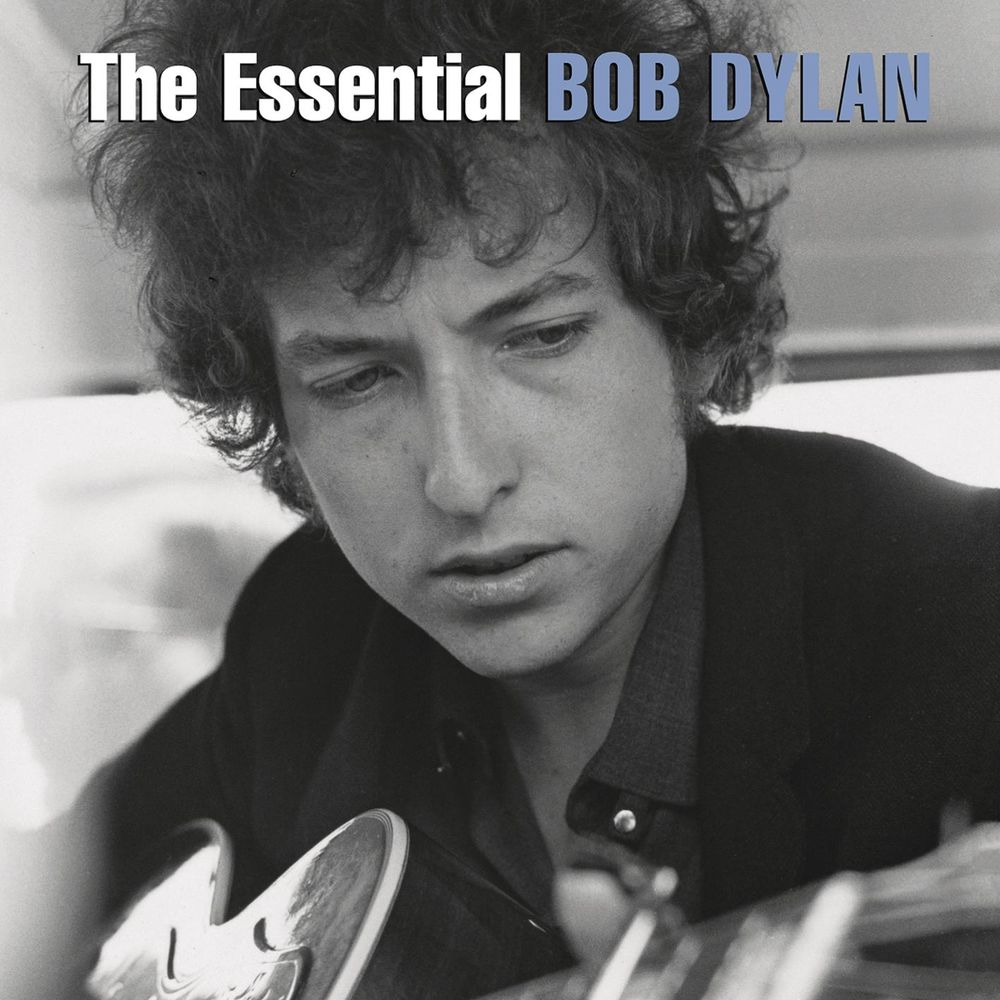
The Essential Bob Dylan
- Released21 March 2014
- UK peak No. 9
- Weeks on UK chart 27
- Entered UK chart 27 May 2001
- LabelColumbia
- Tracks25 · 100 min
13 tracks from it charted as singles. Press a flag to play it in the chart where it peaked.
Tracks
| 1 | Blowin' in the Wind No. 93 · 2009 | 2:47 | |
| 2 | Don't Think Twice, It's All Right | 3:39 | |
| 3 | The Times They Are A-Changin' No. 9 · 1965 | 3:11 | |
| 4 | It Ain't Me Babe | 3:33 | |
| 5 | Maggie's Farm No. 22 · 1965 | 3:55 | |
| 6 | Mr. Tambourine Man | 5:25 | |
| 7 | 2:18 | ||
| 8 | 6:09 | ||
| 9 | 4:07 | ||
| 10 | Just Like a Woman No. 33 · 1966 | 4:50 | |
| 11 | Rainy Day Women #12 & 35 No. 2 · 1966 | 4:34 | |
| 12 | All Along the Watchtower | 2:32 | |
| 13 | Quinn the Eskimo (The Mighty Quinn) (Studio Outtake - 1967) | 2:18 | |
| 14 | I'll Be Your Baby Tonight | 2:38 | |
| 15 | 3:18 | ||
| 16 | If Not for You | 2:41 | |
| 17 | I Shall Be Released (Studio Outtake - 1971) | 3:02 | |
| 18 | You Ain't Goin' Nowhere (Studio Outtake - 1971) | 2:44 | |
| 19 | 2:30 | ||
| 20 | Forever Young (Slow Version) | 4:55 | |
| 21 | Tangled up in Blue No. 31 · 1975 | 5:42 | |
| 22 | 8:32 | ||
| 23 | Ring Them Bells | 3:00 | |
| 24 | Gotta Serve Somebody No. 24 · 1979 | 5:25 | |
| 25 | Jokerman | 6:15 |
About the album
Another Side of Bob Dylan is the fourth studio album by the American singer and songwriter Bob Dylan, released on August 8, 1964, by Columbia Records.
The album deviates from the more socially conscious style which Dylan had developed with his previous LP, The Times They Are A-Changin' (1964). The change prompted criticism from some influential figures in the folk community – Sing Out! editor Irwin Silber complained that Dylan had "somehow lost touch with people" and was caught up in "the paraphernalia of fame".
Despite the album's thematic shift, Dylan performed the entirety of Another Side of Bob Dylan solo, as he had previous records. In addition to his usual acoustic guitar and harmonica, Dylan provides piano on one track, "Black Crow Blues". Another Side of Bob Dylan reached No. 43 in the United States (although it eventually went gold), and peaked at No. 8 on the UK charts in 1965.
A high-definition 5.1 surround sound edition of the album was released on SACD by Columbia in 2003.
Writing
Throughout 1963, Dylan worked on a novel and a play. A number of publishers were interested in signing Dylan to a contract, and at one point, City Lights (a small but prestigious company specializing in poetry) was strongly considered. However, as Dylan worked on his book at a casual pace, his manager, Albert Grossman, decided to make a deal with a major publisher.
Macmillan's senior editor, Bob Markel, said, "We gave [Dylan] an advance for an untitled book of writings ... The publisher was taking a risk on a young, untested potential phenomenon." When Markel met with Dylan for the first time, "there was no book at the time ... The material at that point was hazy, sketchy. The poetry editor called it 'inaccessible.' The symbolism was not easily understood, but on the other hand it was earthy, filled with obscure but marvelous imagery ... I felt it had a lot of value and was very different from Dylan's output till then.
Recording
With Dylan's commercial profile on the rise, Columbia was now urging Dylan to release a steady stream of recordings. Upon Dylan's return to New York, studio time was quickly scheduled, with Tom Wilson back as producer.
The first (and only) recording session was held June 9 at Columbia's Studio A, located at 799 Seventh Avenue in New York City. According to Heylin, "while polishing off a couple of bottles of Beaujolais", Dylan recorded 14 original compositions, in a single three-hour session between 7pm and 10pm that night, 11 of which were chosen for the final album. The three that were ultimately rejected were "Denise Denise", "Mr. Tambourine Man", and "Mama, You Been on My Mind".
Nat Hentoff's article on Dylan for The New Yorker, published in late October 1964, includes remarkable descriptions of the June 9 session.
Reception
As Another Side of Bob Dylan was prepared for release, Dylan premiered his new songs at the Newport Folk Festival in July 1964. The festival also marked Dylan's first meeting with Johnny Cash; Dylan was already an admirer of Cash's music, and vice versa. The two spent a night jamming together in Joan Baez's room at the Viking Motor Inn. According to Cash, "we were so happy to [finally] meet each other that we were jumping on the beds like kids." The next day, Cash performed Dylan's "Don't Think Twice, It's All Right" as part of his set, telling the audience that "we've been doing it on our shows all over the country, trying to tell the folks about Bob, that we think he's the best songwriter of the age since Pete Seeger ... Sure do."
Though the audience at Newport seemed to enjoy Dylan's new material, the folk press did not. Irwin Silber of Sing Out! and David Horowitz criticized Dylan's direction and accused Dylan of succumbing to the pressures/temptations of fame.
Legacy
Years later, mixed reactions over Another Side of Bob Dylan remained but not for the same reasons. Critics later viewed it as a 'transitional' album. Clinton Heylin claimed that "Dylan was simply too close to the experiences he was drawing upon to translate them into art. He was also still experimenting with the imagery found on 'Chimes of Freedom' and 'Mr. Tambourine Man.' 'My Back Pages,' the least successful example of the new style, was replete with bizarre compound images ('corpse evangelists,' 'confusion boats,' etc.)." Salon.com critic Bill Wyman dismissed it as "a lesser, 'relationship' album", but conceded that "Chimes of Freedom" was a "lovely hymn to the 'countless confused, accused, misused, strung-out ones an' worse'."
However, Tim Riley called it "a bridge between folkie rhetoric (albeit superior) and his troika of electric rants ... a rock album without electric guitars, a folk archetype that punches through the hardy, plainspoken mold.