2 tracks from it charted as singles. Press a flag to play it in the chart where it peaked.
Tracks
| 1 | She Has Funny Cars | 3:08 | |
| 2 | Somebody to Love No. 5 · 1967 | 2:54 | |
| 3 | My Best Friend | 2:59 | |
| 4 | Today | 2:57 | |
| 5 | Comin' Back to Me | 5:15 | |
| 6 | 3/5 of a Mile in 10 Seconds | 3:40 | |
| 7 | D. C. B. A.-25 | 2:35 | |
| 8 | How Do You Feel | 3:28 | |
| 9 | Embryonic Journey | 1:52 | |
| 10 | 2:30 | ||
| 11 | Plastic Fantastic Lover | 2:33 | |
| 12 | In The Morning | 6:20 | |
| 13 | J. P. P. Mc Step B. Blues | 2:36 | |
| 14 | Go To Her | 4:01 | |
| 15 | Come Back Baby | 2:55 | |
| 16 | Somebody to Love (Mono Single Version) No. 5 · 1967 | 2:58 | |
| 17 | 5:20 |
About the album
Surrealistic Pillow is the second studio album by the American rock band Jefferson Airplane, released on February 1, 1967, by RCA Victor. It is the first album by the band with vocalist Grace Slick and drummer Spencer Dryden. The album peaked at number three on the Billboard 200 and has been certified Platinum by the Recording Industry Association of America (RIAA). It is considered to be one of the most influential and quintessential works of the early psychedelic rock era and 1960s counterculture.
"My Best Friend" was released as the first single in December 1966 but only reached No. 103 on the Billboard Bubbling Under chart. Two more singles were released in the spring of 1967: "Somebody to Love" and "White Rabbit" peaked respectively at number five and number eight on the Billboard Hot 100 chart and are the band's only Top 40 hits on that chart. "Today" was not released as a single but was played often on college radio and rock stations and remains one of their most popular songs. In 2024, the album was inducted into the National Recording Registry by the Library of Congress for being “culturally, historically, or aesthetically significant”.
Background
Early drummer Alexander "Skip" Spence left the band in mid-1966. He was replaced by Spencer Dryden, an experienced Los Angeles jazz drummer and the half-nephew of Charlie Chaplin. New female vocalist Grace Slick, formerly with another San Francisco rock band The Great Society, joined Jefferson Airplane in October 1966. Slick, Dryden, male lead vocalist-guitarist-songwriter and founder of band Marty Balin, guitarist-vocalist-songwriter Paul Kantner, lead guitarist (and occasional vocalist) Jorma Kaukonen, and bassist Jack Casady formed the core of the best-known line-up of the group, which remained stable until Dryden's departure in early 1970.
Style
The overall style of Surrealistic Pillow has been categorized as "folk-rock-based psychedelia". The material is said to be "both melodic and complex." The style on the album's closing track, "Plastic Fantastic Lover," has been described as "quasi-electronica." The album's fourth track, "Today," has been described as a "delicate ballad". The track "D.C.B.A.-25" contains elements of what is said to be "proto-country-rock" and "3/5 of a Mile in 10 Seconds" contains elements of blues rock.
Title and artwork
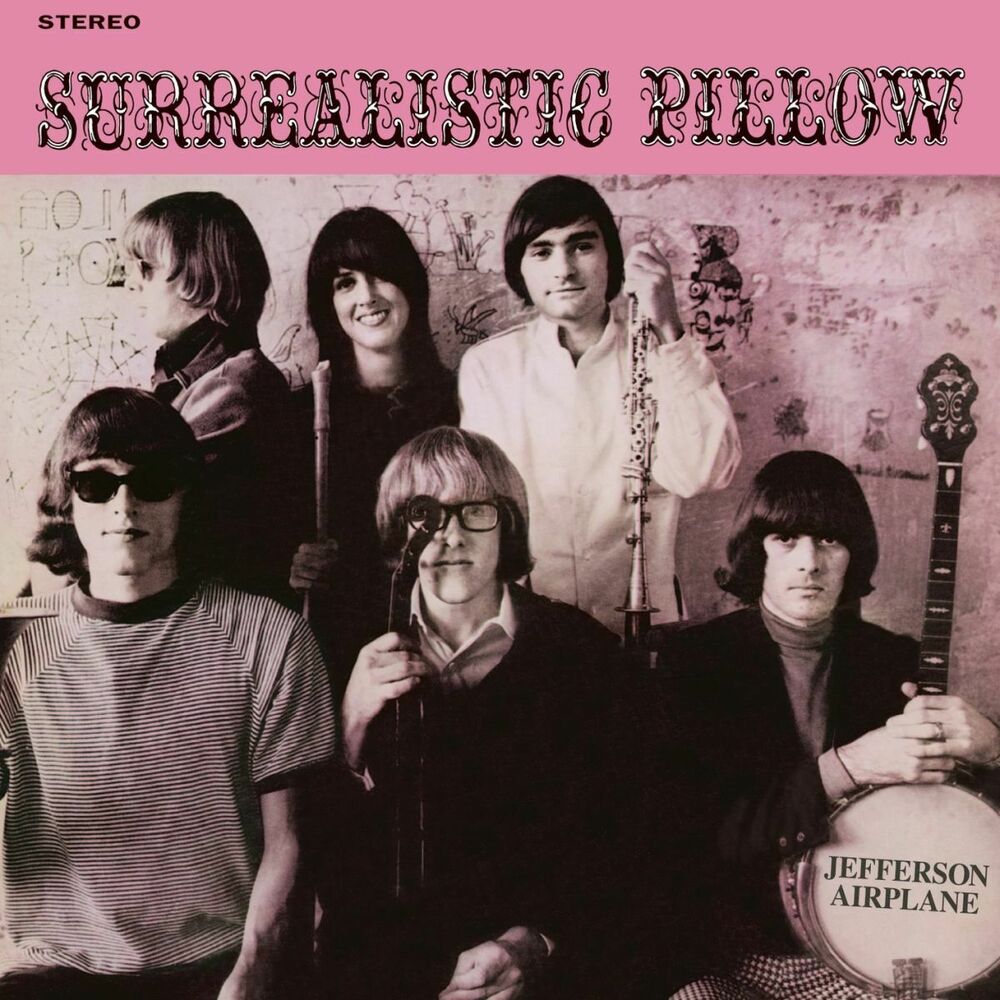
San Francisco photographer Herb Greene photographed the band for the album's cover art in his dining room, whose walls were covered in primitive quasi-hieroglyphics. Marty Balin had wanted the cover tinted in blue but RCA overrode him and chose pink instead, although he liked the change. The back cover was a psychedelic photo collage of the band members picked from shots taken at the same Greene photo session, also assembled by Balin. A comment to Marty by Garcia about the music being "as surrealistic as a pillow" inspired the album title.
Release
The album was initially released on LP record by RCA Victor in different stereo (LSP-3766), and mono (LPM-3766) editions. The stereo mixes include heavier use of reverberation effects than the mono. The mono version was deleted in the late 1960s and remained unavailable until 2001. The first United Kingdom release replaced some original songs with tracks from the group's first US LP, Jefferson Airplane Takes Off.
The album was initially slow to take off until the release of "Somebody to Love" in March. Heavy radio play took the song into the Billboard top 5, aided by the group's first national TV appearances on The Smothers Brothers Comedy Hour on May 7 and American Bandstand on June 3, the former appearance featuring a facsimile of the group's swirling light show, the first time the average American had seen such effects.
Critical reception and legacy
On initial release, the album received positive reviews. Billboard said of "Somebody to Love" that it was a "hard driver, featuring powerful female vocal lead, that never stops from start to finish." Similarly, the magazine said of "White Rabbit" that it was a "change-of-pace number" with "intriguing lyric content and driving beat in strong support". Cash Box wrote of the album that "the LP could easily go all the way to the top of the chart" and "should be especially popular with the teen set". Robert Christgau of The Village Voice gave it a B+ although he critiqued the lyrics, claiming "the sarcasm is as vapid as the optimism".
A live version of "Plastic Fantastic Lover" was released as a single in 1969. Billboard described it as "heavy hard rock". Cash Box wrote that it "features the team's more commercial-than-controversial style" and has "a solid instrumental track and very fine vocal". Record World wrote it was one of the band's favorites.
In subsequent years the reputation of the album has continued to grow.
Reissues
The first compact disc releases were in Japan in 1987 and the U.S. in 1988. A 2001 re-issue by RCA was released as a limited edition gold CD and contained both the stereo and mono recordings. Both mixes were later included as part of the Ignition box set on a standard aluminum CD.
Another stereo reissue appeared on August 19, 2003, with six bonus tracks, including the mono A-sides of "Somebody to Love" and "White Rabbit". The 2003 reissue was produced by Bob Irwin.