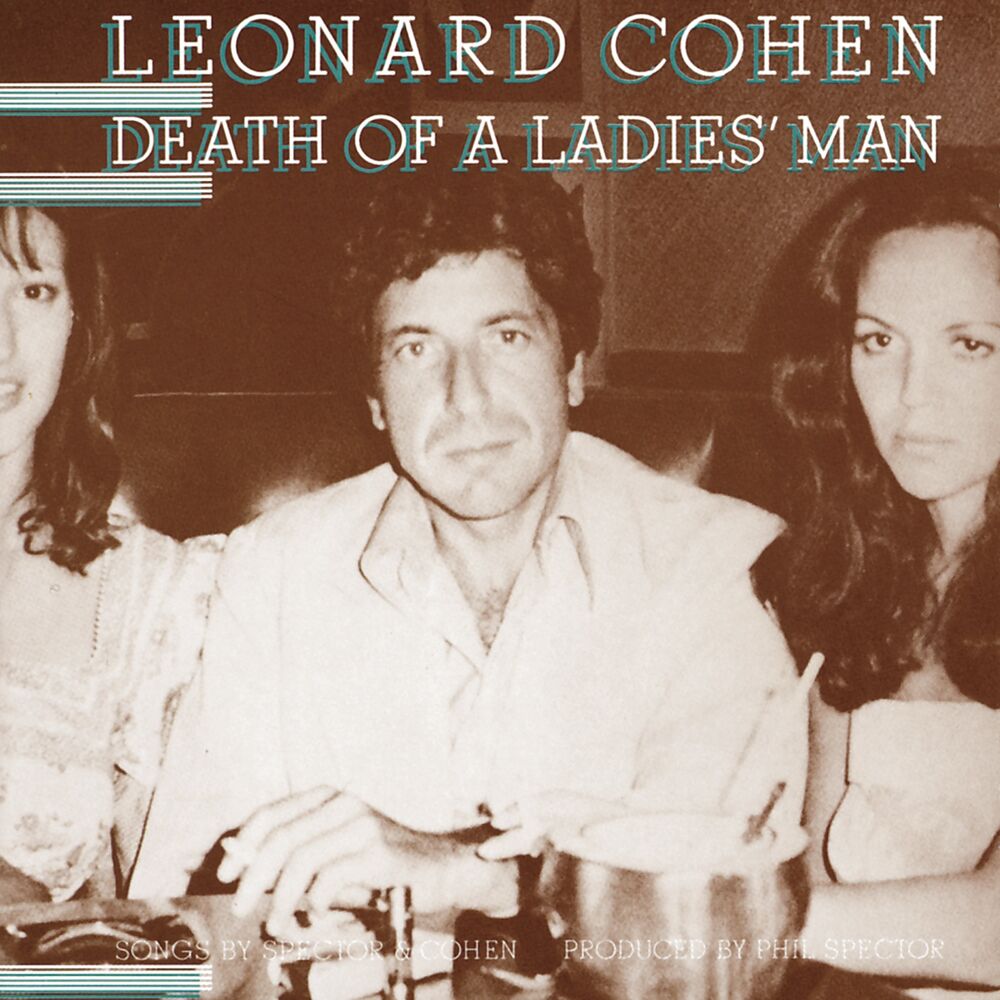
Death Of A Ladies' Man
- Released3 April 2012
- UK peak No. 35
- Weeks on UK chart 5
- Entered UK chart 4 December 1977
- LabelColumbia/Legacy
- Tracks8 · 42 min
Tracks
| 1 | True Love Leaves No Traces | 4:23 | |
| 2 | Iodine | 5:01 | |
| 3 | Paper Thin Hotel | 5:39 | |
| 4 | Memories | 5:56 | |
| 5 | I Left a Woman Waiting | 3:25 | |
| 6 | Don't Go Home With Your Hard-On | 5:33 | |
| 7 | Fingerprints | 2:55 | |
| 8 | Death of a Ladies' Man | 9:20 |
About the album
Death of a Ladies' Man is the fifth studio album by Leonard Cohen, produced and co-written by Phil Spector. The album was in some ways a departure from Cohen's typical minimalist style by using Spector's Wall of Sound recording method, which included ornate arrangements and multiple tracks of instrument overdubs. The album was originally released in the US by Warner Bros., and on CD and the rest of the world by Cohen's longtime label, Columbia Records.
Background
By the mid-1970s, both Cohen and Spector were on a downward slide commercially. Although he remained popular in Europe, Cohen had never achieved the success in the United States that Columbia had hoped for. Spector had created hits such as "Be My Baby" and "You've Lost That Lovin' Feelin'" with his "wall of sound" production technique in the 1960s, and had some success in the early 1970s by producing albums by John Lennon and George Harrison; however, his behavior was increasingly erratic.
As Ira Nadel notes in his 1996 Cohen biography, Various Positions: A Life of Leonard Cohen, stories differ as to how Cohen and Spector became collaborators:
The liner notes on the album state that Marty Machat, who was Spector's lawyer as well as Cohen's, introduced them. According to Cohen, this occurred backstage after one of his performances at the Troubadour in L.A. Spector had uncharacteristically left his well-protected home to see Cohen, and at the show was strangely silent.
Recording
Spector would use three studios for the album, although his favorite remained the Gold Star Studios complex located at 6252 Santa Monica Boulevard near the corner of Vine Street in Hollywood. Spector recruited a plethora of top-shelf Los Angeles studio musicians to play on the songs, including guitarists Dan and David Kessel, drummers Hal Blaine and Jim Keltner, and pedal steel player Al Perkins, among many others. It was precisely in front of an audience, however, that Spector's megalomaniacal switch turned on, and soon Cohen felt overwhelmed. Speaking to Mojo's Sylvie Simmons in 2001, Cohen described his feelings at the time:
It was one of those periods when my chops were impaired, and I wasn't in the right kind of condition to resist Phil's very strong influence on and eventual takeover of the record. There were lots of guns around in the studio and lots of liquor, a somewhat dangerous atmosphere. He had bodyguards who were heavily armed also. He liked guns - I liked guns too but I generally don't carry one, and it's hard to ignore a .45 lying on the console.
Critical reception
Death of a Ladies' Man was released to universal confusion and polarized reviews, leaving many die-hard Cohen fans stunned. In his review for Rolling Stone, Paul Nelson wrote that Death of a Ladies' Man is "either greatly flawed or great and flawed" and observed, "Too much of the record sounds like the world's most flamboyant extrovert producing and arranging the world's most fatalist introvert." Nelson criticized Spector's contributions to the album, such as his Wall of Sound, as "anything but lethal", particularly the track "Memories" that was characterized as a "doo-wop nightmare". The Toronto Star declared in large type, "Leonard Cohen is for Musical Sadists".