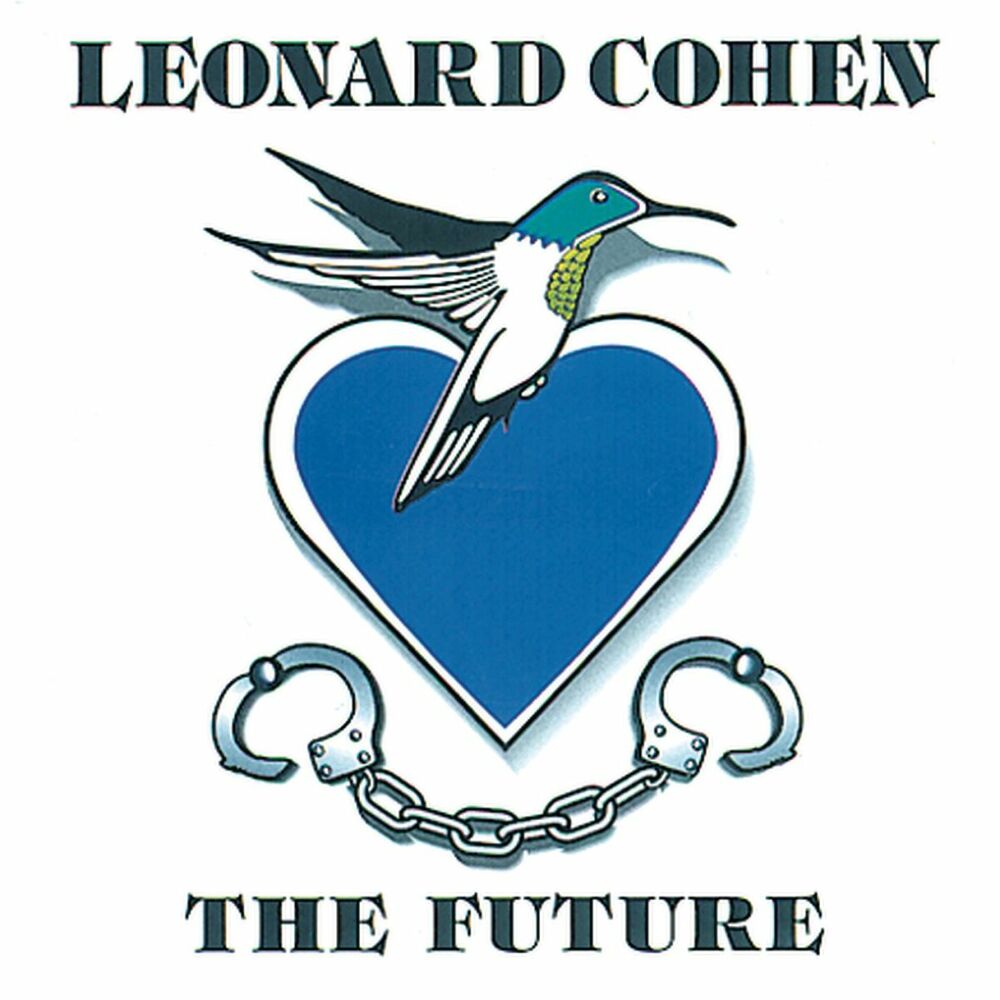
The Future
- Released3 April 2012
- UK peak No. 36
- Weeks on UK chart 3
- Entered UK chart 29 November 1992
- LabelColumbia/Legacy
- Tracks9 · 59 min
Tracks
| 1 | The Future | 6:41 | |
| 2 | Waiting for the Miracle (Album Version) | 7:42 | |
| 3 | Be for Real | 4:29 | |
| 4 | Closing Time | 5:58 | |
| 5 | Anthem | 6:06 | |
| 6 | Democracy | 7:12 | |
| 7 | Light as the Breeze | 7:14 | |
| 8 | Always | 8:02 | |
| 9 | Tacoma Trailer | 5:57 |
About the album
The Future is the ninth studio album by the Canadian singer-songwriter Leonard Cohen, released in 1992. Almost an hour in length, it was Cohen's longest album up to that date. Both the fall of the Berlin Wall and the 1992 Los Angeles riots took place while Cohen was writing and recording the album, which expressed his sense of the world's turbulence. The album was recorded with a large cast of musicians and engineers in several different studios; the credits list almost 30 female singers. The album built on the success of Cohen's previous album, I'm Your Man, and garnered overwhelmingly positive reviews. The Future made the Top 40 in the UK album charts, went double platinum in Canada, and sold a quarter of a million copies in the U.S., which had previously been unenthusiastic about Cohen's albums.
Background
After touring successfully in support of his "comeback" album I'm Your Man (1988), Cohen took a year off to help his son Adam convalesce after a serious car accident in the West Indies left the young man in a coma for four months. Cohen also began a romantic relationship with the actress Rebecca De Mornay. Anthony Reynolds notes in his book Leonard Cohen: A Remarkable Life that work on Cohen's ninth studio album "was not forged in one concentrated effort. The number of studios used ran into double figures and was spread between Montreal and Los Angeles, although the original plan was to record it in Montreal only, with the same personnel that had worked on I'm Your Man. The cast brought to bear on the album was more akin to a movie production and included both a choir and an orchestra..." The songwriting process had not gotten easier for Cohen over the years; in an interview with Q, the singer admitted, "I've never found it easy to write. Period. I mean, I don't want to whine about it or anything but...it's a bitch! It's terrible work.
Composition
According to Ira Nadel's 1996 Cohen memoir Various Positions, the title track was originally called "If You Could See What's Coming Next", and underwent extensive rewrites, taking up almost sixty pages in Cohen's notebook, while "Closing Time" took two years with Cohen even starting over from scratch on the song as late as March 1992. Nadel also reveals that "Anthem" was borrowed from Kabbalistic sources, especially the sixteenth-century rabbi Isaac Luria. In the Paul Zollo book Songwriters on Songwriting, Cohen explains that it takes him so long to finish songs because "Nothing works. After a while, if you stick with the song long enough it will yield. But long enough is way beyond any reasonable estimation of what you think long enough may be...'Anthem' took a decade to write. And I've recorded it three times. More." This is borne out by the fact that some of the lyrics already appear in the song "The Bells" from the soundtrack of the 1986 film Night Magic.
Reception
The album charted as high as No. 36 in the UK and was phenomenally successful in Canada, going gold, platinum, and double-platinum. Cohen also won the Canadian Juno Award for Best Male Vocalist in 1993 for The Future. In his acceptance speech, he quipped, "Only in Canada could somebody with a voice like mine win Vocalist of the Year." The music video for Cohen's song "Closing Time" also won the Juno Award for Best Music Video in 1993. In the original Rolling Stone review, Christian Wright called the album "epic", enthusing "The Future might as easily have been a book: A more troubling, more vexing image of human failure has not been written." Christopher Fielder of AllMusic calls the LP "one long manifesto calling all to challenge the concepts of righteousness and despair in our modern world." In 2010 biographer Anthony Reynolds called The Future "classic big budget AOR yet with lyrics by Lorca, Bukowski and Lowell, sung by an old wino from Skid Row who really wanted to sound like Ray Charles at the Apollo."