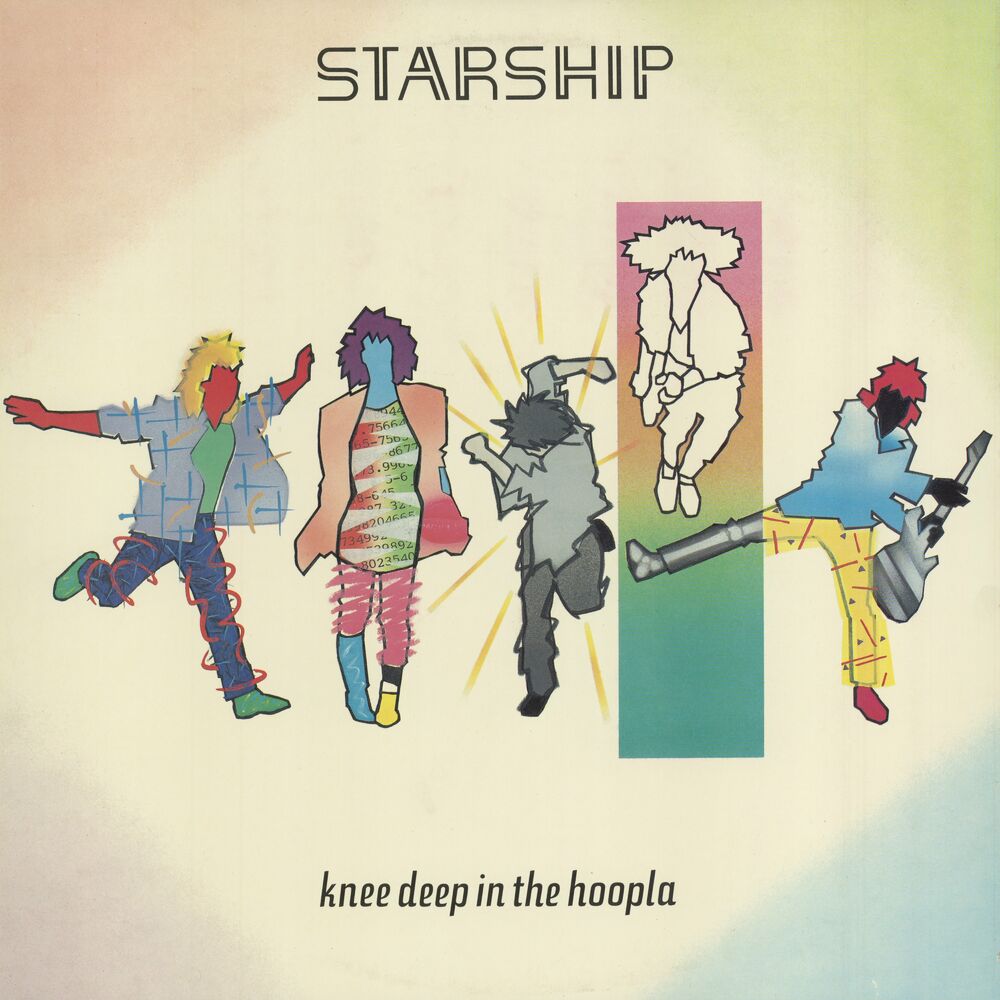
4 tracks from it charted as singles. Press a flag to play it in the chart where it peaked.
Tracks
| 1 | 4:56 | ||
| 2 | 4:52 | ||
| 3 | Tomorrow Doesn't Matter Tonight No. 26 · 1986 | 3:41 | |
| 4 | Rock Myself to Sleep | 3:27 | |
| 5 | Desperate Heart | 4:05 | |
| 6 | Private Room | 4:50 | |
| 7 | Before I Go No. 68 · 1986 | 5:14 | |
| 8 | Hearts Of the World (Will Understand) | 4:23 | |
| 9 | Love Rusts | 4:58 |
About the album
Knee Deep in the Hoopla is the debut studio album by American rock band Starship. It was released on September 10, 1985, through Grunt Records and RCA Records.
The album spawned four singles which all charted in the Billboard Hot 100 chart: the No. 1 hits "We Built This City" and "Sara", "Tomorrow Doesn't Matter Tonight" (No. 26) and "Before I Go" (No. 68).
Background
In May 1984, Jefferson Starship released Nuclear Furniture. Paul Kantner, one of the band's founding members, left shortly after, criticizing the group's tilt toward commercial rock. In October, he sought to dissolve the band and sued his former bandmates over the ownership of its name. The lawsuit was settled in March 1985 with the agreement that the "Jefferson Starship" name would be retired by the group in favor of "Starship", a name now owned by singer Grace Slick and manager Bill Thompson.
Shortly after the new group's creation, David Freiberg (another Jefferson Starship founding member) departed as well. For the band's debut album, the lineup was reduced to a quintet consisting of singer Grace Slick, co-lead singer Mickey Thomas, guitarist Craig Chaquico, bassist Pete Sears, and drummer Donny Baldwin.
Recording and production
Peter Wolf, who had worked on Nuclear Furniture, was hired to produce Knee Deep in the Hoopla. As the band sought a new, radio relevant sound, Wolf brought novel recording techniques. Among these was the use of the Synclavier, which guitarist Craig Chaquico later described as "cutting edge," adding that despite the changes, the group did not feel like they were "selling out," but rather felt like "they were trying to land a man on the moon." However, short-term member David Freiberg recalled in a 1997 interview that one of the reasons for his departure was that in the studio "nobody in the band was playing anything" as it was all about "producing" and "hot stuff keyboard players."
For the album, Wolf also sourced material from a wide variety of outside songwriters, which was said to have made the group more "unified and focused". This was an important change from the old lineup's previous albums, as the songs were primarily written by its members. "We Built This City" was the first product from these new recording efforts and the album's lead single.
Release
Knee Deep in the Hoopla was released on September 10, 1985, through RCA and Grunt. Four singles were released from the album, which all charted on the US Billboard Hot 100 chart: the No. 1 hits "We Built This City" and "Sara", the No. 26 hit "Tomorrow Doesn't Matter Tonight" (peaked at No. 26), and the No. 68 "Before I Go". Knee Deep in the Hoopla was certified platinum by the RIAA on 27 December 1985.
On 22 September 2023, Knee Deep in the Hoopla was reissued as part of the limited-edition "Rhino Reds" series, launched in celebration of Rhino's 45th anniversary. The album was pressed on translucent red vinyl at Third Man and mastered by Jeff Powell. This release also included "Casualty" as a bonus track and was accompanied by a bonus 7" single featuring "We Built This City" and "Private Room".
Critical reception
Joseph McCombs of AllMusic retrospectively described Knee Deep in the Hoopla as the Jefferson Airplane/Jefferson Starship/Starship project's "most overtly commercial effort to date." He noted that the album's songs "are pleasant but lightweight" and that while they "are less than memorable, they are very tuneful and melodic." McCombs highlighted "Love Rusts" as the standout cut.
On 7 September 1985, Cashbox stated that "We Built This City" was a "must-add," describing it as an "ear-catching" and "bouncy" song that was "dance rock with sharp hooks" for Contemporary hits radio. On September 21, the magazine said that Knee Deep in the Hoopla was "rich in commercial potential and musical satisfaction," observing that it placed emphasis on "melodic, pop songwriting" and the "vocal interplay" of Slick and Thomas.