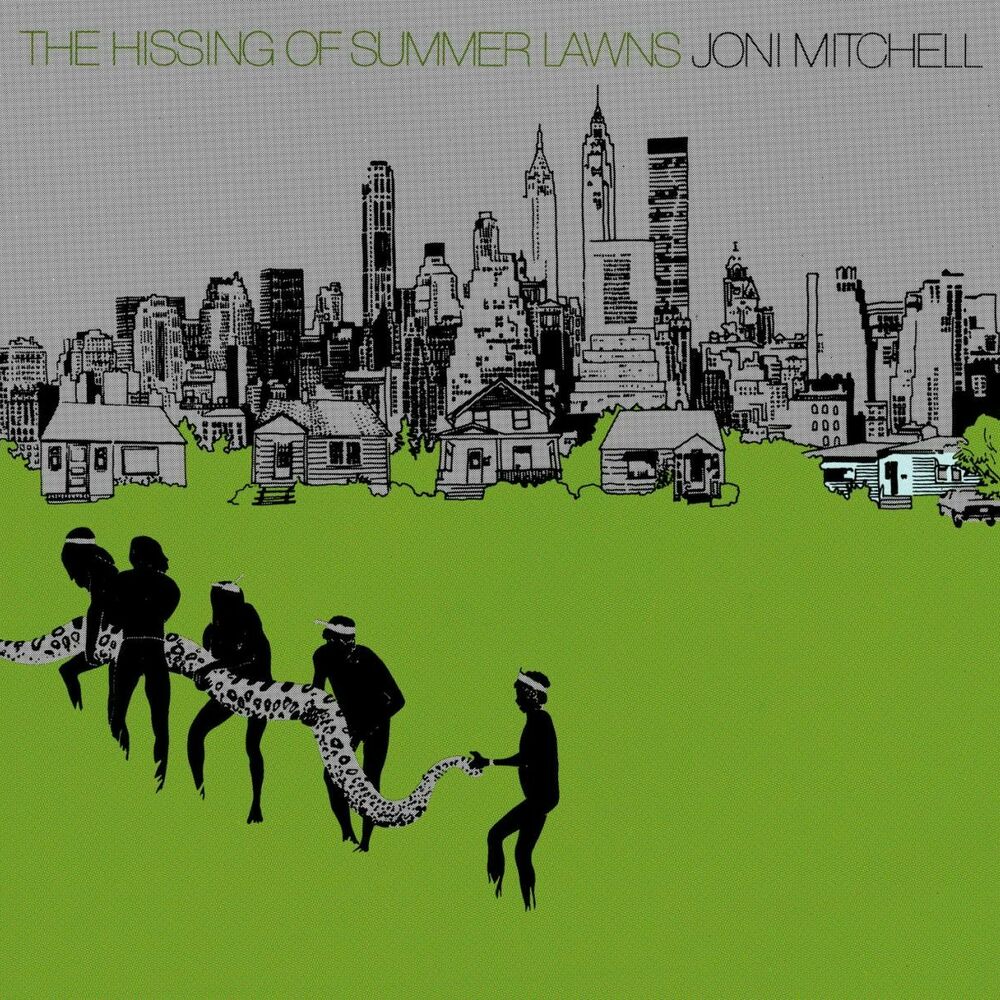
The Hissing of Summer Lawns
- Released5 November 2007
- UK peak No. 14
- Weeks on UK chart 10
- Entered UK chart 21 December 1975
- LabelRhino/Elektra
- Tracks10 · 42 min
One track from it charted as a single. Press a flag to play it in the chart where it peaked.
Tracks
| 1 | In France They Kiss on Main Street No. 66 · 1976 | 3:19 | |
| 2 | The Jungle Line | 4:24 | |
| 3 | Edith and the Kingpin | 3:35 | |
| 4 | Don't Interrupt the Sorrow | 4:04 | |
| 5 | Shades of Scarlett Conquering | 4:57 | |
| 6 | The Hissing of Summer Lawns | 3:01 | |
| 7 | The Boho Dance | 3:50 | |
| 8 | Harry's House / Centerpiece | 6:48 | |
| 9 | Sweet Bird | 4:11 | |
| 10 | Shadows and Light | 4:17 |
About the album
The Hissing of Summer Lawns is the seventh studio album by the Canadian singer-songwriter Joni Mitchell, released in November 1975 on Asylum Records. It continues the jazz-rock influence of Mitchell's previous album, Court and Spark, with more unconventional and experimental material. It features backing from members of jazz-rock groups L.A. Express and The Crusaders, with additional contributions from James Taylor, David Crosby, and Graham Nash. It also introduced synthesizers (Moog and ARP) to Mitchell's work for the first time, as well as experimenting with sampling.
The lyrics focus on women's experiences with patriarchal norms, male dominance, and suburban life, as well as on culture and the music industry. As with many of her albums, Mitchell created the cover art. It depicts a painting of a group of men carrying a large snake superimposed over the Beverly Hills suburbs; Mitchell's house is shaded in blue.
While it did not spawn a major hit single like its predecessor, The Hissing of Summer Lawns reached number 4 in the US and remains Mitchell's last top-10 album. "In France They Kiss on Main Street", the only single, reached number 66 on the Billboard Hot 100.
The Hissing of Summer Lawns initially received negative reviews, with critics finding the jazz stylings a disservice to Mitchell's lyrics and comparing it negatively to Court and Spark.
Background
The slick jazz-pop sound Mitchell developed on Court and Spark (1974) would be pushed into more adventurous territory on The Hissing of Summer Lawns. Some tracks reflect a fusion of jazz and "shimmering avant-pop". The album also features an ARP synthesizer and African drums.
On "The Jungle Line", Mitchell is credited with the first commercially released song to include a sample, featuring a looped recording of percussion by the African ensemble The Drummers of Burundi. This interest in world music presaged the work of Peter Gabriel and Paul Simon in subsequent years. In a 1983 interview for Musician Magazine Mitchell was asked what prompted her to use the drums. Mitchell explained: "Because I loved that Burundi warriors passage. It had a Bo Diddley lick in it which I took out and made into a loop and then ran this black cultural poem under it. I thought I was black for about three years.
Reception
The album initially received harsh criticism. In Rolling Stone, Stephen Holden wrote that the album's lyrics were impressive but the music was a failure. "If The Hissing of Summer Lawns offers substantial literature, it is set to insubstantial music... Four members of Tom Scott's L.A. Express are featured on Hissing, but their uninspired jazz-rock style completely opposes Mitchell's romantic style... The Hissing of Summer Lawns is ultimately a great collection of pop poems with a distracting soundtrack. Read it first. Then play it." Critic Robert Christgau called the musical accompaniment "the most ambitious of her career," but criticized Mitchell's choice of session musicians and opined that "only on a couple of cuts — 'The Jungle Line' and 'Don't Interrupt the Sorrow' — do these skillful sound effects strengthen the lyrics. The result is that Mitchell's words must stand pretty much on their own."
The record's reputation has grown in stature over the years.
Accolades
In 1977, at the 19th Grammy Awards, Mitchell was nominated for the Grammy Award for Best Female Pop Vocal Performance for the album.
It was voted number 217 in the third edition of Colin Larkin's All Time Top 1000 Albums (2000). The album was included in Robert Dimery's 1001 Albums You Must Hear Before You Die. in 2020, Rolling Stone ranked the album at number 258 in the 2020 edition of its 500 greatest albums of all time.