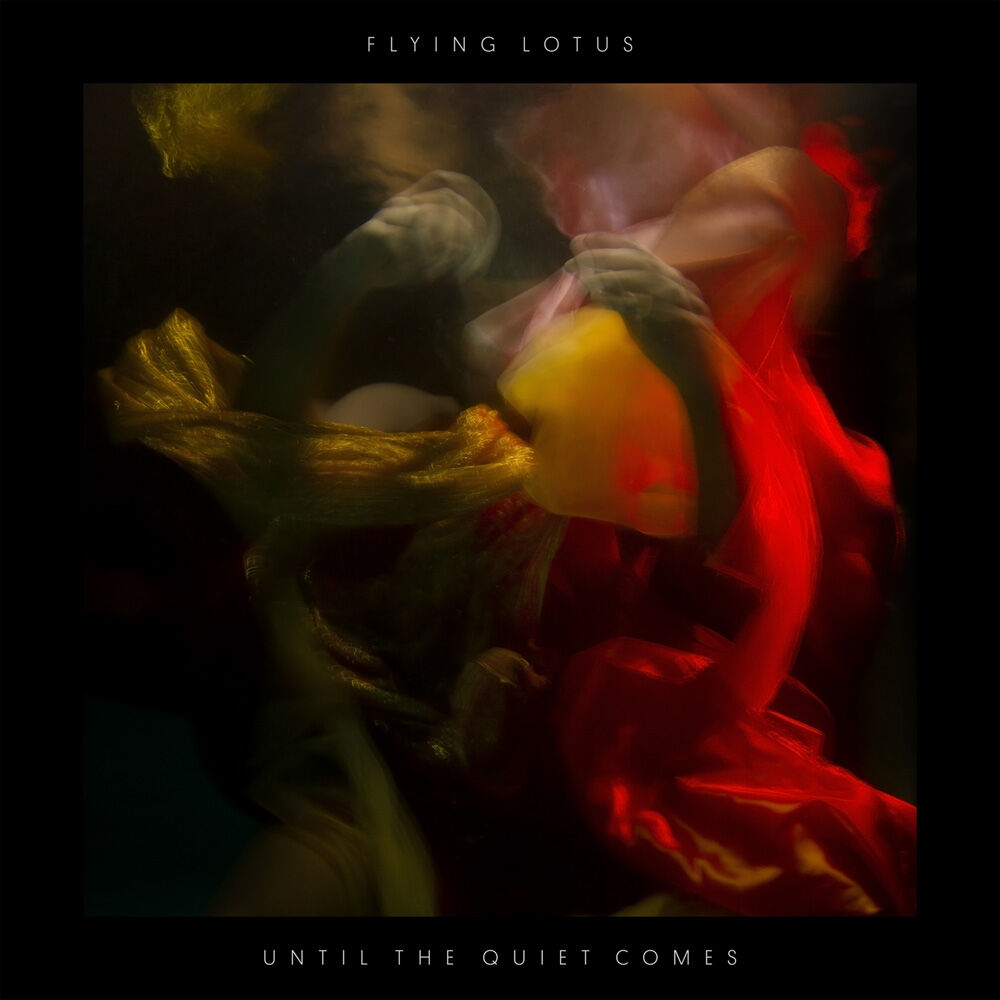
Until The Quiet Comes
- Released1 October 2012
- UK peak No. 34
- Weeks on UK chart 1
- Entered UK chart 7 October 2012
- LabelWarp Records
- Tracks18 · 47 min
Tracks
| 1 | All In | 2:58 | |
| 2 | Getting There (feat. Niki Randa) | 1:49 | |
| 3 | Until The Colours Come | 1:07 | |
| 4 | Heave(n) | 2:22 | |
| 5 | Tiny Tortures | 3:03 | |
| 6 | All The Secrets | 1:56 | |
| 7 | Sultan’s Request | 1:41 | |
| 8 | Putty Boy Strut | 2:53 | |
| 9 | See Thru To U (feat. Erykah Badu) | 2:24 | |
| 10 | Until The Quiet Comes | 2:40 | |
| 11 | DMT Song (feat. Thundercat) | 1:19 | |
| 12 | The Nightcaller | 3:28 | |
| 13 | Only If You Wanna | 1:42 | |
| 14 | Electric Candyman (feat. Thom Yorke) | 3:32 | |
| 15 | Hunger (feat. Niki Randa) | 3:39 | |
| 16 | Phantasm (feat. Laura Darlington) | 3:51 | |
| 17 | me Yesterday//Corded | 4:39 | |
| 18 | Dream To Me | 1:36 |
About the album
Until the Quiet Comes is the fourth studio album by American electronic music producer Flying Lotus, released on September 26, 2012 by Warp Records. Flying Lotus was inspired to create the album by psychedelic music, African percussion, and concepts of the human subconscious and dream world. He recorded for two years at his home in Los Angeles, experimenting with different mixing techniques and dynamics while primarily using an Ableton Live sequencer along with other instruments and software. The producer was accompanied on certain songs by guest vocalists, including Erykah Badu, Thom Yorke, and Laura Darlington. The album also continued his creative partnership with bassist Thundercat, who had appeared on Flying Lotus' 2010 record Cosmogramma.
An electronic jazz album, Until the Quiet Comes features free jazz elements, varying musical tones, contrasting scales, and shifts in rhythmic feel. Its songs are sequenced together and characterized by what music journalists noted to be ghostly vocal production, irregular drum beats, pulsating percussive textures, trembling basslines, trilled synthesizers, and fluctuating samples. The album has a journey-like concept and dreamy musical narrative, which Flying Lotus conceived while imagining himself in the process of astral projection.
Background
In 2010, Flying Lotus released his third album Cosmogramma to critical acclaim and mainstream exposure. He recorded the album while grieving his mother's death, and titled it as a reference to his late great-aunt Alice Coltrane. The album showcased his dense, loose mix of electronic and live instrumentation with avant-garde jazz, dance, and hip-hop influences. During its recording, he developed a creative relationship with contributing bassist Thundercat, a member of his Brainfeeder record label. They continued working together on Flying Lotus' 2010 EP Pattern+Grid World, which continued the dense electronic style of Cosmogramma. They developed more musical ideas together, from which Flying Lotus culled and produced for Thundercat's debut album The Golden Age of Apocalypse in 2011.
For Until the Quiet Comes, Flying Lotus was inspired by African percussion music and psychedelic bands such as Silver Apples, Can, Stereolab, Portishead, and Gentle Giant.
Recording and production
Flying Lotus started working on Until the Quiet Comes at his home in Mount Washington, Los Angeles, which featured more acoustic space than his previous residence in Echo Park. He recorded the album for two years, using a spacious room there as a recording studio. He revisited scrapped ideas from the sessions for Thundercat's debut album and revised their direction for Until the Quiet Comes. The song "Hunger" developed from a demo he had recorded for the soundtrack to one of the Twilight films, and "Sultan's Request" was performed live by Flying Lotus for three years before the album. For "Electric Candyman", he used a beat he had prepared for sessions that ultimately fell through with Burial, and he used a five-year-old recording with Samiyam for the second half of "The Nightcaller".
Flying Lotus recorded Until the Quiet Comes in a three-part process—first composing rough drafts for songs, then refining them for several months with additional instrumentation to make them substantial, and finally mixing the songs for a cohesive album.
Music
Until the Quiet Comes is characterized by varying musical tones, contrasting scales, both consonant and dissonant sounds, counterpoint, and shifts in feel. Its complex, diverse soundscapes deviate from popular music song forms and employ contrast and improvisational adjustments in mood, structure, and time signature. Darryl Kirchner of The Huffington Post notes an emphasis on timbre throughout the album. Mark Richardson of Pitchfork observes Flying Lotus "putting a smaller frame around each individual part" throughout the album's shifts and finds the "energy" to be "just as strong" as on his previous albums, but "concentrated into a smaller space." Although he finds it less "imposing" than its predecessor, Thomas May of musicOMH comments that "Until the Quiet Comes is like a chamber concerto to Cosmogramma's symphony", noting "an increased sense of space and separation" on the former.
Songs on the album incorporate ghostly vocal production, winding basslines, uptempo drum-and-bass fills, broad orchestral elements, pulsating percussive textures, bright keyboards, trilled synthesizers,
Concept and interpretations
Until the Quiet Comes has been described by Uncut and Mojo as having a dreamy musical narrative; the latter magazine said it is, "quite literally, a dream album". Andy Beta from Spin likened it to the "dreams within dreams within dreams" concept from the 2010 film Inception. Karen Lawler of State said "if the limbo between awake and sleeping, dreams and nightmares could be expressed through music, this album might well be it." Jeff Weiss, writing in LA Weekly, felt the record had a loose concept that "surrounds the nocturnal visions of a child lost in spacedust dreams" and likens it to a narcotic film in the vein of Little Nemo and Michel Gondry, writing that "swirling voices seem like clouds communing. Snare crashes mimic obscene villains. Hard beats propel chase scenes. Basslines gurgle like goofy dancing sidekicks. Erykah Badu plays the all-powerful good witch.
Marketing and sales
Two singles were released to promote Until the Quiet Comes, beginning with "See Thru to U" on August 16, 2012, as a digital download on iTunes. It was accompanied by the release of an abstract music video online. On September 17, Flying Lotus released a teaser video called Small Moments, in which previews of the album's songs were accompanied by mysterious, botanical imagery. "Putty Boy Strut" was released on September 19 with an accompanying animated, robot-themed video by Cyriak. A music video for "Tiny Tortures" was released on November 29 and featured Elijah Wood playing a depressed man without a right arm who envisions objects in his room recreating his arm, but is revealed to be torturing himself.
A short film promoting the album was released on September 6, 2012. It was titled after the album and directed by Kahlil Joseph, who shot it in 35 mm film at the Nickerson Gardens housing project in Watts, Los Angeles and incorporated three songs from the album—"See Thru to U", "Hunger", and "Getting There".