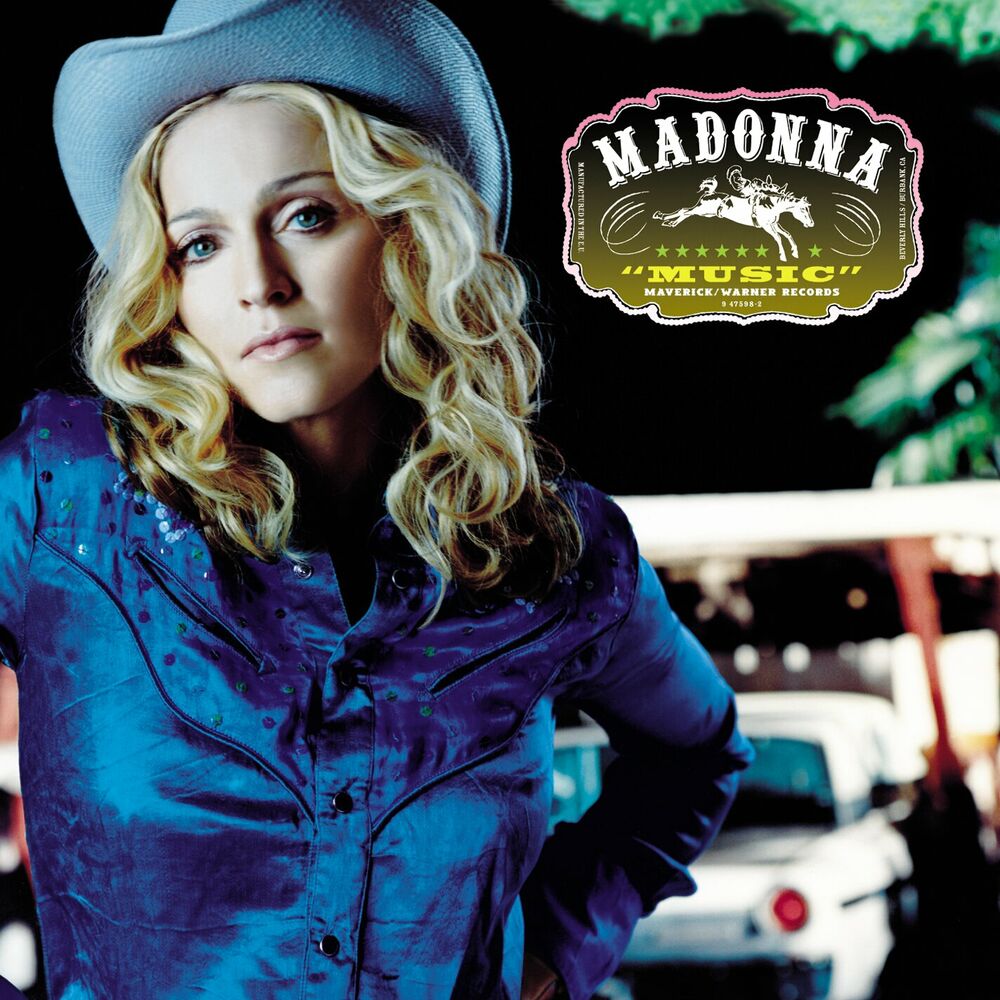
Music
- Released18 September 2000
- UK peak No. 1
- Weeks on UK chart 73
- Entered UK chart 24 September 2000
- LabelWarner Records/Maverick
- Tracks10 · 45 min
3 tracks from it charted as singles. Press a flag to play it in the chart where it peaked.
Tracks
| 1 | 3:45 | ||
| 2 | Impressive Instant | 3:37 | |
| 3 | Runaway Lover | 4:47 | |
| 4 | I Deserve It | 4:23 | |
| 5 | Amazing | 3:43 | |
| 6 | Nobody's Perfect | 4:58 | |
| 7 | 4:41 | ||
| 8 | 4:43 | ||
| 9 | Paradise (Not for Me) | 6:33 | |
| 10 | Gone | 3:25 |
About the album
Music is the eighth studio album by American singer and songwriter Madonna. It was released on September 18, 2000, by Maverick and Warner Bros. Records. Following the success of her previous album Ray of Light (1998), Madonna found herself in a music scene increasingly influenced by a younger generation of singers such as Britney Spears and Christina Aguilera. This led her to seek a distinctive sound that would set her apart in the evolving musical landscape. Her collaborations with Mirwais Ahmadzaï and William Orbit resulted in a more experimental direction for the album. Music incorporates many different genres into its overall dance-pop and electronica vibe, taking influences from funk, house, techno, rock, country, folk and R&B. With the album embracing a western motif, Madonna reimagined her image in the role of a cowgirl.
Music received acclaim from music critics, with many comparing its production to Ray of Light. The album earned a total of five Grammy Award nominations, winning one for Best Recording Package at the 43rd ceremony. The record was a commercial success, selling four million copies in its first ten days of release and topping the album charts in twenty-three countries. In the United States, it topped the Billboard 200 with over 420,000 copies sold first week—her highest to date.
Background and development
In 1998, Madonna released her seventh studio album Ray of Light to critical and commercial success, winning four Grammy Awards at the 41st edition of the ceremony, including Best Pop Album. Madonna intended to embark on a new concert tour to promote it in 1999, after filming The Next Best Thing; however, the film's production suffered a delay and due to limited time, plans for a tour were eventually canceled. The Next Best Thing was released in March 2000, receiving unfavorable reviews from critics. As part of the film's soundtrack, she recorded a cover version of Don McLean's "American Pie" (1971) at the request of her co-star Rupert Everett, which garnered mixed reactions from critics and the public. However, it became a commercial success worldwide, topping the charts in several countries throughout Europe. The song also became her ninth number-one single in the United Kingdom, extending her record of most chart-topping singles by a female artist in the region.
Writing and recording
Recording sessions for Music began in September 1999 at Sarm West Studios in Notting Hill, London, where she had recently moved, and were almost completed by January 2000. Madonna first began collaborating with Orbit. During his sessions with Madonna, he invited DJ Sasha to work on music for possible inclusion on the album, as they were "looking for a trancey sound". Orbit commented that the material was "a little edgier" and a follow-up "without standing still" to her previous album, and elaborated, "It's almost like we started off with a lot of slow ballad songs and she's started to kind of chuck 'em out in favor of more edgy tracks. The album is getting more kind of fast, very European sounding, very English and French sounding, naturally, 'cause everybody working on it apart from her is English or French. Pretty exciting, actually". After some recording sessions with Orbit, she felt she needed a different sound for her project and scrapped most of the material recorded up to that point.
Music and lyrics
The title track, "Music", is the opening song on the album, and features a disco and funk production. Its production features a dry sound, with heavy usage of equalization, which creates contrast within the vocal track, continuing until the first chorus. The song begins with Madonna's a cappella, slightly lowered and vocodered voice uttering "Hey, Mr. DJ, put a record on; I wanna dance with my baby". The phrase reiterates the uniting power of music. The primary hook, "Music makes the people come together, yeah / Music makes the bourgeoisie and the rebel", was deemed as having political implications, with Madonna apparently renouncing the bourgeoisie. Track two, the "space-age", futuristic-sounding "Impressive Instant", has been described by Billboard's Larry Flick as a "club-savvy stomper" marked by interesting keyboard lines, with Madonna's vocals changing from "distorted, robotic lines" to "playful, childlike chants". Throughout the song, her vocals are often isolated, backed by electronic sounds and an octave bass.
Artwork and release
The album artwork for Music was taken from an April 10–13, 2000 photo shoot by French fashion photographer Jean Baptiste Mondino at Smashbox Studios in Los Angeles. Madonna and Mondino had collaborated several times previously and Mondino would also go on to direct the music video for Don't Tell Me. The original concept of a cowboy-inspired aesthetic for the album was suggested by Mondino, who was commissioned to photograph the artwork. Although initially reluctant with the idea, Madonna loved the final result and was inspired to use the style as a basis for the album's design and visuals. Styling for the photo shoot was handled by Arianne Phillips, who had taken inspiration from Rodeo Girl, a photography book by Lisa Eisner and had the idea to style vintage Western clothing and cowboy hats with rhinestone-embellished cowboy shirts, jeans and high heels. The visuals and typographical style paid homage to the iconography of the American West, celebrating Americana culture while simultaneously satirizing it.
Singles
"Music" was made available commercially as the lead single from the album on August 21, 2000. It had previously been leaked on internet platforms such as Napster, leading Madonna's team to respond with a statement threatening to take legal measures against them. It has been praised by contemporary critics. The single achieved international success by topping the charts in 25 countries worldwide. It became Madonna's 12th number-one single on the US Billboard Hot 100, making her tie the Supremes as the fifth artist with most Hot 100 number-ones. In the United Kingdom, "Music" also reached at number one on the UK Singles Chart, with the singer becoming the first solo female artist to collect ten number-one singles.
"Don't Tell Me" was released to radios in the United States on November 28, 2000, as the second single from the album, while "Music" was slowly descending on the charts. It reached number four on the Hot 100 chart, tying Madonna with the Beatles as the artist with the second-most top-ten singles in the chart history.