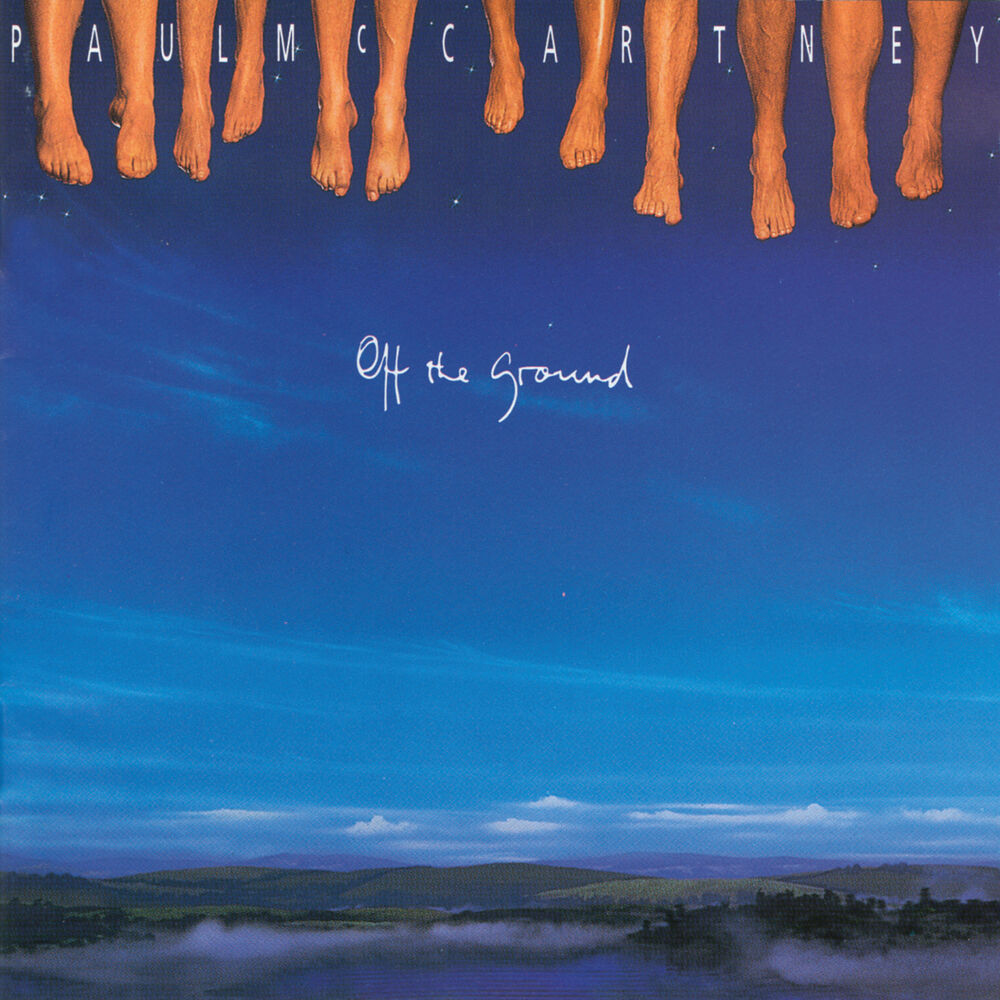
Off The Ground
- Released1 January 1993
- UK peak No. 5
- Weeks on UK chart 4
- Entered UK chart 7 February 1993
- LabelPaul McCartney Catalog
- Tracks12 · 50 min
2 tracks from it charted as singles. Press a flag to play it in the chart where it peaked.
Tracks
| 1 | Off The Ground | 3:41 | |
| 2 | Looking For Changes | 2:47 | |
| 3 | 3:21 | ||
| 4 | Mistress And Maid | 3:00 | |
| 5 | I Owe It All To You | 4:51 | |
| 6 | Biker Like An Icon | 3:26 | |
| 7 | Peace In The Neighbourhood | 5:06 | |
| 8 | Golden Earth Girl | 3:44 | |
| 9 | The Lovers That Never Were | 3:42 | |
| 10 | Get Out Of My Way | 3:32 | |
| 11 | Winedark Open Sea | 5:26 | |
| 12 | C'Mon People No. 41 · 1993 | 7:42 |
About the album
Off the Ground is the tenth solo studio album by the English musician Paul McCartney. It was released on 1 February 1993, through Parlophone in the United Kingdom and Capitol Records in the United States. The record was produced by McCartney with Julian Mendelsohn. As his first studio album of the 1990s, it is also the follow-up to the well-received Flowers in the Dirt (1989).
In contrast with the extensive list of personnel showcased on McCartney's previous albums, Off the Ground saw McCartney utilize a live-in-the-studio recording approach using only his touring band. Lyrically, the album sees McCartney delve deeper into social issues on songs such as "C'Mon People" and the animal rights anthem "Looking for Changes". Additionally, the record includes two tracks co-written with Elvis Costello, whom McCartney had previously worked with on Flowers in the Dirt.
Off the Ground was released to varying critical and commercial success. While the album reached number 5 in the UK and gained a top 20 hit with lead single "Hope of Deliverance", it only reached number 17 in the US, with the single stalling at number 83. The record was much more successful in Japan, where it sold better than its predecessor, and in mainland Europe, especially Germany, where it has become McCartney's most successful album.
Recording and structure
After planning another world tour, the New World Tour, in 1993, to promote the album, McCartney chose to record Off the Ground with his touring band. Blair Cunningham joined on drums to replace Chris Whitten, who left to join Dire Straits.
McCartney decided to record the album "live in the studio", meaning that the band would rehearse an entire song then record it in one take, instead of recording each vocal track and instrumental track separately. This approach gave a raw, direct feel to the work.
The compositions, some of which were outtakes from Flowers in the Dirt, seemed less complex than those on the earlier album. "Mistress and Maid" and "The Lovers That Never Were", which emerged from McCartney's songwriting collaboration with Elvis Costello, made their appearance on this album. Costello, who had performed on Flowers in the Dirt, did not appear on Off the Ground.
McCartney chose co-producer Julian Mendelsohn to co-produce the album. He later told author Luca Perasi that McCartney "wanted spontaneity".
Release and reception
The lead single, "Hope of Deliverance", was released on 29 December 1992, and the album followed on 1 February 1993. Off the Ground was the first Paul McCartney album to contain no sizeable US hit singles since Wings' Wild Life in 1971. The album's first single barely reached the top 20, hitting number 18, in the UK, where "C'Mon People" became a minor hit as well. In the US, the album's title track also entered the Adult Contemporary chart at number 27. Singles from Off the Ground floundered on the US and the UK charts. However, "Hope of Deliverance" achieved commercial success elsewhere. It became McCartney's first international hit single since "Say, Say, Say" with Michael Jackson in 1983, cracking the top 5 on the charts in over five European territories except his homeland and selling over 250,000 copies in Germany alone.
In the United Kingdom, the album itself debuted at number 5 and quickly fell off the chart, spending only six weeks inside the top 100.