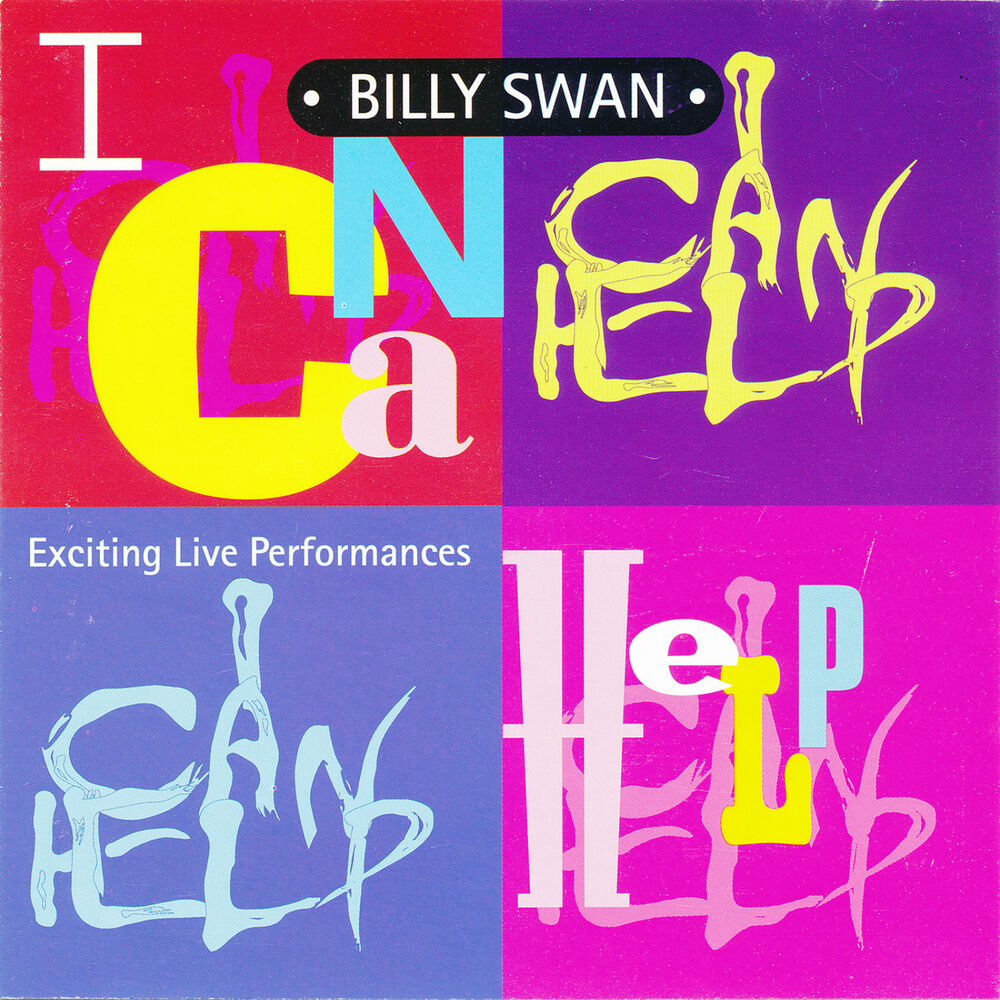
I Can Help (Exciting Live Performances) (Exciting Live Performances)
- Released5 January 2015
- Label706 Records
- Tracks18 · 56 min
2 tracks from it charted as singles. Press a flag to play it in the chart where it peaked.
Tracks
| 1 | All Shook Up | 2:39 | |
| 2 | Driving Wheel | 2:37 | |
| 3 | Rave On | 2:04 | |
| 4 | When Will I Be Loved | 2:27 | |
| 5 | Hallelujah I Love Her So | 3:04 | |
| 6 | Vanessa | 3:26 | |
| 7 | Don't Be Cruel No. 42 · 1975 | 4:30 | |
| 8 | My Bucket's Got A Hole In It | 2:50 | |
| 9 | 3:24 | ||
| 10 | Bright Lights, Big City | 2:37 | |
| 11 | I'd Rather Go Blind | 5:15 | |
| 12 | Shake, Rattle & Roll | 3:54 | |
| 13 | Lover Please | 2:24 | |
| 14 | Since I Met You Baby | 2:42 | |
| 15 | Great Balls of Fire | 2:55 | |
| 16 | Rock The Joint | 2:17 | |
| 17 | Me & Bobby McGee | 4:09 | |
| 18 | Rockhouse | 2:40 |
About the album
Soundtracks for the Blind is the tenth studio album by the American experimental rock band Swans, released first as a double album on October 22, 1996. Conceived by the frontman Michael Gira as the group's final statement before their initial breakup, the album incorporates a wide range of archival material collected since 1981. Its construction drew on handheld cassette tapes, surveillance recordings, found sounds, and multitrack sessions, which were combined with new studio performances through digital editing and layering techniques. The resulting work has been described by Gira as an "immersive universe", introducing collaborators such as Larry Mullins and Vudi.
The album has often been regarded as Swans's most experimental and avant-garde release, being variously characterized as a post-rock and drone record, blending elements of ambient, industrial, folk, and musique concrète. Critics have highlighted its thematic focus on despair, oppression, aging, and human frailty, with several songs incorporating deeply personal recordings from Gira's father and Jarboe's family. Soundtracks for the Blind received widespread acclaim upon release and in retrospective assessments, with reviewers praising its scale, intensity, and emotional depth. It has since been recognized as one of Swans's defining works, cited as a "masterpiece" by several critics.
Background and recording
After a brief and unsatisfactory major-label association with MCA Records for The Burning World (1989), Michael Gira founded Young God Records in 1991, granting him full artistic control. Subsequent albums, including White Light from the Mouth of Infinity (1991) and Love of Life (1992), emphasized long-form compositions and interludes. By the mid-1990s, Swans had moved toward extended, mood-driven pieces, culminating in The Great Annihilator (1995), which reintroduced aggressive, industrial textures that had characterized their early releases such as Filth (1983) and Greed (1986), while incorporating tribal rhythms. In 1996, the group released the EP Die Tür ist zu exclusively in Germany, which anticipated Soundtracks for the Blind and included early versions of several tracks, among them a German-language reworking of "Helpless Child" titled "Ligeti's Breath/Hilflos Kind".
By 1995, Gira had grown exhausted from the financial and creative demands of maintaining Swans and decided to make their next release a definitive final statement.
Release
Soundtracks for the Blind was released as the band's tenth studio album on October 29, 1996, in the United States, under the labels Young God and Atavistic Records. Released only as a compact disc, it is a double album divided into two discs, Silver and Copper. The album cover depicts a gray circle with a black outline set against a yellow-beige cardstock background. The upper and lower portions of the cover are dark reddish-brown, with the band's name, "SWANS", printed in large black letters at the top. The album title, "SOUNDTRACKS FOR THE BLIND", appears in black lettering on the bottom portion of the cover. The album was issued in a cardboard digipak. The package included a lyric sheet inserted in an inside pocket, with a silkscreen print of a human boneyard on the reverse side. Jurek has described the visual presentation as "ambiguous", "austere", and "imposing".
Gira had proclaimed the end of Swans in 1996, stating Soundtracks for the Blind would be their last album, serving as a deliberate "swan song" for the group.
Critical reception
Many critics evaluated Soundtracks for the Blind positively and have hailed it as a "masterpiece". From contemporary reviews, Metro Times' Thom Jurek called it Swans's "final statement" and praised it as evidence that the band was "exiting at the very top of their game". He described the album as "focused on their particular strengths" and found the work "almost unbearably beautiful", lauding its ability to balance seduction and horror, epiphany and despair, and concluded that it was "one of the most sexually charged and emotionally honest recordings" he had ever heard. It was received favorably in Alternative Press magazine, whose reviewer wrote that "Swans' out-and-out noise may have receded into quietude and somnolent hypnoscapes, but this monster of an album will leave ripples pulsing out for many years to come".
Kurt B. Reighler of Audio awarded the album a grade of A− for sound and B+ for performance, praising the album as an "ambitious collage" that combined found sounds, tape loops, and studio recordings into a "dense aural mélange".