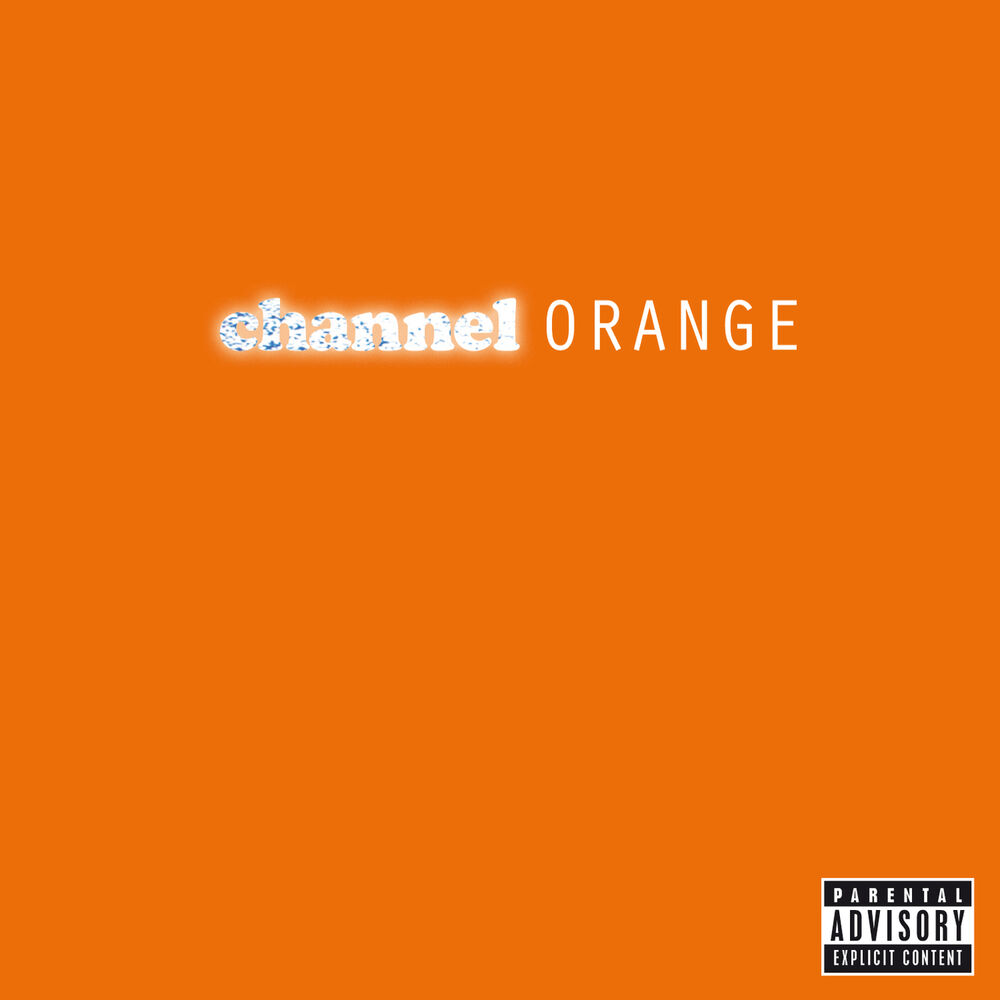
channel ORANGE
- Released1 January 2012
- UK peak No. 2
- Weeks on UK chart 73
- Entered UK chart 15 July 2012
- LabelRed Zone Entertainment / IDJ
- Tracks17 · 56 min
2 tracks from it charted as singles. Press a flag to play it in the chart where it peaked.
Tracks
| 1 | Start | 0:46 | |
| 2 | 3:22 | ||
| 3 | Fertilizer | 0:40 | |
| 4 | Sierra Leone | 2:29 | |
| 5 | Sweet Life | 4:23 | |
| 6 | Not Just Money | 1:00 | |
| 7 | Super Rich Kids | 5:05 | |
| 8 | Pilot Jones | 3:04 | |
| 9 | Crack Rock | 3:44 | |
| 10 | Pyramids | 9:53 | |
| 11 | Lost No. 44 · 2022 | 3:54 | |
| 12 | White | 1:16 | |
| 13 | Monks | 3:20 | |
| 14 | Bad Religion | 2:55 | |
| 15 | Pink Matter | 4:29 | |
| 16 | Forrest Gump | 3:15 | |
| 17 | End | 2:14 |
About the album
Channel Orange (stylized as channel ORANGE) is the debut studio album by the American R&B singer-songwriter Frank Ocean. It was released on July 10, 2012, by Def Jam Recordings. After releasing his mixtape Nostalgia, Ultra the previous year, Ocean began writing new songs with Malay, a producer and songwriter who then assisted him with recording Channel Orange at EastWest Studios in Hollywood. Rather than rely on samples as he had with his mixtape, Ocean wanted to approach sound and song structure differently on the album. Other producers who worked on the album included Om'Mas Keith and Pharrell Williams. Its recording also featured guest appearances from Odd Future rappers Earl Sweatshirt and Tyler, the Creator, vocalist/songwriter André 3000, and guitarist John Mayer.
Noted by writers as musically unconventional, Channel Orange draws on electro-funk, pop-soul, jazz-funk, and psychedelic styles, as well as nonmusical sounds such as film dialogue and ambient noise that function as interludes. Vocally, Ocean uses a free-form flow as well as alternating falsetto and tenor registers throughout the album. His songwriting explores themes of unrequited love, decadence, social class, and drugs through the use of surrealistic imagery, conversational devices, and descriptive narratives depicting dark characters.
Background
Frustrated with Def Jam Recordings' inactivity in his recording career, Frank Ocean released his debut mixtape Nostalgia, Ultra online for free in February 2011. It showcased the singer's original tracks, repurposed songs by other recording acts, and featured musical and lyrical elements unconventional in R&B. Although it lacked conventional promotion, the mixtape attained a following among listeners and received critical acclaim. Ocean and Def Jam eventually mended their relationship, and while a planned contracted edition of Nostalgia, Ultra never materialized, the label released two of its songs as singles, including the Billboard charting "Novacane". An agreement was then reached to release a tentative follow-up album for 2012.
Writing
Ocean started writing songs for Channel Orange in February 2011 with songwriter and producer Malay, his friend and creative partner since their start in the music industry as songwriters. They originally met in Atlanta and worked for the same publishing company, through which they reconnected after Malay moved to Los Angeles. Ocean spent more time with Malay, introducing him to his Odd Future collective, while connecting creatively through their respective songwriting, which led to their partnership for Channel Orange. For the album, Ocean wrote his lyrics to complement Malay's ideas for the music. Occasionally, they wrote songs together by improvising musical ideas from Malay's keyboard and guitar playing. Channel Orange was written in two weeks, according to the singer.
Although Ocean had creative freedom for both projects, he felt more confident as a songwriter for Channel Orange and typed his lyrics on a laptop rather than composing in his head as he had done for Nostalgia, Ultra.
Recording and production
Once the songs were written, Ocean ordered them into what ultimately became the album's track listing and began recording them in that order. He recorded most of the album at EastWest Studios in Hollywood, near where he was renting a home at the time. The studio complex featured recording equipment from the 1960s. Other recording locations included Henson Recording Studios and the Record Plant in Hollywood, Westlake Recording Studios and Studio for the Talented and Gifted in Los Angeles, Manhattan Sound Recording in New York City, and San Ysidro in Beverly Hills. He originally planned to rent recording equipment and the Beverly Hills mansion alone rather than rent a studio for $1,600 a day. He had a maid at the mansion and enjoyed amenities such as a pool and a sauna, but ended up recording only three songs there—"Lost", "Pyramids", and "Analog 2", a collaboration with fellow Odd Future member Tyler, the Creator.
Ocean recorded his vocals alone for several months, striving intensively for high performance standards, before rejoining Malay for the album's production.
Music
According to music journalists, Channel Orange has an unconventional musical style, with influences from psychedelic, pop-soul, jazz-funk, and electro-funk genres. HipHopDX categorized it as an alternative R&B album, while Evan Rytlewski from The A.V. Club called it a neo soul record and Time Out New York's Hank Shteamer described it as progressive soul. Sputnikmusic's Sobhi Youssef remarked that, although its production "pull[s] from a spectrum of popular modern and classic influences", they are used "within the 'constraints' of R&B without any singular genre taking over the record." Songs on the album are characterized by electronic keyboard, muted percussion, fluctuating backing tracks, shifting synthesizers, vamps, vibrant guitar, and hazy electronic effects such as dub reverb.
Lyrics
Channel Orange has themes of unrequited love, sex, and existential longing. Allusions to Ocean's own experience with unrequited love are featured in several songs, including "Thinkin Bout You", "Bad Religion", and "Forrest Gump". Jon Caramanica of The New York Times found the album to be "rife with the sting of unrequited love, both on the receiving and inflicting ends", with "lovers who tantalize but remain at arm's length." Ryan Dombal from Pitchfork said Ocean exhibits "a timeless philosophy ... one of hard-won acceptance and the acknowledgement that love and sex and loss will always draw legends to them." The album also explores decadence, the trappings of class disparity, drug dependency, and the tension between spirituality and secularity, a prevalent theme in soul music. Music journalist Sasha Frere-Jones noted "a combination of decadence and spiritual ache similar to Prince's".
Title and packaging
Ocean titled the album in reference to his experience with grapheme–color synesthesia, a neurological phenomenon in which an individual's perception of numbers and letters is associated with the experience of colors. He discussed the phenomenon with Pharrell Williams, who had also experienced it and similarly referenced it for the title of his side project N.E.R.D.'s 2008 album Seeing Sounds. The title also alludes to the first time that Ocean fell in love, as it was summer and he perceived everything to be orange. Ocean's mother called it "a perfect summertime album" after attending a listening session.
According to Malay, Kanye West helped Ocean during the album's final stages by providing "a mentorship situation" and connecting him with his "visual people". Malay recalled how he and Ocean were "somewhat oblivious to how quickly everything happened" and Ocean's name "continuing to get bigger and bigger" as they completed the album.