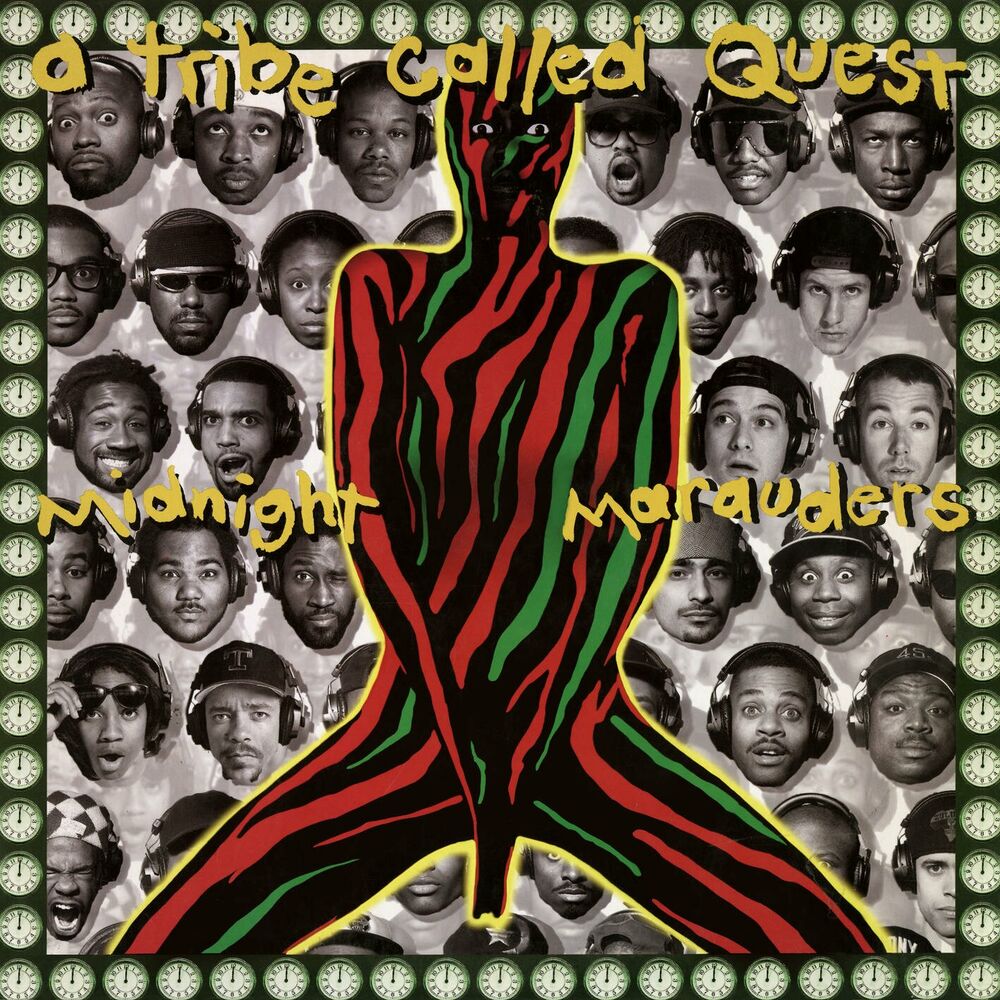
Midnight Marauders
- Released8 November 1993
- UK peak No. 70
- Weeks on UK chart 1
- Entered UK chart 21 November 1993
- LabelJive
- Tracks14 · 51 min
3 tracks from it charted as singles. Press a flag to play it in the chart where it peaked.
Tracks
| 1 | Midnight Marauders Tour Guide | 0:45 | |
| 2 | Steve Biko (Stir It Up) | 3:11 | |
| 3 | Award Tour (feat. Trugoy The Dove) No. 47 · 1994 | 3:46 | |
| 4 | 8 Million Stories | 4:21 | |
| 5 | Sucka Nigga | 4:05 | |
| 6 | Midnight (feat. Raphael Saadiq) | 4:25 | |
| 7 | We Can Get Down | 4:19 | |
| 8 | Electric Relaxation No. 65 · 1994 | 4:03 | |
| 9 | Clap Your Hands | 3:16 | |
| 10 | Oh My God (feat. Busta Rhymes) No. 81 · 1994 | 3:28 | |
| 11 | Keep It Rollin' (feat. Large Professor) | 3:06 | |
| 12 | The Chase, Part II | 4:02 | |
| 13 | Lyrics to Go | 4:09 | |
| 14 | God Lives Through | 4:15 |
About the album
Midnight Marauders is the third studio album by American hip-hop group A Tribe Called Quest, released on November 9, 1993, by Jive Records. The recording sessions for the album occurred at Battery Studios, Platinum Island Studios, and Sorcerer Sound in New York City. It was produced primarily by Q-Tip, with contributions from Skeff Anselm, Large Professor and the group's DJ, Ali Shaheed Muhammad. A culmination of the group's two previous albums, People's Instinctive Travels and the Paths of Rhythm and The Low End Theory, it features an eclectic, gritty sound based on jazz, funk, soul and R&B samples, in addition to socially conscious, positively-minded, and humorous lyrics.
Midnight Marauders debuted at number eight on the Billboard 200 and number one on the Top R&B/Hip-Hop Albums chart. The first two singles, "Electric Relaxation" and "Award Tour", charted on the Billboard Hot 100, before the release of the final single, "Oh My God". On January 14, 1994, the album was certified gold by the Recording Industry Association of America (RIAA), with shipments of 500,000 copies in the United States. It was certified platinum by the RIAA nearly a full year later, on January 11, 1995, with shipments of one million copies.
The album received mostly positive reviews from critics upon release.
Recording
A Tribe Called Quest sought to further develop the bass-heavy sound of its previous album, The Low End Theory, with group member Q-Tip setting up his production equipment in the house basement of fellow member Phife Dawg's grandmother. Phife Dawg explained, "my grandmother gave him a key, the whole nine, he used to just go in and do his thing." Most of the album was planned in the basement, though Q-Tip also worked on outside projects there, including the beat for Nas's single "One Love", which appeared on his debut album Illmatic (1994). Rapper and producer Large Professor recalled the inviting, relaxed atmosphere in the basement: "[Phife Dawg] would just be there chilling, watching a basketball game or something, playing a video game and just listening to the beats, like, 'Yeah, yeah, I like that right there.' It was just so casual and cool ... just kind of sitting there and chillin' out, going to get something to eat, going through sounds and picking the sounds out. Telling a few jokes, watching some television like that; it was really nice.
Production
The production on Midnight Marauders is a return to the eclectic sampling that the group was originally known for, featuring samples of mainly 1970s jazz, funk, soul and R&B. The sound is noticeably grittier and funkier than The Low End Theory, with John Bush of AllMusic noting that the group "moved closer to their harder contemporaries" and praising them for producing "the most inviting grooves heard on any early-'90s rap record." The album has been described as "hooky" and was given critical praise for its frequent horn hooks. Q-Tip implemented his drum layering technique to great effect on the album, varying the drum frequencies on each song. Describing the album's drum programming to Vibe, Q-Tip said:
These are some epic drum sounds that will tear your fucking head off. And there are ways you can get that sound on different levels too. The drums don't always have to be super loud. When you listen to 'Electric Relaxation' the drums are not trying to kill you. It's [very much] controlled.
Lyrics
The lyricism on Midnight Marauders is often regarded as the best on any A Tribe Called Quest album, and the group's biggest improvement since their debut People's Instinctive Travels and the Paths of Rhythm. The group's documentary director Michael Rapaport stated, "They followed a classic and upped the ante. Put it like this: [The Low End Theory] would be the first run at the championship ring, but it takes a different mentality to stay focused and do it again." Subject matter on the album includes social issues, use of the word nigger and everyday life, as well as several sports references. Building on the lyrical interplay that was established on The Low End Theory, Q-Tip and Phife Dawg are "practically telepathic" on some songs, providing a contrast in both delivery and style. AllMusic's John Bush described this contrast as "focused yet funky" and "polished but raw."
All aspects of the group's lyricism improved on the album, including cadence, flow, diction and use of metaphors.
Commercial performance
Midnight Marauders peaked at number eight on the Billboard 200 and number one on the Top R&B/Hip-Hop Albums chart. Two of its singles, "Award Tour" and "Electric Relaxation", charted on the Billboard Hot 100, peaking at number 47 and 65, respectively.
On January 14, 1994, the album was certified gold by the Recording Industry Association of America (RIAA), with shipments of 500,000 copies in the United States. It was certified platinum by the RIAA nearly a full year later, on January 11, 1995, with shipments of one million copies. It became the first of three A Tribe Called Quest albums to be certified platinum by the RIAA, doing so 21 days before The Low End Theory achieved the feat.
Critical reception
Midnight Marauders was generally well received by music critics, with Vibe hailing it as "a rap classic" and NME calling it the group's "most complete work to date." James Bernard of Entertainment Weekly stated that the album "sounds as fresh" as People's Instinctive Travels, praising its "smooth-as-butter" production and "whimsical vibe." The Source's dream hampton credited the group for doing "what they've always done—ignore all of the current trends in hip-hop and deliver a solid collectable", adding that they "rely solely on their street poetry, Zulu delivery and be-bop beats" to attract consumers.
Spin's Colson Whitehead praised Q-Tip and Phife Dawg for "complementing each other's styles perfectly", finding that their lyrical interplay "evokes the spontaneity of an improv jam session", and also lauded the album's "smooth textures that bubble up from unseen, mellow depths." In his consumer guide for The Village Voice, Robert Christgau quipped that it was "intelligent easy-listening rap", choosing the track "Steve Biko (Stir It Up)" as a highlight; he later commended the album, ra