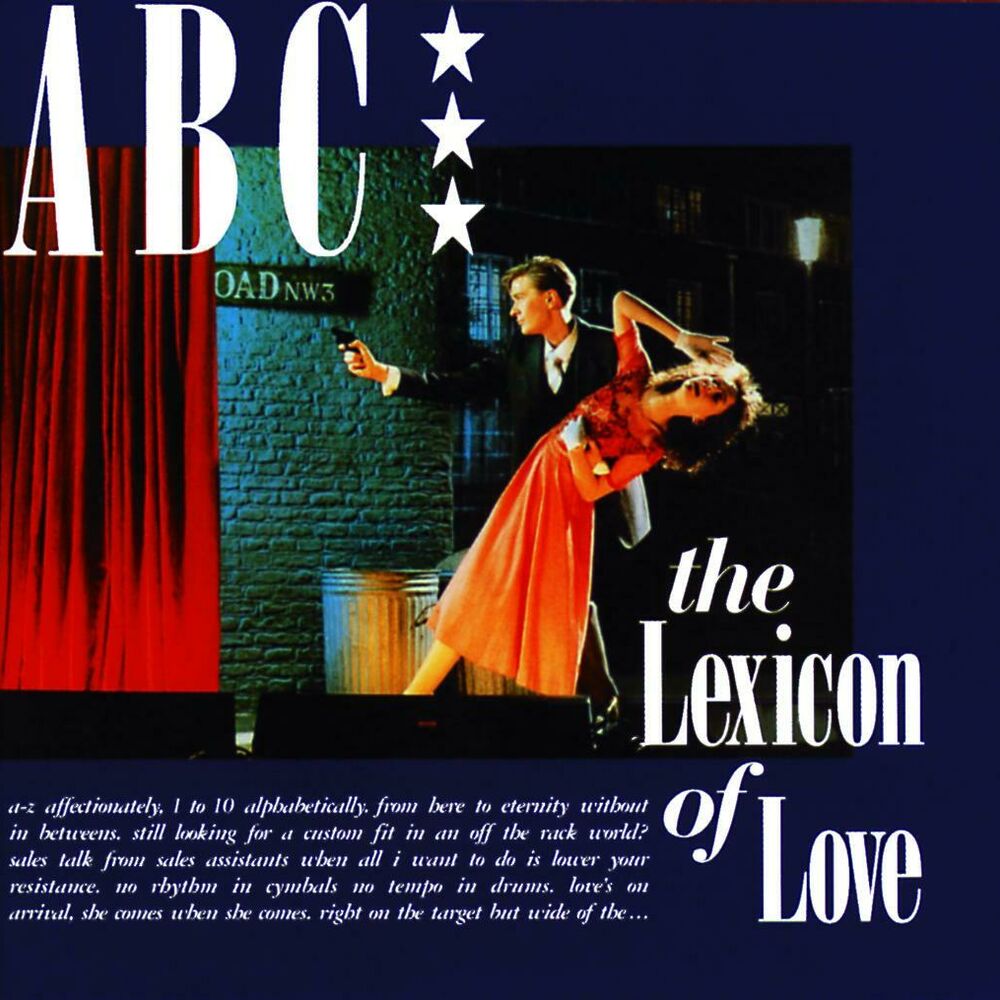
The Lexicon Of Love
- Released16 November 1998
- UK peak No. 1
- Weeks on UK chart 50
- Entered UK chart 27 June 1982
- LabelEMI
- Tracks11 · 42 min
3 tracks from it charted as singles. Press a flag to play it in the chart where it peaked.
Tracks
| 1 | Show Me | 4:01 | |
| 2 | 3:22 | ||
| 3 | Many Happy Returns | 3:57 | |
| 4 | Tears Are Not Enough No. 19 · 1981 | 3:28 | |
| 5 | Valentine's Day | 3:40 | |
| 6 | The Look Of Love, Pt.1 | 3:27 | |
| 7 | Date Stamp | 3:51 | |
| 8 | All Of My Heart No. 5 · 1982 | 5:17 | |
| 9 | 4 Ever 2 Gether | 5:29 | |
| 10 | The Look Of Love, Pt.4 | 0:58 | |
| 11 | Theme From "Mantrap" | 4:19 |
About the album
The Lexicon of Love is the debut studio album by the English pop band ABC. Released on 21 June 1982 by Neutron Records, it entered the UK Albums Chart at number one, also topping the New Zealand and Finnish charts. Certified gold in the US, it went platinum in the UK where four singles reached the top 20; "Tears Are Not Enough", "Poison Arrow", "The Look of Love" and "All of My Heart", which Pitchfork ranked number one on their "Now That's What I Call New Pop!" list.
The album has frequently been ranked as one of the greatest albums of the 1980s, and was included in the 2018 edition of Robert Dimery's book 1001 Albums You Must Hear Before You Die.
Background, recording and release
ABC was formed by Stephen Singleton and Mark White as electronic band Vice Versa. Joined by Martin Fry, the band eventually morphed into ABC, with Fry as lead vocalist. A debut single, "Tears Are Not Enough", followed in 1981; it was remixed by record producer Trevor Horn for inclusion in The Lexicon of Love. The album's title originated in the headline of an NME review of an ABC gig.
The group set out to create an album that merged their disco and post-punk influences. "I loved the strings on Chic records, and the whole soundscape of Earth, Wind & Fire", Fry said. "Fusing that with the likes of the Cure and Joy Division was what we were after." The band also sought to blend the sentimentality of mid-20th century show tunes with a distinctly modern songwriting aesthetic. Fry was enamoured by contemporary synth-pop acts such as Gary Numan and OMD, but elected to pursue an alternate lyrical approach to those artists' often technology-based themes: "I wanted to take my songs to a more emotional level, along the lines of Rodgers and Hammerstein or Cole Porter.
Critical reception
The album entered the UK Albums Chart at number 1 and remained on the charts for 50 weeks. It was the fourth biggest selling album in the UK in 1982. Mitchell Cohen of Creem contemporaneously declared it to be a "piece of sumptuous kitsch", adding that "the whole shebang is so florid, so exaggerated, so damned catchy – you want to hear "The Look of Love" a second time before it's even half over; it's a casserole of about forty different pop hits and advertising jingles – that you may feel guilty for falling for it." Robert Christgau gave the album an "A–" rating, writing that "Martin Fry's candid camp and ad-man phrasing don't fully justify his histrionic flights, but they do give him room to be clever, which is clearly his calling--some of these synthetic funk rhythms make me laugh out loud, and he's an ace jingle writer".
Legacy
The Lexicon of Love was ranked as the 4th best album of the 1980s by Record Mirror in December 1989. NME ranked it at number 15 on their "Greatest Albums: The 1980's" in 1993, and at number 117 on their "The Greatest albums of all time" in 2013. Record Collector included it on their list "70 Landmark Albums" in 2019. Observer Music Monthly ranked it at number 42 on their "Greatest British Albums" in 2004. In 2024, Uncut placed it at number 26 on their list "The 500 Greatest Albums of the 1980's".