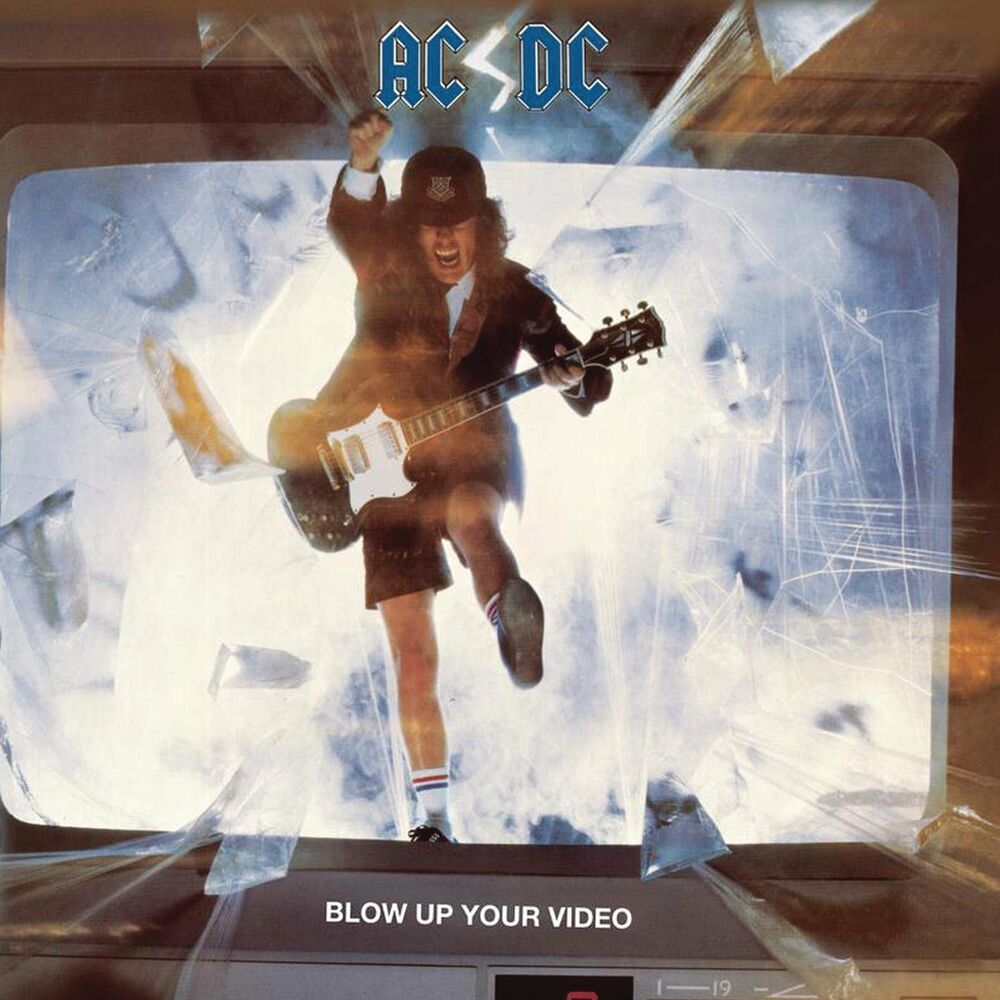
Blow Up Your Video
- Released7 October 2014
- UK peak No. 2
- Weeks on UK chart 14
- Entered UK chart 7 February 1988
- LabelColumbia
- Tracks10 · 43 min
2 tracks from it charted as singles. Press a flag to play it in the chart where it peaked.
Tracks
| 1 | Heatseeker No. 12 · 1988 | 3:50 | |
| 2 | That's the Way I Wanna Rock 'N' Roll No. 22 · 1988 | 3:45 | |
| 3 | Meanstreak | 4:10 | |
| 4 | Go Zone | 4:27 | |
| 5 | Kissin' Dynamite | 3:58 | |
| 6 | Nick of Time | 4:16 | |
| 7 | Some Sin for Nuthin' | 4:11 | |
| 8 | Ruff Stuff | 4:28 | |
| 9 | Two's Up | 5:20 | |
| 10 | This Means War | 4:21 |
About the album
Blow Up Your Video is the eleventh studio album by Australian hard rock band AC/DC, released on 1 February 1988. The album was re-released in 2003 as part of the AC/DC Remasters series.
Recording
Writing sessions for Blow Up Your Video took place in London's Nomis Studio in July 1987, with the band convening at Studio Miraval in Le Val in Provence in the south of France in August and September with Harry Vanda and George Young, the production team behind the band's early albums. This was also the final studio album to feature drummer Simon Wright.
In a 2008 Rolling Stone cover story, George Young admitted to David Fricke that, during the Blow Up Your Video sessions, he realised his brother Malcolm, who had always been a heavy drinker, was in the grip of alcoholism: "I saw the signs. Malcolm had a problem. I said if he didn't get his act together, I was out of there. I don't recall it having any effect."
The band recorded 16 tracks during the sessions, including the unreleased songs "Let It Loose" and "Alright Tonight", as well as other versions of "Heatseeker", and "That's the Way I Wanna Rock 'n' Roll". Two additional songs, "Snake Eye" and "Borrowed Time", were recorded but not featured on the album.
Reception
The album was the band's biggest-selling album of new material since For Those About to Rock We Salute You, being certified Platinum in the US. Blow Up Your Video reached No. 2 in the UK and No. 12 in the US. The album was nominated for the Grammy Award for Best Hard Rock/Metal Performance Vocal or Instrumental in 1989. In the original Rolling Stone review, Jim Farber wrote, "Fortunately, the Young brothers continue to come up with enough inspired riffs to make the tunnel vision justifiable. In fact, the riffs here add up to the band's catchiest work since its classic album Back in Black." Greg Prato of AllMusic called the album "unfocused" and "glutted with such throwaways as "Nick of Time"." Canadian journalist Martin Popoff found the album "frustrating" and the band "looking too deeply for a new enigmatic direction".
Author Paul Stenning, however, described the album as, "the sound of a group remaining current but still defining the rock art form on their own terms."
Modern reviews are less enthusiastic, being more on the negative side.
Production
Harry Vanda, George Young – producers
Tom Swift – engineer
Jean-Jacques Lemoine, Chuck Cavanagh – assistant engineers
Roy Cicala – special assistance
George Marino – mastering at Sterling Sound, New York
Gered Mankowitz, George Bodnar – photography