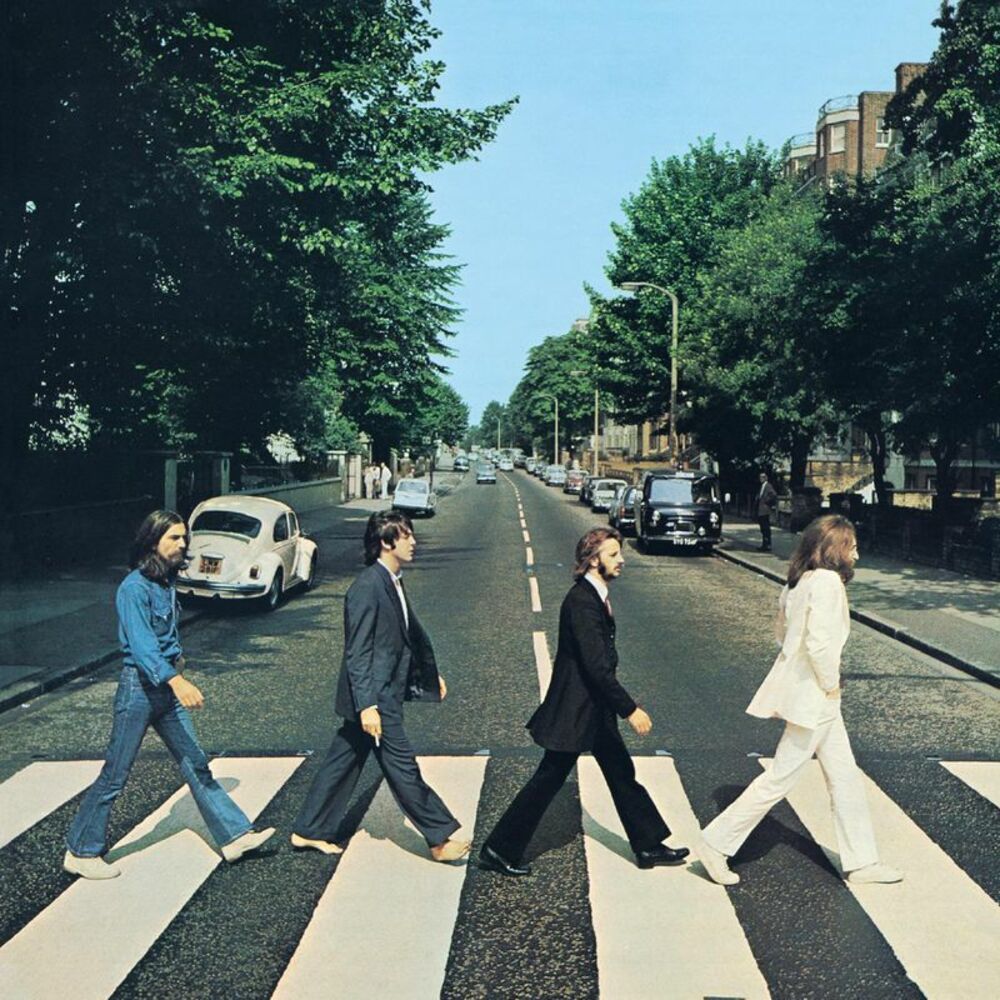
Abbey Road (Remastered 2009)
- Released24 December 2015
- UK peak No. 1
- Weeks on UK chart 81
- Entered UK chart 28 September 1969
- LabelEMI Catalogue
- Tracks17 · 47 min
3 tracks from it charted as singles. Press a flag to play it in the chart where it peaked.
Tracks
| 1 | 4:18 | ||
| 2 | 3:01 | ||
| 3 | Maxwell's Silver Hammer (Remastered 2009) | 3:26 | |
| 4 | Oh! Darling (Remastered 2009) | 3:27 | |
| 5 | Octopus's Garden (Remastered 2009) | 2:49 | |
| 6 | I Want You (She's So Heavy) (Remastered 2009) | 7:45 | |
| 7 | Here Comes The Sun (Remastered 2009) No. 58 · 2012 | 3:04 | |
| 8 | Because (Remastered 2009) | 2:45 | |
| 9 | You Never Give Me Your Money (Remastered 2009) | 4:02 | |
| 10 | Sun King (Remastered 2009) | 2:26 | |
| 11 | Mean Mr Mustard (Remastered 2009) | 1:06 | |
| 12 | Polythene Pam (Remastered 2009) | 1:12 | |
| 13 | She Came In Through The Bathroom Window (Remastered 2009) | 1:57 | |
| 14 | Golden Slumbers (Remastered 2009) | 1:31 | |
| 15 | Carry That Weight (Remastered 2009) | 1:36 | |
| 16 | The End (Remastered 2009) | 2:22 | |
| 17 | Her Majesty (Remastered 2009) | 0:25 |
About the album
Abbey Road is the eleventh studio album by the English rock band the Beatles, released on 26 September 1969 by Apple Records. It is the last album the group recorded – although Let It Be had mostly been recorded earlier, its release was delayed due to production issues. Abbey Road was mostly recorded in April, July and August 1969, and topped the record charts in both the United States and the United Kingdom. A double A-side single from the album, "Something" / "Come Together", was released in October, which also topped the charts in the US.
Abbey Road incorporates styles such as rock, pop, blues, and progressive rock, and makes prominent use of the Moog synthesiser and guitar played through a Leslie speaker unit. It is also notable for having a long medley of songs on side two that have subsequently been covered as one suite by other notable artists. The album was recorded in a more congenial atmosphere than the Get Back / Let It Be sessions earlier in the year, but there were still significant confrontations within the band, particularly over Paul McCartney's song "Maxwell's Silver Hammer", and John Lennon was absent on several tracks.
Background
After completing the recording sessions for the proposed Get Back album, Paul McCartney suggested to producer George Martin that the group get together and make an album "the way we used to do it", free of the conflict during sessions for The Beatles (also known as the "White Album"). Martin agreed, but on the strict condition that all the group – particularly John Lennon – allow him to produce the record in the same manner as earlier albums and that discipline would be adhered to.
Many traditional works of Beatles scholarship agree that when working on Abbey Road, the four Beatles knew their time as a band was moving towards divorce. However, this account has been disproven; during a taped meeting in October 1969, after the album had come out, the group mulled over strategies for how they could bridle their songwriting differences—Lennon suggested releasing new music, and McCartney wished for them to work together as they always had—yet all to no avail. Still, some people close to the Beatles had their suspicions.
Recording history
The first sessions for Abbey Road began on 22 February 1969, only three weeks after the Get Back sessions, in Trident Studios. There, the group recorded a backing track for "I Want You (She's So Heavy)" with Billy Preston accompanying them on Hammond organ. No further group recording occurred until April because of Ringo Starr's commitments on the film The Magic Christian. After a small amount of work that month and a session for "You Never Give Me Your Money" on 6 May, the group took an eight-week break before restarting it on 2 July. Recording continued through July and August, and the last backing track, for "Because", was taped on 1 August. Overdubs continued through the month, with the final sequencing of the album coming together on 20 August – the last time all four Beatles were present in a studio together.
McCartney, Starr and Martin have reported positive recollections of the sessions, while Harrison said, "we did actually perform like musicians again".
Release
In mid-1969, Lennon formed a new group, the Plastic Ono Band, in part because the Beatles had rejected his song "Cold Turkey". While Harrison worked with such artists as Leon Russell, Doris Troy, Preston and Delaney & Bonnie through to the end of the year, McCartney took a hiatus from the group after his daughter Mary was born on 28 August. On 20 September, six days before Abbey Road was released, Lennon told McCartney, Starr, and business manager Allen Klein (Harrison was not present) that he "wanted a divorce" from the group. Apple released "Something" backed with "Come Together" in the US on 6 October 1969. Release of the single in the UK followed on 31 October, while Lennon released the Plastic Ono Band's "Cold Turkey" the same month.
The Beatles did little promotion of Abbey Road directly, and no public announcement was made of the band's split until McCartney announced he was leaving the group in April 1970. By this time, the Get Back project (by now retitled Let It Be) had been re-examined, with overdubs and mixing sessions continuing into 1970.