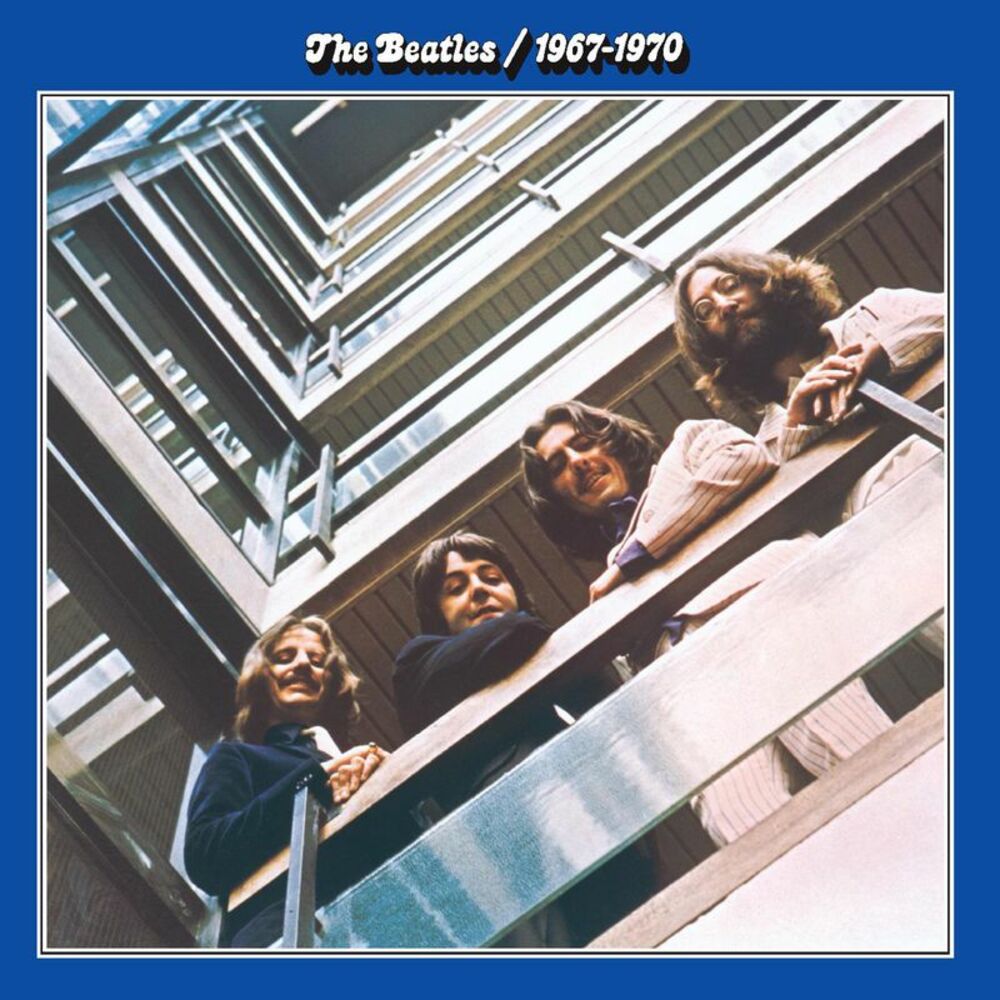
The Beatles 1967 - 1970 (Remastered 2009)
- Released24 December 2015
- UK peak No. 1
- Weeks on UK chart 17
- Entered UK chart 1 December 1968
- LabelEMI Catalogue
- Tracks25 · 88 min
17 tracks from it charted as singles. Press a flag to play it in the chart where it peaked.
Tracks
| 1 | 4:07 | ||
| 2 | 2:59 | ||
| 3 | 2:02 | ||
| 4 | With A Little Help From My Friends (Remastered 2009) | 2:44 | |
| 5 | Lucy In The Sky With Diamonds (Remastered 2009) | 3:28 | |
| 6 | A Day In The Life (Remastered 2010) | 5:05 | |
| 7 | 3:50 | ||
| 8 | I Am The Walrus (Remastered 2009) No. 56 · 1967 | 4:33 | |
| 9 | 3:28 | ||
| 10 | The Fool On The Hill (Remastered 2009) | 2:57 | |
| 11 | Magical Mystery Tour (Remastered 2009) No. 2 · 1967 | 2:49 | |
| 12 | 2:15 | ||
| 13 | 7:09 | ||
| 14 | Revolution (Remastered 2009) No. 12 · 1968 | 3:24 | |
| 15 | Back In The U.S.S.R. (Remastered 2009) | 2:43 | |
| 16 | While My Guitar Gently Weeps (Remastered 2009) | 4:45 | |
| 17 | Ob-La-Di, Ob-La-Da (Remastered 2009) No. 48 · 1976 | 3:08 | |
| 18 | 3:11 | ||
| 19 | Don't Let Me Down (Remastered 2009) No. 35 · 1969 | 3:34 | |
| 20 | 2:58 | ||
| 21 | Old Brown Shoe (Remastered 2009) | 3:17 | |
| 22 | Here Comes The Sun (Remastered 2009) No. 58 · 2012 | 3:04 | |
| 23 | 4:18 | ||
| 24 | 3:01 | ||
| 25 | Octopus's Garden (Remastered 2009) | 2:49 |
About the album
The Beatles (commonly referred to as The White Album) is the ninth studio album and only double album by the English rock band the Beatles, released on 22 November 1968. Featuring a plain white sleeve, the cover contains no graphics or text other than the band's name embossed. This was intended as a direct contrast to the vivid cover artwork of the band's previous LP, Sgt. Pepper's Lonely Hearts Club Band (1967). The Beatles is recognised for its fragmentary style and diverse range of genres, including folk, country rock, British blues, ska, music hall, hard rock and avant-garde. Some critics have since viewed it as a postmodern work, and it is widely regarded as one of the greatest albums of all time. The album was the band's first LP release on their then-recently founded Apple Records.
In late May 1968, the Beatles returned to EMI Studios in London to commence recording sessions that lasted until mid-October. During these sessions, arguments frequently broke out among the foursome over creative differences and the presence of John Lennon's new partner, Yoko Ono, which countered the Beatles' policy of excluding wives and girlfriends from the studio. After a series of problems, including producer George Martin taking an unannounced holiday and engineer Geoff Emerick suddenly quitting during a session, Ringo Starr left the band for two weeks in August.
Background
By 1968, the Beatles had achieved unprecedented levels of commercial and critical success. The group's mid-1967 release, Sgt. Pepper's Lonely Hearts Club Band, was number one in the UK for 27 weeks, until the start of February 1968, having sold 250,000 copies in the first week after release. Time magazine declared that Sgt. Pepper constituted a "historic departure in the progress of music – any music", while the American writer Timothy Leary wrote that the band were "the wisest, holiest, most effective avatars (Divine Incarnate, God Agents) that the human race has ever produced". The band received a negative critical response to their television film Magical Mystery Tour, which aired in Britain in December 1967, but fan reaction was nevertheless positive.
Most of the songs for The Beatles were written during a Transcendental Meditation course with Maharishi Mahesh Yogi in Rishikesh, India, between February and April 1968.
Singles
"Hey Jude" was recorded at the end of July 1968 during the sessions for The Beatles but was issued separately as a single nearly three months before the album's release. This was the first release on Apple Records and ultimately the band's most successful single in the US. The B-side, "Revolution", was a different version of the album's "Revolution 1". Lennon wanted the original version of "Revolution" to be released as a single, but the other three Beatles objected that it was too slow. Instead, a new, faster version, with heavily distorted guitar and an electric piano solo by Nicky Hopkins was featured on the "Hey Jude" single.
The convention in the British music industry at the time was that singles and albums were distinct entities and should not duplicate songs. But although no singles were taken from The Beatles in Britain or America, "Ob-La-Di, Ob-La-Da" backed with "While My Guitar Gently Weeps" was released in other markets. The single was a commercial success in Australia (where it spent five weeks at number one on the Go-Set chart), Japan, Austria and Switzerland.
Packaging
The Beatles was issued on 22 November 1968 in Britain and three days later in the US. It was the third album to be released by Apple Records, following Harrison's Wonderwall Music and Lennon and Ono's Two Virgins. The record was referred to as "the White Album" immediately upon release.
Conceptual artist Richard Hamilton designed the record sleeve in collaboration with McCartney. Hamilton's design was in stark contrast to Pop artists Peter Blake's and Jann Haworth's elaborate and vivid cover art for Sgt. Pepper's Lonely Hearts Club Band, and consisted of a plain white sleeve. The band's name, in Helvetica, was crookedly blind embossed slightly below the middle of the album's right side. Later vinyl record releases in the US showed the title in grey printed (rather than embossed) letters. Each copy of the record featured a unique stamped serial number, "to create", in Hamilton's words, "the ironic situation of a numbered edition of something like five million copies".
Reissues
Tape versions of the album did not feature a white cover or the numbering system. Instead, cassette and 8-track versions (issued on two cassettes/cartridges in early 1969) contained cover artwork that featured high contrast black and white (with no grey) versions of the four Kelly photographs. These two-tape releases were both contained in black outer cardboard slipcase covers embossed with the words The Beatles and the outline of an apple in gold print. The songs on the cassette version of The Beatles are sequenced differently from the album, in order to equalise the lengths of the tape sides. Two reel-to-reel tape releases of the album were issued, both using the monochrome Kelly artwork. The first, issued by Apple/EMI in early 1969, packaged the entire double-LP on a single tape, with the songs in the same running order as on the LPs. The second release, licensed by Ampex from EMI in early 1970 after the latter ceased manufacture of commercial reel-to-reel tapes, was issued as two separate volumes, and sequenced the songs in the same manner as on the cassette version.