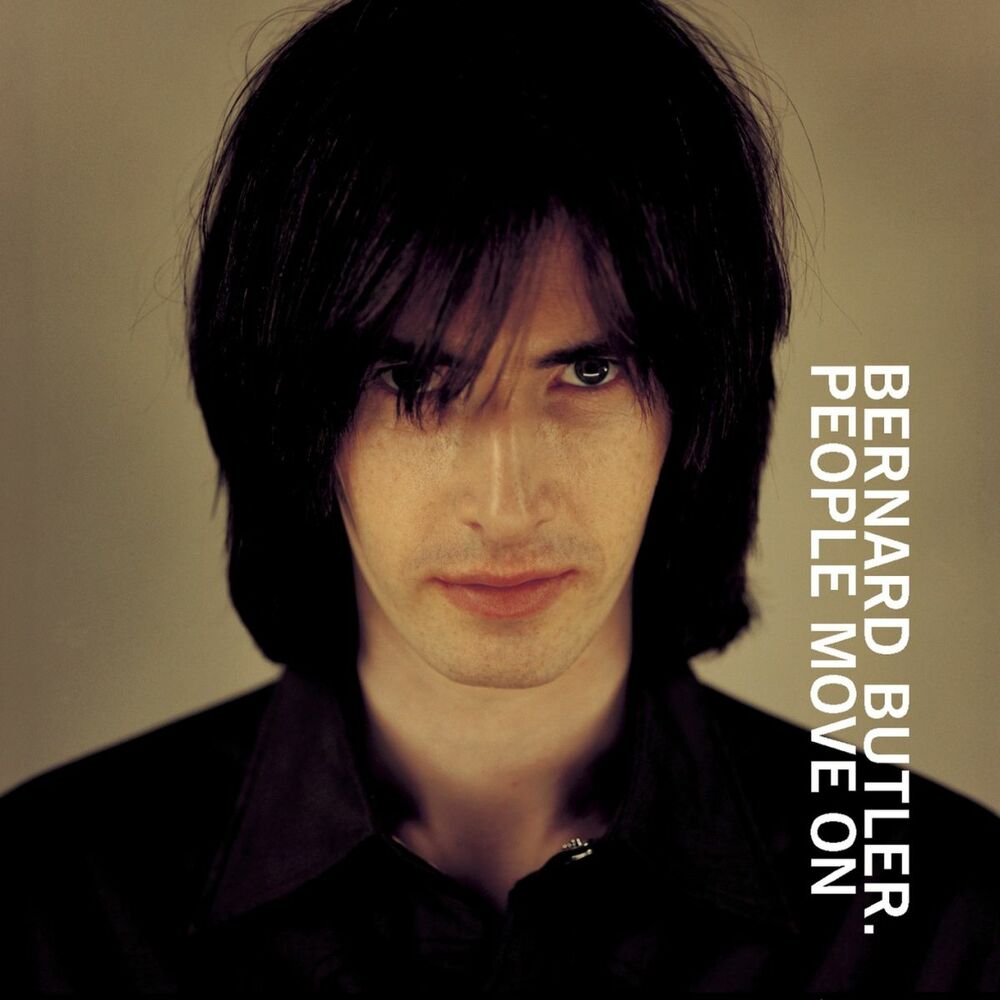
People Move On
- Released6 February 1998
- UK peak No. 11
- Weeks on UK chart 9
- Entered UK chart 12 April 1998
- LabelCreation/Columbia
- Tracks12 · 64 min
3 tracks from it charted as singles. Press a flag to play it in the chart where it peaked.
Tracks
| 1 | Woman I Know | 7:51 | |
| 2 | You Just Know | 4:39 | |
| 3 | People Move On | 4:39 | |
| 4 | A Change of Heart No. 45 · 1998 | 4:41 | |
| 5 | Autograph | 8:45 | |
| 6 | You Light the Fire | 3:53 | |
| 7 | Not Alone No. 27 · 1998 | 3:51 | |
| 8 | When You Grow | 5:25 | |
| 9 | You've Got What It Takes | 4:50 | |
| 10 | Stay No. 12 · 1998 | 5:15 | |
| 11 | In Vain | 4:55 | |
| 12 | I'm Tired | 4:54 |
About the album
People Move On is the debut studio album of English singer-songwriter Bernard Butler that was released on 6 April 1998 through Creation Records. After a dispute with David McAlmont over the McAlmont & Butler project, Butler collaborated with various artists before starting his solo career. Following a brief period with Sony LRD in early 1996, by the end of that year, Butler had signed to Creation and switched managers from Geoff Travis to Gail Colson. Butler produced the sessions for People Move On at RAK and Air Studios, both in London, between February and July 1997. The album, which is described as a pop, rock, and folk release, has been compared to the work of Jeff Buckley, Neil Young, and Wilco.
Music critics gave People Move On generally favourable reviews, though some of them criticized Butler's ability as a vocalist. The album charted at number 11 in the UK Albums Chart; all three of its singles charted on the UK Singles Chart, where "Stay" – the album's best-selling single – peaked at number 12. The British Phonographic Industry (BPI) certified the album silver in the United Kingdom. Before the release of the first two singles of People Move On, "Stay" on 5 January 1998 and "Not Alone" on 16 March 1998, Butler held a four-show residency in London.
Background
Between the late 1980s and 1994, Bernard Butler served as a guitarist of British rock band Suede, whose self-titled debut studio album won the 1993 Mercury Prize. In June 1994, Butler left the band part-way through the recording of their second studio album Dog Man Star. He disliked frontman Brett Anderson's desire to be a pop star; Anderson responded by saying Butler was difficult to work with. In 1995, Butler began working with soul singer David McAlmont; the pair worked under the name McAlmont & Butler; the duo released the single "Yes", which reached number ten in the UK. The duo split due to personal issues before their debut studio album The Sound Of... McAlmont & Butler was released the same year.
Butler spent some time collaborating with Bryan Ferry, Neneh Cherry, and Aimee Mann, and produced Hopper's sole album, English and French (1996). Butler was in contact with James vocalist Tim Booth, with whom he worked with on Booth's project Booth and the Bad Angel. Butler unsuccessfully tried to persuade Booth to leave James and start a band with him.
Writing and production
In mid 1996, Butler received a call from Richard Ashcroft's management, who asked whether Butler would like to collaborate with Ashcroft alongside the Verve members Simon Jones and Peter Salisbury for an album. Butler, who was still writing for his own album, was interested in the offer. After three weeks without any contact from Ashcroft, Ashcroft's manager transported Ashcroft, Jones and Salisbury to Butler's house. They worked in a rehearsal room for two days and practiced material that would later appear on the Verve's third studio album Urban Hymns (1997). Butler spent a week as a member of the Verve before they decided to reinstate their original guitarist Nick McCabe. Butler recorded instrumental demos at Mike Hedges' studio at Château de la Motte in Domfront, France, with Hedges and engineer Ian Grimble, for a week in October 1996. Butler wrote six rough drafts of new songs; he went back to London and met up with Makoto Sakamoto, with whom he had worked as part of McAlmont & Butler.
Composition and lyrics
Musically, the sound of People Move On has been described as pop, rock, and folk, steering away from the glam-pop of Suede. It has been compared to the work of Jeff Buckley, Neil Young, and Wilco. MTV's Dakota Smith referred to it as a "collection of love ballads, symphony-backed anthems, catchy pop refrains and pared-down guitars and lyrics". Lucy O'Brien of The Independent noted influences from classic rock from the late 1960s and 1970s, and wrote: "People Move On echoes the early Seventies cool rock singer/songwriting era in its heartfelt sentiment and warm, melodic approach." Despite this, Butler has stressed that it was not a "retro record". Some songs on the record have a Spector-esque influence, which according to Mac Randall of Rolling Stone, display an "old-fashioned big-pop-production quality." The album marked Butler's first attempt at singing, which Gail Worley of Ink 19 called "sweet, clear, and highly emotive".
Release and promotion
In December 1997, Sony had Butler film an electronic press kit, where he performed in front of a camera operator for an hour. It was recorded at a rehearsal studio on Benwell Road, London, and was ultimately scrapped. The music video for "Stay" debuted in the UK on the MTV's programme Up for It on 15 December 1997. The track was released as the first single from People Move On on 5 January 1998. The UK version included "Hotel Splendide" and "The Sea", while the Australian and European editions also featured a radio edit of "Stay". In the 7 February 1998 issue of Billboard, People Move On was announced for release in two months' time. "Not Alone" was released as the second single on 16 March 1998, with "Bye Bye" and "It's Alright" as its B-sides. The Japanese edition of the single, released through Epic Records, included all of the tracks from "Not Alone" and the UK version of "Stay". Butler held a four-date residency at the Highbury Garage in London, which was followed by an acoustic show shortly afterwards.
Reissues
In 2021, People Move On was re-pressed on vinyl as part of that year's Record Store Day. The following year, a four-CD set including a version of the album with re-recorded vocals and a new rendition of "I'm Tired" was released. For a number of years, Demon Records had been asking Butler if he wanted to reissue the album; he repeatedly rejected the idea. While reviewing his body of past work, Demon asked again and Butler accepted the offer provided he could re-record his vocal tracks. Butler recorded the new vocals at Studio 355 in London; he sung over 1997 instrumental mixes of the songs that had been saved to Digital Audio Tapes that were made during the mixing process. Because several iterations of the songs were made during mixing, the sounds of the individual instruments differ from the final issued version of the album. No instrumental mix of "I'm Tired" existed so Butler re-recorded the song.
The introduction to "A Change of Heart", which Butler thought was "boring", was shortened, and "People Move On" and "In Vain" were given extra miniature-guitar solos.