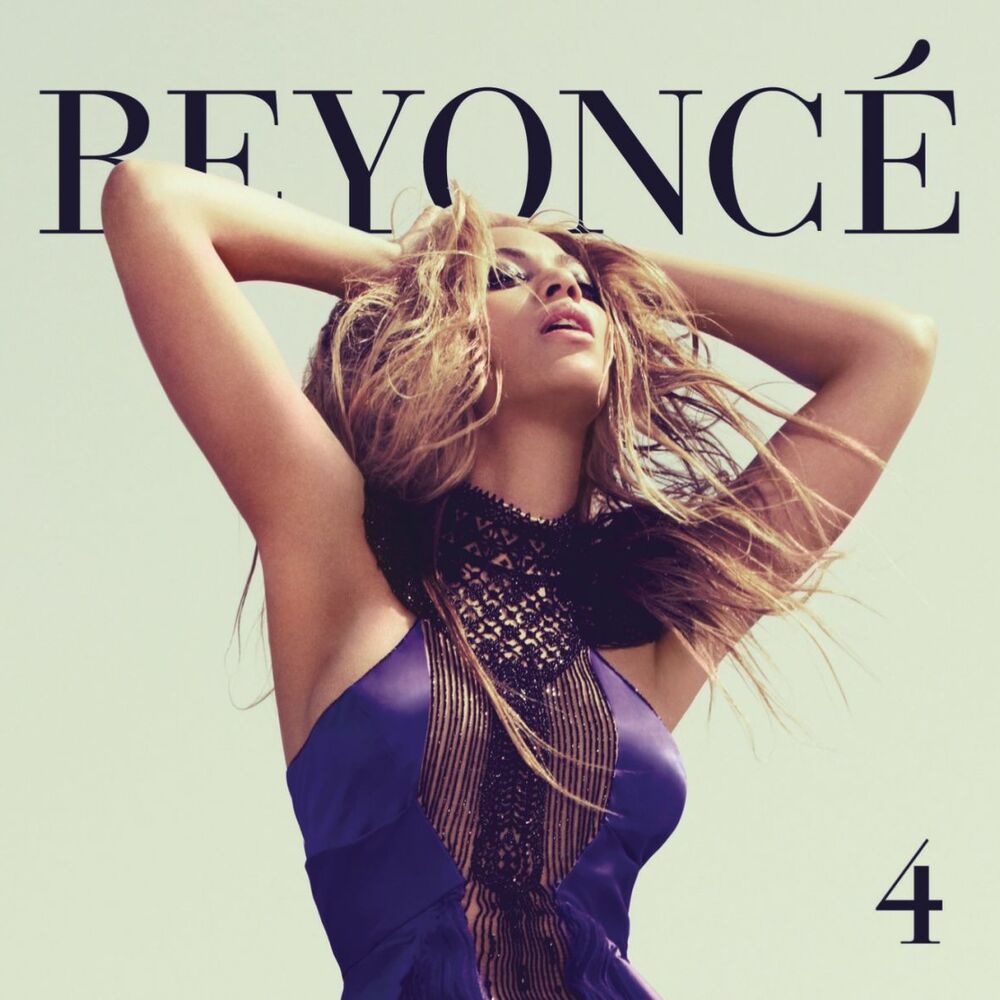
4
- Released29 March 2013
- UK peak No. 1
- Weeks on UK chart 56
- Entered UK chart 3 July 2011
- LabelParkwood Entertainment/Columbia
- Tracks14 · 58 min
8 tracks from it charted as singles. Press a flag to play it in the chart where it peaked.
Tracks
| 1 | 4:28 | ||
| 2 | Party (feat. André 3000) No. 50 · 2011 | 4:06 | |
| 3 | Schoolin' Life | 4:52 | |
| 4 | 3:34 | ||
| 5 | I Miss You | 2:59 | |
| 6 | Dance for You No. 78 · 2012 | 6:15 | |
| 7 | I Care | 4:00 | |
| 8 | Rather Die Young | 3:43 | |
| 9 | 4:35 | ||
| 10 | End of Time No. 39 · 2012 | 3:44 | |
| 11 | 3:55 | ||
| 12 | 4:13 | ||
| 13 | Start Over | 3:19 | |
| 14 | I Was Here | 4:00 |
About the album
4 is the fourth studio album by the American singer and songwriter Beyoncé. It was released on June 24, 2011, by Parkwood Entertainment and Columbia Records. Recorded from March 2010 to May 2011, the album was produced by Beyoncé alongside Babyface, Jeff Bhasker, Kanye West, Kaskade, Brent Kutzle, and Ryan Tedder of OneRepublic, Switch, and The-Dream, among others. The album features a single lead guest appearance, from André 3000 of Outkast. Following a career hiatus that reignited her creativity, Beyoncé conceived 4 as a record rooted in traditional rhythm and blues that stood apart from contemporary popular music.
4 was Beyoncé's first album after she ended her working relationship with her father and manager Mathew Knowles. She conceived 4 as an intimate album that departed from the commercially oriented music of her past releases. Her collaborations with songwriters and record producers The-Dream, Tricky Stewart, and Shea Taylor resulted in a more subdued tone that incorporates vocal styles and influences from 1970s and 1980s funk, hip-hop, and soul music. The lyrics address monogamy, female empowerment, and self-reflection, reflecting Beyoncé's effort to convey a more mature message and assert artistic credibility.
Beyoncé promoted 4 in mid-2011 through television and festival performances, including a headlining set at the Glastonbury Festival.
Background and development
Following the release of her third album I Am... Sasha Fierce (2008) and the ensuing world tour, Beyoncé took a career hiatus in 2010 "to live life [and] to be inspired by things again". During her hiatus, she "killed" Sasha Fierce, the aggressive stage alter-ego used in I Am... Sasha Fierce, as she felt she could now merge her two personalities. She severed professional ties with her father and manager Mathew Knowles, who had guided her career since the 1990s with Destiny's Child, noting that the decision made her feel vulnerable.
It was a time where [sic] everyone was doing pop/dance music, and R&B and soul were getting lost. It was popular and fun, but it wasn’t my thing. It was not where I was going with my music career at that time. I was yearning for something deeper with more musicality. That’s when I put out "1+1" and "Love On Top."
In an interview for Complex, Beyoncé expressed dissatisfaction with contemporary radio. She intended 4 to help change that status, commenting, "Figuring out a way to get R&B back on the radio is challenging ...
Recording and production
Three months into her hiatus, in March 2010, Beyoncé began recording at her husband Jay-Z's Roc the Mic Studios in New York City. One song—"Party"—was recorded because she wanted to see what working relationship would develop with engineer DJ Swivel. Kanye West assisted the production of "Party" after Beyoncé was impressed by his work on My Beautiful Dark Twisted Fantasy (2010). André 3000, the only featured artist on 4, contributed a rap verse to the song, which he recorded in Georgia.
Six weeks later, in May 2010, she asked Swivel to work on the entire project. Concerning his working relationship with Beyoncé, he commented, "There was no 'We're doing this today.' It was a very kind of open project, where whatever she felt like recording at that time was what we'd work on. It was based on how she felt, her mood, and also her listening to the demos that writers would give us." With Swivel, she experimented with horns, drums, guitars and percussion instruments.
Music and lyrics
The final version of 4 comprises twelve tracks on the standard edition and eighteen on the deluxe edition—three of which are remixes of "Run the World (Girls)". Critics viewed 4 as a major departure from Beyoncé's previous catalog, with a distinctive more subdued sound. The album consists mostly of mid-tempo R&B songs, with 1970s funk, 1980s pop and 1990s soul influences. The second half is more eclectic, exploring a variety of genres including hard rock, reggae and adult contemporary. The Guardian wrote that the album's divergence from the "layering [of] Euro-synths on pop-step woomphs" set it apart from the music of Beyoncé's contemporaries.
The balladry of the first half of 4 combines diverse vocal styles with the use of live instrumentation. "1+1" demonstrates Beyoncé's vocal-flexing over "magnificent guitar bombast" and a soft backing beat, while "Start Over", a mid-tempo R&B ballad, uses a futuristic rhythm with electric elements and synthesizers.
Release and promotion
In an interview for Billboard, Beyoncé stated that despite having another concept for the album, she was ultimately influenced by her fans to name the album 4. She described the number four as "special" to her because her birthday, Jay-Z's birthday, several other family and friends' birthdays, and her wedding anniversary fall on the fourth day of their respective months. The cover of the standard edition was revealed on Beyoncé's website on May 18, 2011. Shot on the rooftop of the Hôtel Meurice in Paris, Beyoncé is looking into the distance with her arms raised over her head, wearing smokey eye makeup, thick gold cuffs and a fox-fur stole by cult French designer Alexandre Vauthier, embellished with Swarovski crystals by the Lesage embroidery house. The cover of the deluxe edition was shown on June 16, in which Beyoncé is dressed in a tight-fitting blue-purple dress by French designer Maxime Simoens, holding her hands in her hair. For its artwork, she opted for clothing made by lesser-known designers.
Critical reception
4 received positive reviews from music critics. At Metacritic, which assigns a weighted mean rating out of 100 to reviews from mainstream critics, the album received an average score of 73, based on 36 reviews. Michael Cragg of The Observer called it Beyoncé's "most accomplished album yet". Slant Magazine's Eric Henderson believed 4 succeeds vocally as an album of mostly intimate and slow-tempo ballads. Mikael Wood of Spin magazine applauded its ballads, mid-tempo songs, and evocations of late 1970s and early 1980s pop-soul. In his review for Rolling Stone, Jody Rosen wrote that Beyoncé eschews contemporary production styles for a more personal and idiosyncratic album. Jon Caramanica of The New York Times viewed it as a good showcase for Beyoncé as a torch singer, because she convincingly sings about heartbreak and the strong emotional effect of love. Pitchfork's Ryan Dombal found it easygoing, retro-informed, and engaging because it shows "one of the world's biggest stars exploring her talent in ways few could've predicted".