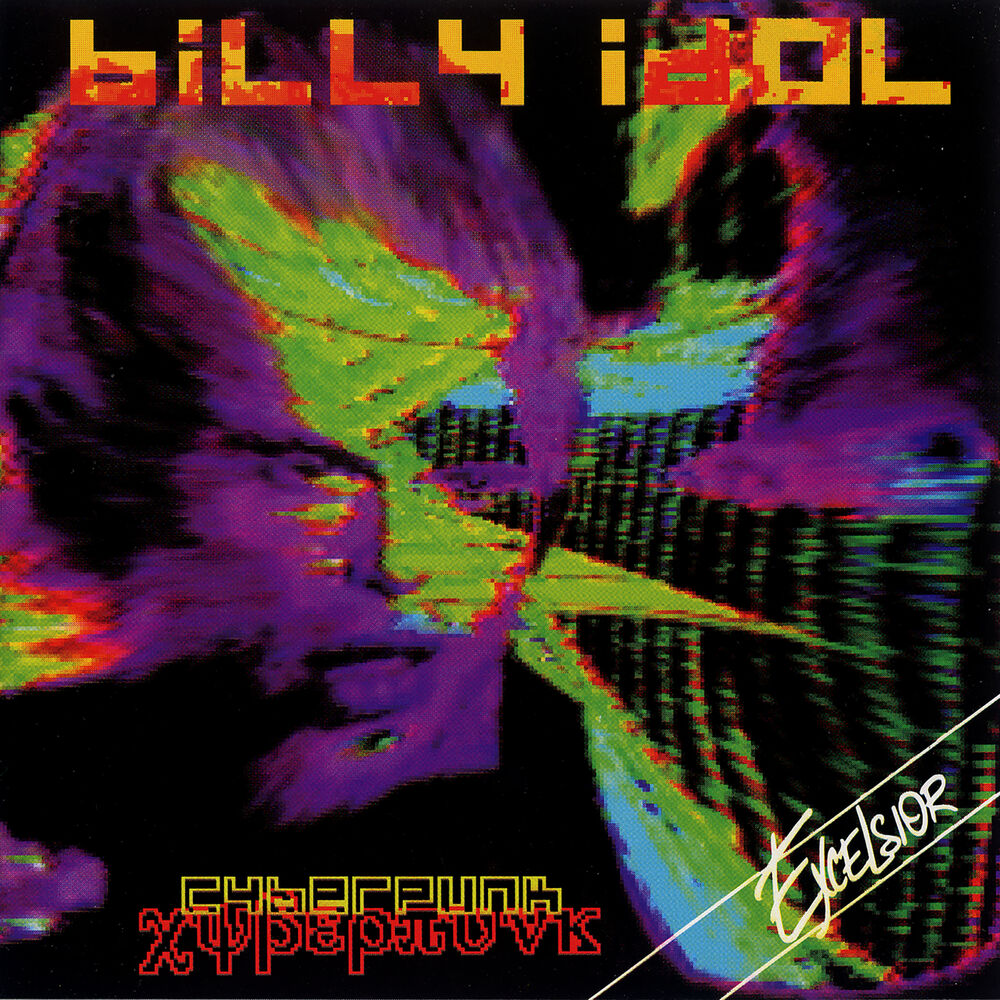
Cyberpunk
- Released28 April 2017
- UK peak No. 20
- Weeks on UK chart 2
- Entered UK chart 4 July 1993
- LabelCAPITOL CATALOG MKT (C92)
- Tracks20 · 72 min
One track from it charted as a single. Press a flag to play it in the chart where it peaked.
Tracks
| 1 | Intro | 1:01 | |
| 2 | Wasteland | 4:33 | |
| 3 | Interlude 1 | 0:19 | |
| 4 | Shock To The System No. 30 · 1993 | 3:33 | |
| 5 | Tomorrow People | 5:04 | |
| 6 | Adam In Chains | 6:23 | |
| 7 | Neuromancer | 4:34 | |
| 8 | Power Junkie | 4:45 | |
| 9 | Interlude 2 | 0:27 | |
| 10 | Love Labours On | 3:53 | |
| 11 | Heroin | 6:57 | |
| 12 | Interlude 3 | 0:22 | |
| 13 | Shangrila | 7:28 | |
| 14 | Concrete Kingdom | 4:50 | |
| 15 | Interlude 4 | 0:38 | |
| 16 | Venus | 5:45 | |
| 17 | Then The Night Comes | 4:37 | |
| 18 | Interlude 5 | 0:25 | |
| 19 | Mother Dawn | 5:01 | |
| 20 | Outro | 0:56 |
About the album
Cyberpunk is the fifth studio album by the English rock singer Billy Idol, released on 28 June 1993 by Chrysalis Records. A concept album, it was inspired by his personal interest in technology and his first attempts to use computers in the creation of his music. Idol based the album on the cyberdelic subculture of the late 1980s and early 1990s. Heavily experimental in its style, the album was an attempt to take control of the creative process in the production of his albums, while simultaneously introducing Idol's fans and other musicians to the opportunities presented by digital media.
The album featured a cyberpunk-styled narrative, as well as synthesised vocals and industrial influences. Despite its critical and commercial failure, Billy Idol set several precedents in the process of promoting the album. These included his use of the Internet, e-mail,[I] virtual communities, and multimedia software, each a first for a mainstream celebrity. Idol also based his fashion style, music videos, and stage shows on cyberpunk themes and aesthetics.
Released to negative reviews, Cyberpunk polarised internet communities of the time, with detractors viewing it as an act of cooptation and opportunistic commercialisation. It was also seen as part of a process that saw the overuse of the term "cyberpunk" until it lost its original meaning.
Background
During the release of 1990's Charmed Life, Idol suffered a broken leg in a motorcycle accident. While in recovery, he was interviewed by Legs McNeil. McNeil noticed the electronic muscle stimulator on Idol's leg and referred to him as a "cyberpunk", citing the cyborg qualities of his appearance. This led to Idol taking a serious interest in the works of William Gibson for the first time, although he had read Neuromancer in the mid-'80s. In the following months, Idol continued to investigate cyberpunk fiction and technology. He also read Neal Stephenson's Snow Crash, works by Robert Anton Wilson, and others.
At approximately the same time, he began to work with Trevor Rabin to create his music, having parted ways with his former producer, Keith Forsey. Rabin introduced Idol to his home studio, which was centralised around Rabin's Macintosh computer and music software. The ability to personally produce music from his home, rather than at a professional studio, appealed to Idol's "do it yourself" ethic.
Recording
Cyberpunk was created in Idol's home studio in Los Angeles, centred around his Macintosh computer and accompanying software. Programs used in the production included Opcode Studio Vision, and Digidesign Pro Tools. Idol later recalled that the beginning of the recording sessions coincided with the onset of the 1992 Los Angeles riots. "We'd just installed the computer in my music room, and there was a window above it overlooking the whole city. And there was a fire raging. There was smoke just pouring across the whole of LA. It was LA burning. And so I just straight quickly wrote the lyrics and sang them three times. What you're hearing on the single 'Shock to the System' is my news reportage of what I'm seeing." Idol recalled for a German broadcast. "We started the album with a riot. So that's really rock and roll."
Excited by the DIY aspects of the production process, Idol took only ten months to record the album, which he often contrasted with the combined period of eight years it took to create his two previous albums.
Themes
Cyberpunk was a departure from Idol's previous style of pop-rock music. Several spoken or sound-effect segues were placed between the album tracks to create a linear narrative. The effect of these segues caused the album to become a concept album. Karen Schoemer, of the New York Times, commented that "[w]ith its booming techno beats, screeching guitar riffs, sampled computer voices and songs like 'Power Junkie' ('I feel tonight we're bought and sold/Ah yeah, I think I'll overload'), the album functions as Mr. Idol's interpretation of cyber culture."
When asked why he was pursuing such a shift in his musical style by adopting electronic music, Idol responded that he had attempted to incorporate technology in his older work, but found the equipment of the late 1970s and early 1980s too limiting and gave up. With the computers of the 1990s, Idol finally felt that the technology was able to quickly and easily make changes as he saw fit.
Music videos
Three of four Cyberpunk singles were promoted by music videos: "Heroin", "Shock to the System", and "Adam in Chains". The fourth single, "Wasteland", did not receive a music video.
The first single, "Heroin", was accompanied with the most music videos, with a total of five for several different remixed versions of the cover. Each was a "Blendo" video which rapidly shifted random imagery and colours in time with the music. Four of the music videos for the song were directed by Brett Leonard, with a fifth being credited to Howard Deutch. Each used stock footage shot by Idol and Leonard, filmed personally and edited on Idol's computer. Idol did so with the intention of sending a "do-it-yourself" message that mocked and rejected the standards of MTV music video creation.
Release
A press pack was distributed to the media prior to its release to promote the album. The centerpiece of the pack was a copy of the Billy Idol's Cyberpunk custom stickered 3½" floppy disk, which was housed in a custom multi-coloured folder with artist and title logo on the front and contact information on the back. The pack included a 5-page version of the biography in the diskette, for the benefit of any journalist who lacked the equipment to operate the floppy disk. Also included in the pack were three black-and-white publicity photographs. Two pictures of Idol were taken by Peter Gravelle and the other was a digitally edited image of Idol as he appeared in the blendo video, "Heroin".
As part of press junkets promoting the album, Idol reportedly insisted attending journalists be familiar with cyberpunk fiction. It was also revealed that Idol was not entirely as familiar with the genre as he had proclaimed.