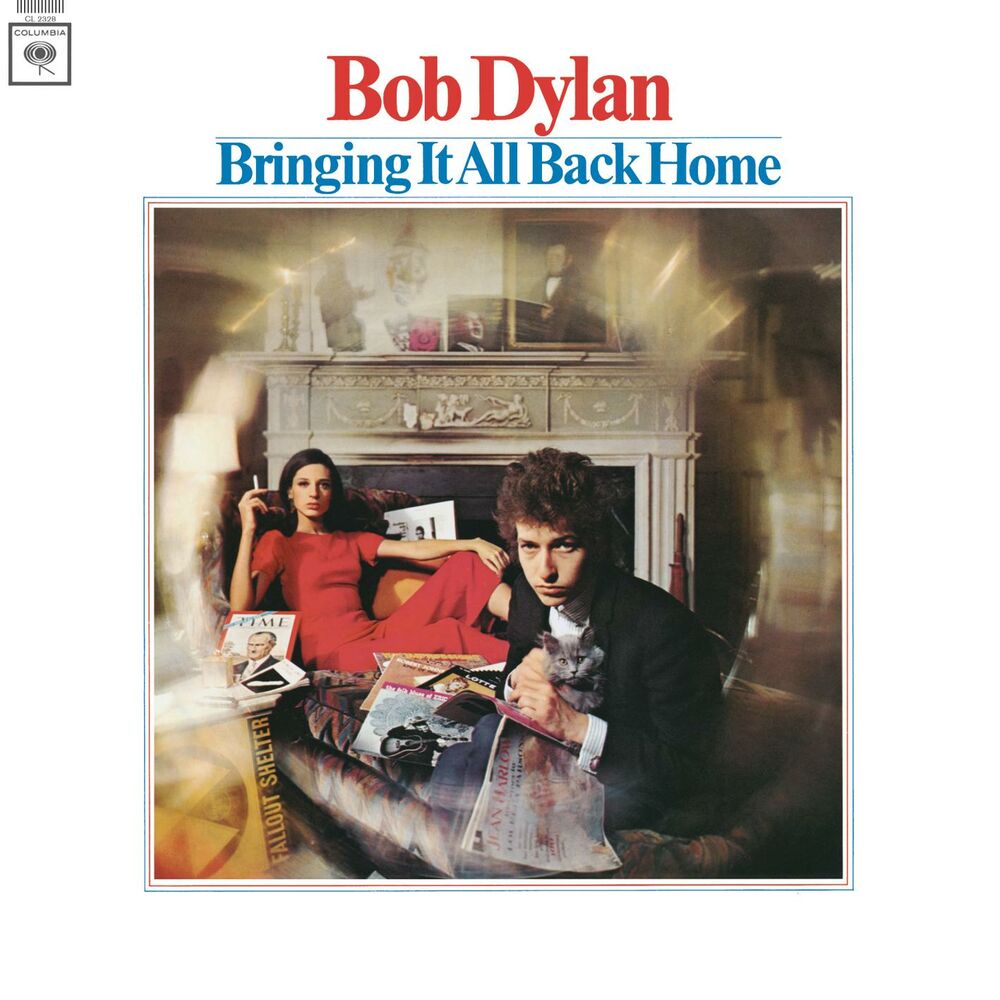
Bringing It All Back Home
- Released19 March 1965
- UK peak No. 1
- Weeks on UK chart 29
- Entered UK chart 9 May 1965
- LabelColumbia
- Tracks11 · 47 min
2 tracks from it charted as singles. Press a flag to play it in the chart where it peaked.
Tracks
| 1 | 2:18 | ||
| 2 | She Belongs to Me | 2:47 | |
| 3 | Maggie's Farm No. 22 · 1965 | 3:55 | |
| 4 | Love Minus Zero | 2:49 | |
| 5 | Outlaw Blues | 3:02 | |
| 6 | On the Road Again | 2:35 | |
| 7 | Bob Dylan's 115th Dream | 6:31 | |
| 8 | Mr. Tambourine Man | 5:25 | |
| 9 | Gates of Eden | 5:41 | |
| 10 | It's Alright, Ma (I'm Only Bleeding) | 7:31 | |
| 11 | It's All Over Now, Baby Blue | 4:14 |
About the album
Bringing It All Back Home is the fifth studio album by the American singer-songwriter Bob Dylan. Released by Columbia Records in April 1965, the album was Dylan's first to incorporate electric instrumentation. It was so different from his earlier work that it caused controversy and divided the contemporary folk scene.
On the first half of the album—the songs on side one of the original LP—Dylan is backed by an electric rock and roll band. The second half features mainly acoustic songs. The album abandons the protest music of Dylan's previous records for more surreal, complex lyrics.
The album reached No. 6 on Billboard's Pop Albums chart, the first of Dylan's LPs to break into the US Top 10. It topped the UK charts later that spring. The first track, "Subterranean Homesick Blues", became Dylan's first single to chart in the US, peaking at No. 39. Bringing It All Back Home has been described as one of the greatest albums of all time by multiple publications. In 2003, it was ranked number 31 on Rolling Stone's list of the "500 Greatest Albums of All Time"; it was ranked number 181 in the 2020 edition.
Recording
Dylan spent much of the summer of 1964 in Woodstock, a small town in upstate New York where his manager, Albert Grossman, had a place. When Joan Baez went to see Dylan that August, they stayed at Grossman's house. Baez recalls that "most of the month or so we were there, Bob stood at the typewriter in the corner of his room, drinking red wine and smoking and tapping away relentlessly for hours. And in the dead of night, he would wake up, grunt, grab a cigarette, and stumble over to the typewriter again." Dylan already had one song ready for his next album: "Mr. Tambourine Man" was written in February 1964 but omitted from Another Side of Bob Dylan. Another song, "Gates of Eden", was written earlier that year, appearing in the original manuscripts to Another Side of Bob Dylan; it's unclear whether subsequent lyrical changes were made that August in Woodstock. At least two songs were written that month: "If You Gotta Go, Go Now" and "It's Alright, Ma (I'm Only Bleeding)".
Artwork
The album's cover, photographed by Daniel Kramer with an edge-softened lens, features Sally Grossman (wife of Dylan's manager Albert Grossman) lounging in the background. There are also artifacts scattered around the room, including LPs by the Impressions (Keep On Pushing), Robert Johnson (King of the Delta Blues Singers), Ravi Shankar (India's Master Musician), Lotte Lenya (Sings Berlin Theatre Songs by Kurt Weill) and Eric Von Schmidt (The Folk Blues of Eric Von Schmidt). Dylan had "met" Schmidt "one day in the green pastures of Harvard University" and would later mimic his album cover pose (tipping his hat) for his own Nashville Skyline four years later. A further record, Françoise Hardy's EP J'suis D'accord, was on the floor near Dylan's feet but can only be seen in other shots from the same photo session, as well as a copy of the Wilhelm/Baynes version of I Ching.
Visible behind Grossman is the top of Dylan's head from the cover of Another Side of Bob Dylan; under her right arm is the magazine Time with President Lyndon B.
Release
Bringing It All Back Home was released in April 1965 by Columbia Records. The mono version of Bringing It All Back Home was re-released in 2010 on The Original Mono Recordings, accompanied by a booklet containing a critical essay by Greil Marcus. A high-definition 5.1 surround sound edition of the album was released on SACD by Columbia in 2003.
Reception
The release of Bringing It All Back Home coincided with the final show of a joint tour with Joan Baez. By this time, Dylan had grown far more popular and acclaimed than Baez, and his music had radically evolved from their former shared folk style in a totally unique direction. It would be the last time they would perform extensively together until 1975. (She would accompany him on another tour in May 1965, but Dylan would not ask her to perform with him.) The timing was appropriate as Bringing It All Back Home signaled a new era. Dylan was backed by an electric rock and roll band—a move that further alienated him from some of his former peers in the folk music community. The album reached No. 6 on Billboard's Pop Albums chart, the first of Dylan's LPs to break into the US top 10. It also topped the UK charts later that spring. The first track, "Subterranean Homesick Blues", became Dylan's first single to chart in the US, peaking at No. 39.
Legacy
Bringing It All Back Home is regarded as one of the greatest albums in rock history. In 1979 Rolling Stone Record Guide critic Dave Marsh wrote: "By fusing the Chuck Berry beat of the Rolling Stones and the Beatles with the leftist, folk tradition of the folk revival, Dylan really had brought it back home, creating a new kind of rock & roll [...] that made every type of artistic tradition available to rock." Clinton Heylin later wrote that Bringing It All Back Home was possibly "the most influential album of its era. Almost everything to come in contemporary popular song can be found therein." In 2003, the album was ranked number 31 on Rolling Stone magazine's list of the "500 Greatest Albums of All Time", maintaining the rating in a 2012 revised list. It moved down to number 181 on the 2020 list. The album was inducted into the Grammy Hall of Fame in 2006.