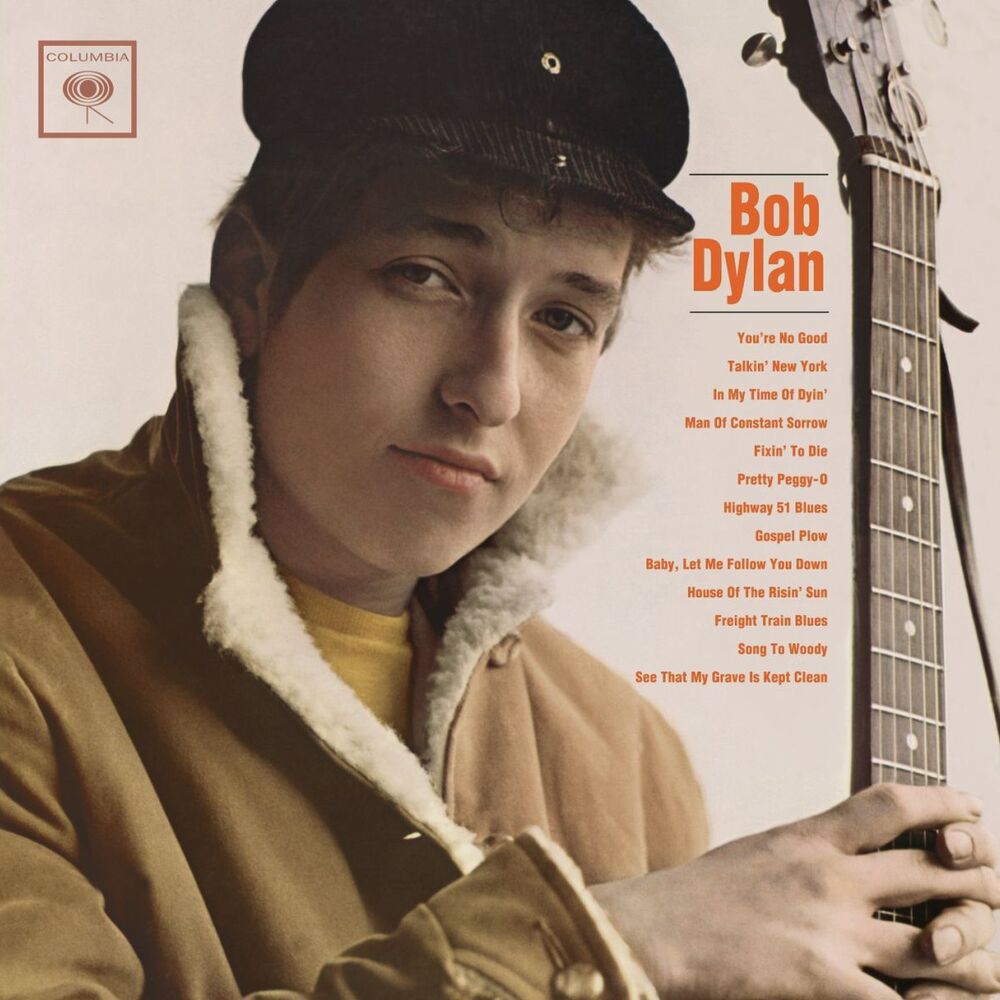
Bob Dylan
- Released16 March 1962
- UK peak No. 13
- Weeks on UK chart 6
- Entered UK chart 2 May 1965
- LabelColumbia
- Tracks13 · 36 min
Tracks
| 1 | You're No Good | 1:36 | |
| 2 | Talkin' New York | 3:17 | |
| 3 | In My Time of Dyin' | 2:37 | |
| 4 | Man of Constant Sorrow | 3:05 | |
| 5 | Fixin' to Die | 2:18 | |
| 6 | Pretty Peggy-O | 3:21 | |
| 7 | Highway 51 Blues | 2:49 | |
| 8 | Gospel Plow | 1:43 | |
| 9 | Baby, Let Me Follow You Down | 2:33 | |
| 10 | House of the Risin' Sun | 5:16 | |
| 11 | Freight Train Blues | 2:16 | |
| 12 | Song to Woody | 2:41 | |
| 13 | See That My Grave Is Kept Clean | 2:43 |
About the album
Bob Dylan is the debut studio album by the American singer-songwriter Bob Dylan, released on March 19, 1962, by Columbia Records. The album was produced by Columbia talent scout John H. Hammond, who had earlier signed Dylan to the label, a controversial decision at the time. The album primarily features folk standards but also includes two original compositions, "Talkin' New York" and "Song to Woody". The latter was an ode to Woody Guthrie, a significant influence in Dylan's early career.
The album received little attention at first, but began to sell as Dylan's career progressed. Three years after its release, it charted in the UK, reaching No. 13.
Recording
Dylan met John Hammond at a rehearsal session for Carolyn Hester on September 14, 1961, at the apartment shared by Hester and her then-husband, Richard Fariña. Hester had invited Dylan to the session as a harmonica player, and Hammond approved him as a session player after hearing him rehearse, with recommendations from his son, musician John P. Hammond, and from Liam Clancy.
Hammond later told Robert Shelton that he decided to sign Dylan "on the spot" and invited him to the Columbia offices for a more formal audition recording. No record of that recording has turned up in Columbia's files, but Hammond, Dylan, and Columbia's A&R director Mitch Miller have all confirmed that an audition occurred.
On September 26, Dylan began a two-week run at Gerde's Folk City, second on the bill to The Greenbriar Boys. On September 29, an exceptionally favorable review of Dylan's performance appeared in the New York Times, written by Robert Shelton. The same day, Dylan played harmonica at Hester's recording session at Columbia's Manhattan studio.
Music
By the time sessions were held for his debut album, Dylan was absorbing an enormous amount of folk material from sitting and listening to contemporaries performing in New York's clubs and coffeehouses. Many of these individuals were also close friends who performed with Dylan, often inviting him to their apartments where they would introduce him to more folk songs. At the same time, Dylan was borrowing and listening to many folk, blues, and country records, many of which were hard to find at the time. Dylan claimed in the documentary No Direction Home that he needed to hear a song only once or twice to learn it.
The final album sequence of Bob Dylan features only two original compositions; the other eleven tracks are folk standards and traditional songs. Few of these were staples of his club/coffeehouse repertoire. Only two of the covers and both originals were in his club set in September 1961. Dylan stated in a 2000 interview that he was hesitant to reveal too much of himself at first.
Of the two original songs, "Song to Woody" is the better known.
Critical reception
Bob Dylan did not receive acclaim until years later. "These debut songs are essayed with differing degrees of conviction," writes music critic Tim Riley in 1999, "[but] even when his reach exceeds his grasp, he never sounds like he knows he's in over his head, or gushily patronizing ... Like Elvis Presley, what Dylan can sing, he quickly masters; what he can't, he twists to his own devices. And as with the Presley Sun sessions, the voice that leaps from Dylan's first album is its most striking feature, a determined, iconoclastic baying that chews up influences, and spits out the odd mixed signal without half trying."
However, at the time of its release, Bob Dylan received little notice, and both Hammond and Dylan were soon dismissive of the album. The April 14, 1962, issue of Billboard magazine highlighted it as a 'special merit' release, saying, '[Dylan] is one of the most interesting, and most disciplined youngsters to appear on the pop-folk scene in a long time' with 'moving readings of originals such as "Song to Woody" and "Talkin' New York".