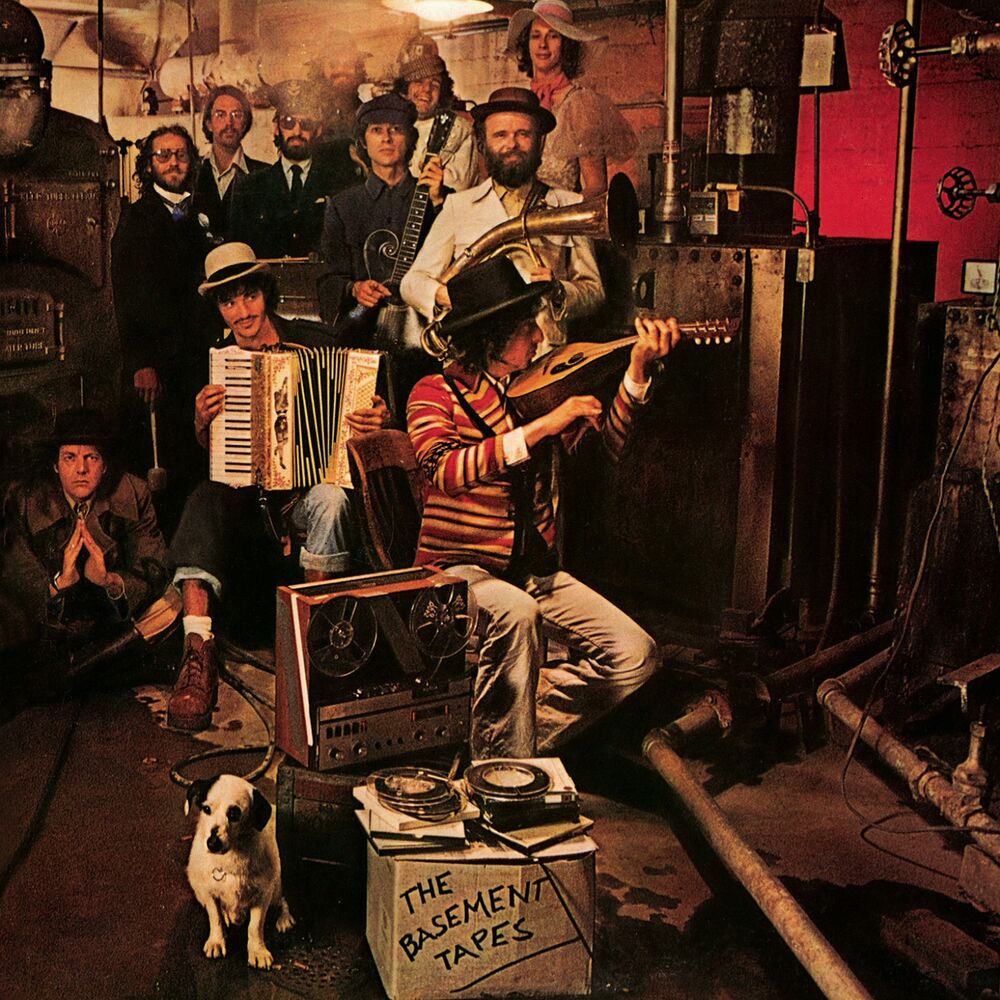
The Basement Tapes
- Released26 June 1975
- UK peak No. 8
- Weeks on UK chart 10
- Entered UK chart 20 July 1975
- LabelColumbia/Legacy
- Tracks24 · 77 min
Tracks
| 1 | Odds and Ends | 1:46 | |
| 2 | Orange Juice Blues | 3:37 | |
| 3 | Million Dollar Bash | 2:31 | |
| 4 | Yazoo Street Scandal | 3:27 | |
| 5 | Goin' to Acapulco | 5:26 | |
| 6 | Katie's Been Gone | 2:43 | |
| 7 | Lo and Behold! | 2:45 | |
| 8 | Bessie Smith | 4:17 | |
| 9 | Clothes Line Saga | 2:56 | |
| 10 | Apple Suckling Tree | 2:48 | |
| 11 | Please, Mrs. Henry | 2:31 | |
| 12 | Tears of Rage | 4:11 | |
| 13 | Too Much of Nothing | 3:01 | |
| 14 | Yea! Heavy And A Bottle Of Bread | 2:13 | |
| 15 | Ain't No More Cane | 3:56 | |
| 16 | Crash on the Levee | 2:03 | |
| 17 | Ruben Remus | 3:13 | |
| 18 | Tiny Montgomery | 2:45 | |
| 19 | You Ain't Goin' Nowhere | 2:42 | |
| 20 | Don't Ya Tell Henry | 3:12 | |
| 21 | Nothing Was Delivered | 4:22 | |
| 22 | Open the Door, Homer | 2:49 | |
| 23 | Long Distance Operator | 3:38 | |
| 24 | This Wheel's On Fire | 3:49 |
About the album
The Basement Tapes is the sixteenth studio album by the American singer-songwriter Bob Dylan and his second with the Band. It was released on June 26, 1975, by Columbia Records. Two-thirds of the album's 24 tracks feature Dylan on lead vocals backed by the Band, and were recorded in 1967, eight years before the album's release, in the lapse between the release of Blonde on Blonde and the subsequent recording and release of John Wesley Harding, during sessions that began at Dylan's house in Woodstock, New York, then moved to the basement of a house nicknamed Big Pink. While most of these songs had appeared on bootleg albums, The Basement Tapes marked their first official release. The remaining eight songs, all previously unavailable, feature the Band without Dylan and were recorded between 1967 and 1975.
During his 1965–1966 world tour, Dylan was backed by the Hawks, a five-member rock group who would later become famous as the Band. After Dylan was injured in a motorcycle accident in July 1966, four members of the Hawks came to Dylan's home in the Woodstock area to collaborate with him on music and film projects. While Dylan was out of the public's eye during an extended period of recovery in 1967, he and the members of the Hawks recorded more than 100 tracks together, incorporating original compositions, contemporary covers, and traditional material.
Background and recording
By July 1966, Bob Dylan was at the peak of both creative and commercial success. Highway 61 Revisited had reached number three on the US album chart in November 1965; the recently released double-LP Blonde on Blonde was widely acclaimed. From September 1965 to May 1966, Dylan embarked on an extensive tour across the US, Australia and Europe backed by the Hawks, a band that had formerly worked with rock and roll musician Ronnie Hawkins. The Hawks comprised four Canadian musicians—Rick Danko, Garth Hudson, Richard Manuel and Robbie Robertson—and one American, Levon Helm. Dylan's audiences reacted with hostility to the sound of their folk icon backed by a rock band. Dismayed by the negative reception, Helm quit the Hawks in November 1965 and drifted around the South, at one point working on an oil rig in the Gulf of Mexico. The tour culminated in a famously raucous concert in Manchester, England, in May 1966 when an audience member shouted "Judas!" at Dylan for allegedly betraying the cause of politically progressive folk music.
Release
In January 1975, Dylan unexpectedly gave permission for the release of a selection of the basement recordings, perhaps because he and Grossman had resolved their legal dispute over the Dwarf Music copyrights on his songs. Clinton Heylin argues that Dylan was able to consent following the critical and commercial success of his album Blood on the Tracks, released that same month: "After Blood on the Tracks, The Basement Tapes no longer had the status of a final reminder of Dylan's lost genius". In 1975, as well, the Band purchased Shangri-La ranch in Malibu, California, which they transformed into their recording studio.
Engineer Rob Fraboni was brought to Shangri-La to clean up the recordings still in the possession of Hudson, the original engineer. Fraboni had worked on Dylan's Planet Waves album, with backing by the Band, and the live Dylan–Band album Before the Flood, both released in 1974. Fraboni has described Robertson as the dominant voice in selecting the final tracks for The Basement Tapes and reported that Dylan was not in the studio very often.
Reception and sales
Columbia Records released The Basement Tapes on June 26, 1975. The album peaked at number seven on the Billboard Top LPs & Tape chart, and reached number eight in the UK. It was acclaimed by critics. John Rockwell of The New York Times hailed it as "one of the greatest albums in the history of American popular music." Rolling Stone's Paul Nelson called its contents "the hardest, toughest, sweetest, saddest, funniest, wisest songs I know". The review in The Washington Post declared, "He may perplex, irritate, and disappoint, but Dylan has to rank as the single greatest artist modern American pop music has produced." The Basement Tapes topped the Voice's Pazz & Jop Critics Poll. Robert Christgau, the poll's creator and supervisor, said the recordings sounded richer and stranger in 1975 than when they were made and concluded, "We don't have to bow our heads in shame because this is the best album of 1975. It would have been the best album of 1967, too."
Themes
Although The Basement Tapes reached the public in an unorthodox manner, officially released eight years after the songs were recorded, critics have assigned them an important place in Dylan's development. Michael Gray writes, "The core Dylan songs from these sessions actually do form a clear link between ... two utterly different albums. They evince the same highly serious, precarious quest for a personal and universal salvation which marked out the John Wesley Harding collection—yet they are soaked in the same blocked confusion and turmoil as Blonde on Blonde. 'Tears of Rage', for example, is an exact halfway house between, say, 'One of Us Must Know (Sooner or Later)' and 'I Dreamed I Saw St. Augustine'".
Singer-songwriter David Gray commented that the great achievement of The Basement Tapes is that Dylan found a way out of the anguish and verbal complexity that had characterized his mid-sixties albums such as Blonde on Blonde: "It's the sound of Dylan letting his guard down.
Legacy
While removed from the public's gaze, Dylan and the Band made music very different from the recordings of other major artists. Andy Gill writes, "Musically, the songs were completely at odds with what was going on in the rest of the pop world, which during the long, hot summer of 1967 was celebrating the birth of the hippie movement with a gaudy explosion of 'psychedelic' music—mostly facile paeans to universal love draped in interminable guitar solos." Patrick Humphries itemizes the ways in which Dylan's songs dissented from the dominant ethos of rock culture: "While the rock world vented its spleen on parents and leaders, Dylan was singing privately about parental fidelity. While George Harrison was testifying that life went on within and without you, Dylan was taking his potatoes down to be mashed. While Mick Jagger was 2,000 light years from home, Dylan was strapping himself to a tree with roots."
This aspect of the basement recordings became obvious when Dylan chose to record his next album, John Wesley Harding, in Nashville in late 1967.