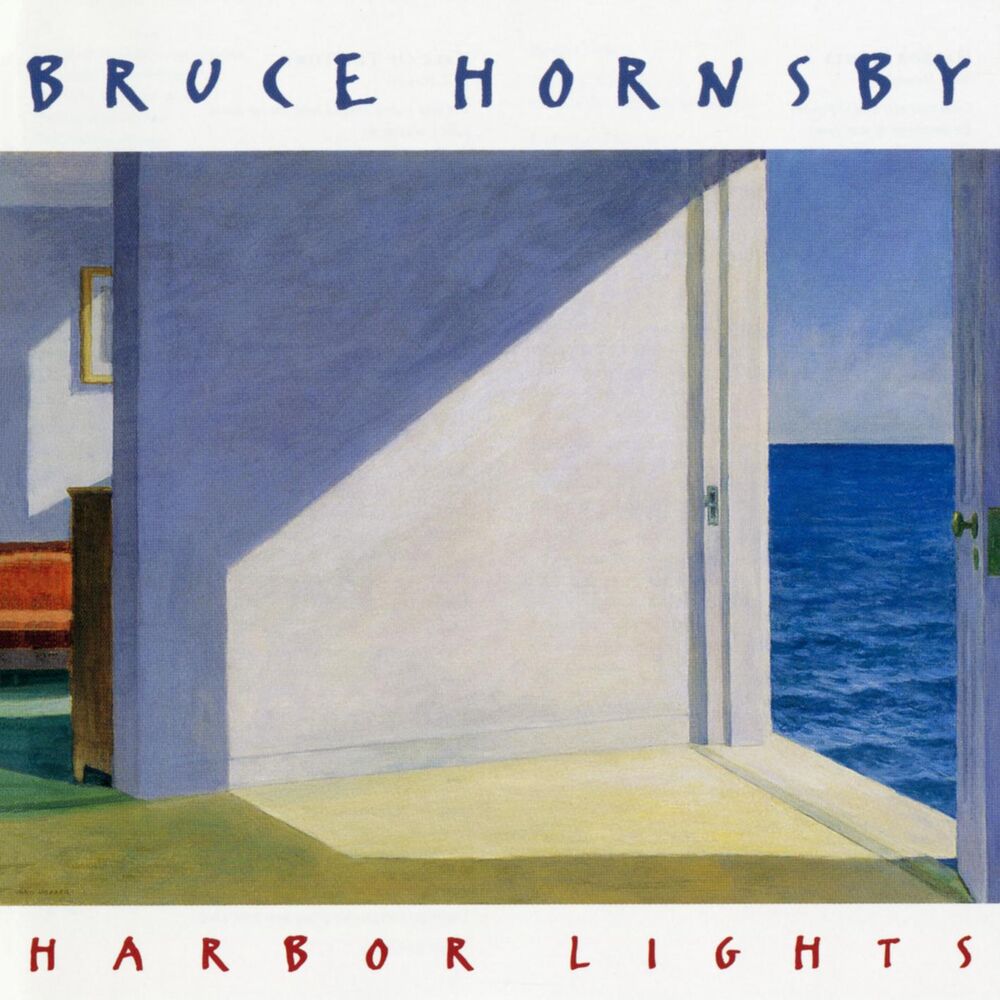
Harbor Lights
- Released5 April 1993
- UK peak No. 32
- Weeks on UK chart 3
- Entered UK chart 2 May 1993
- LabelRCA Records Label
- Tracks10 · 51 min
One track from it charted as a single. Press a flag to play it in the chart where it peaked.
Tracks
| 1 | Harbor Lights | 7:11 | |
| 2 | Talk of the Town | 5:11 | |
| 3 | Long Tall Cool One | 4:59 | |
| 4 | China Doll | 5:16 | |
| 5 | Fields of Gray No. 69 · 1993 | 4:52 | |
| 6 | Rainbow's Cadillac | 4:37 | |
| 7 | Passing Through | 4:12 | |
| 8 | The Tide Will Rise | 3:55 | |
| 9 | What a Time | 4:03 | |
| 10 | Pastures of Plenty | 6:31 |
About the album
Harbor Lights is the fourth album by Bruce Hornsby and was released by RCA Records in 1993. It was the first album credited solely to Hornsby, without his previous backing band, the Range. It was also his first album released under the management company Q-Prime. The album cover uses Edward Hopper's 1951 painting Rooms By the Sea.
Background
On Harbor Lights, Hornsby set out to create an album that was distinct from his previous releases. He felt that his first two albums had been "70% me and a machine", and that his third album was an attempt to incorporate a greater degree of improvisation, which Hornsby said was not fully achieved. To this end, Hornsby opted to forgo the use of The Range and an outside producer, instead opting to produce the album himself and solicit the help of guest musicians. Hornsby believed that the album marked a departure from his earlier offerings, saying "I'm typecast as a Top-40 cat. But this album should dash anybody's notion about that."
Discussing his use of guest musicians, Hornsby said that he "called whomever I heard in my head for that particular song. They would stay at my house, stay for dinner, work on the record and take a walk in the woods. It was a very relaxed atmosphere".
Critical reception
Billboard wrote that Harbor Lights "presents a wider musical range than [Hornsby's] previous work, and shows a deeper involvement in jazz modes". Music & Media thought that Hornsby "opted for a far more jazzy flavour" on Harbor Lights.
Writing for Entertainment Weekly, Dave DiMartino said that Harbor Lights "exudes the same warmth, the same sense of every note being in the right place as, say, James Taylor's Gorilla — and unfortunately, in 1993, most people may want to hear it about as often." J. D. Considine of Musician magazine believed that Hornsby placed more of an emphasis on songwriting with Harbor Lights, where he decided on "casting each arrangement in terms of what the song needs, not what the players want."
Stereo Review thought that the differences between Harbor Lights and Hornsby's previous works "aren't monumental...but they're the signs of a restless musical mind", adding "Where he once played piano with a new-agey jazz accent, you can hear a number of different dialects here, from Keith Jarrett to Vince Guaraldi." AllMusic praised Harbor Lights for its "cooler, jazzie
Production
Bruce Hornsby – producer, horn charts
Wayne Pooley – engineer, mixing (1, 3–5, 7, 8, 10)
Steve Strassman – engineer
Eddie King – additional engineer
Keith Cohen – mixing (2)
David Leonard – mixing (2, 6, 9)
Bob Ludwig – mastering at Gateway Mastering (Portland, Maine) and Masterdisk (New York City, New York)
John McLaughlin Williams – string quartet charts
Sharona Sabbag – production assistant
Shamina Singh – production assistant
Amy Wenzler – production assistant
Norman Moore – art direction, design
Edward Hopper – cover and inside artwork
Greg Gorman – back cover photography
Carey Wilhelm – inside photography
Q-Prime, Inc. – management
Leo Schatzel – piano tuning and service
Carolyn Chrzan – guitar technician for Pat Metheny
Danny Gillen – tambourine technician