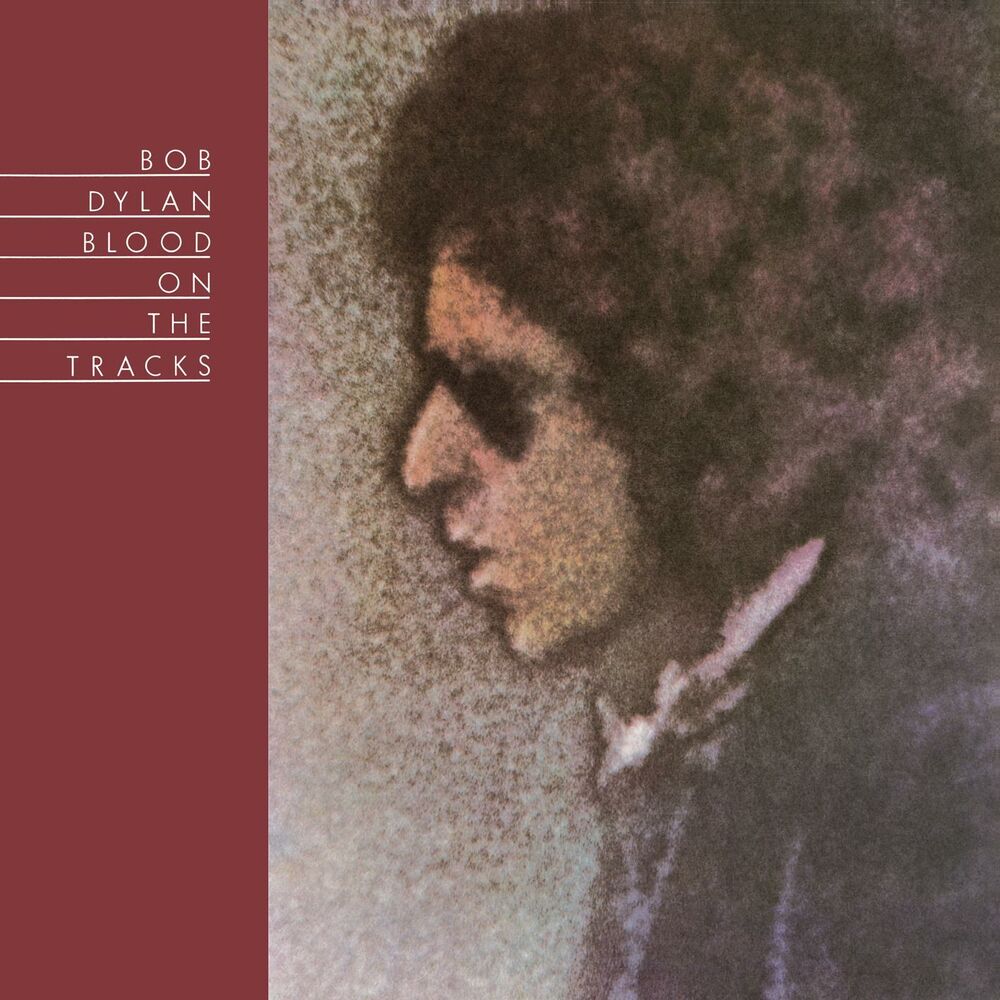
Blood On The Tracks
- Released17 January 1975
- UK peak No. 4
- Weeks on UK chart 17
- Entered UK chart 9 February 1975
- LabelColumbia
- Tracks10 · 52 min
One track from it charted as a single. Press a flag to play it in the chart where it peaked.
Tracks
| 1 | Tangled up in Blue No. 31 · 1975 | 5:42 | |
| 2 | Simple Twist of Fate | 4:17 | |
| 3 | You're a Big Girl Now | 4:31 | |
| 4 | Idiot Wind | 7:49 | |
| 5 | You're Gonna Make Me Lonesome When You Go | 2:53 | |
| 6 | Meet Me in the Morning | 4:21 | |
| 7 | Lily, Rosemary and the Jack of Hearts | 8:51 | |
| 8 | If You See Her, Say Hello | 4:49 | |
| 9 | Shelter from the Storm | 5:02 | |
| 10 | Buckets of Rain | 3:24 |
About the album
Blood on the Tracks is the fifteenth studio album by the American singer-songwriter Bob Dylan, released on January 20, 1975, by Columbia Records. The album marked Dylan's return to Columbia after two albums with Asylum Records. Dylan began recording the album at an A & R studio in New York City in September 1974. In December, shortly before Columbia was due to release the album, Dylan abruptly re-recorded much of the material in Sound 80 studio in Minneapolis. The final album contains five tracks recorded in New York and five from Minneapolis. The songs have been linked to tensions in Dylan's personal life, including his estrangement from his then-wife Sara. One of their children, Jakob Dylan, described the songs as "my parents talking". Dylan has denied that the songs were autobiographical.
Blood on the Tracks initially received mixed reviews, but has since been acclaimed by critics and fans as one of Dylan's best albums; various publications have listed it as one of the greatest albums of all time. It was a commercial success, peaking at No. 1 on the Billboard 200 and No. 4 on the UK Albums Chart; the single "Tangled Up in Blue" peaked at No. 31 on the Billboard Hot 100.
Background and recording
After his 1974 tour with the Band, Dylan began a relationship with a Columbia Records employee, Ellen Bernstein, which Dylan biographer Clinton Heylin has described as the beginning of the end of Dylan's marriage to his wife Sara. In spring 1974, Dylan spent several weeks in New York while he took art classes from the painter Norman Raeben. Dylan credited Raeben with transforming his understanding of time, and during the summer of 1974 he began to write songs using this new knowledge in three small notebooks:
[Raeben] taught me how to see ... in a way that allowed me to do consciously what I unconsciously felt ... when I started doing it, the first album I made was Blood on the Tracks.
Artwork and packaging
The front cover shows Bob Dylan in a portrait in profile looking to the left. To the left of this is a burgundy color strip with the artist's name and album title, both in white and underlined. While the cover image looks like a painting, it is a heavily edited photograph by Paul Till (who is credited accordingly). Till explained that the picture was taken with a telephoto lens at a concert at Maple Leaf Gardens, in Toronto on January 10, 1974. When developing the photo he solarized it, then hand colored it using watercolors, however Ron Coro, then the West Coast Art Director for Columbia Records states that he did not end up using the Paul Till solarized artwork and had used a blown up version of a 4" x 4" black and white printed photo that Bob Dylan had brought with him in case Ron wanted a copy of the original photo to use. The 4" x 4" print was blown up quite a bit and was extremely grainy. Ron had Bob's profile features retouched for better clarity and then recolored the print as close as possible to Paul Till's original for use as the final art.
Critical reception and legacy
Released in early 1975, Blood on the Tracks initially received mixed reviews from critics. Rolling Stone published two assessments. The first, by Jonathan Cott, called it "Dylan's magnificent new album". The second reviewer, Jon Landau, wrote that "the record has been made with typical shoddiness." In NME, Nick Kent described "the accompaniments [as] often so trashy they sound like mere practice takes", while Crawdaddy magazine's Jim Cusimano found the instrumentation incompetent.
An influential review of the album was written by Dylan critic Michael Gray for the magazine Let It Rock. Gray argued that it transformed the cultural perception of Dylan, and that he was no longer defined as "the major artist of the sixties. Instead, Dylan has legitimized his claim to a creative prowess as vital now as then—a power not bounded by the one decade he so affected." This view was amplified by Clinton Heylin, who wrote: "Ten years after he turned the rock & roll brand of pop into rock ...