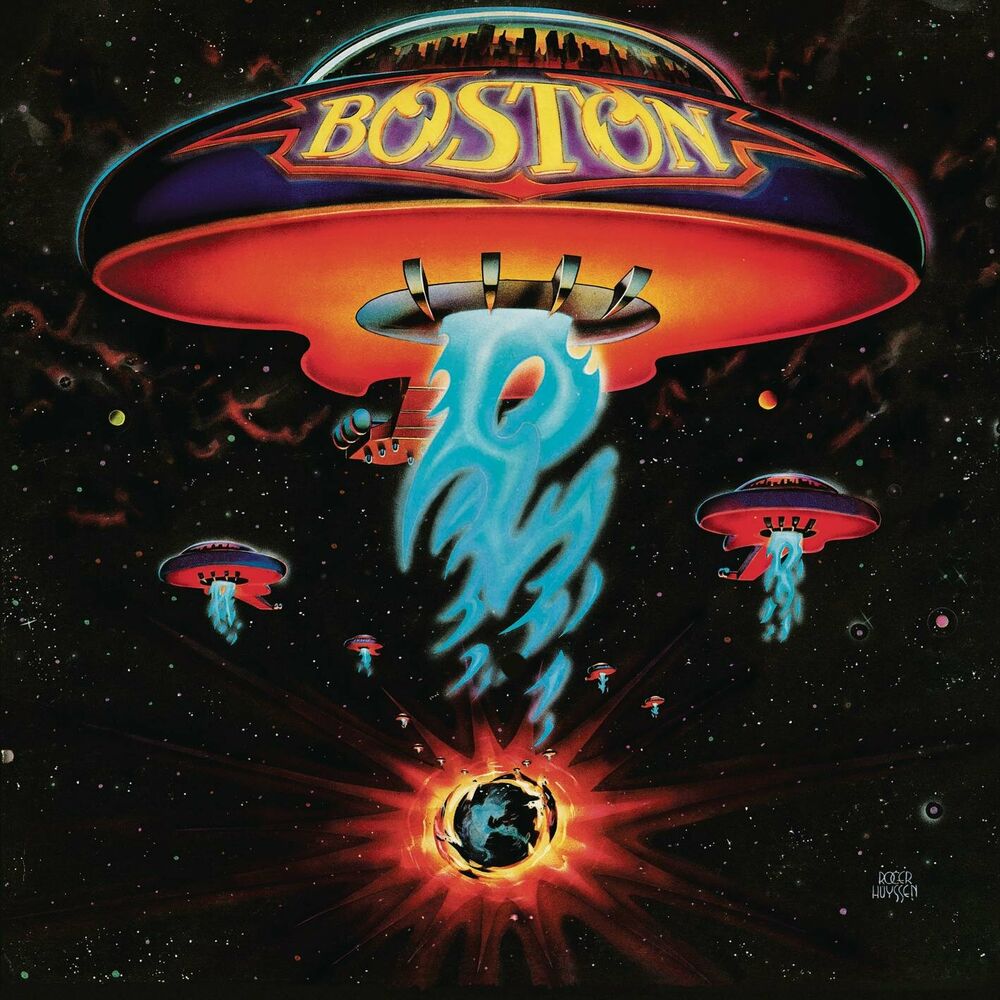
Boston
- Released23 March 1999
- UK peak No. 11
- Weeks on UK chart 22
- Entered UK chart 30 January 1977
- LabelEpic/Legacy
- Tracks8 · 38 min
2 tracks from it charted as singles. Press a flag to play it in the chart where it peaked.
Tracks
| 1 | 4:44 | ||
| 2 | Peace of Mind No. 38 · 1977 | 5:03 | |
| 3 | Foreplay / Long Time | 7:44 | |
| 4 | Rock & Roll Band | 3:00 | |
| 5 | Smokin' | 4:21 | |
| 6 | Hitch a Ride | 4:11 | |
| 7 | Something About You | 3:48 | |
| 8 | Let Me Take You Home Tonight | 4:43 |
About the album
Boston is the debut studio album by American rock band Boston, released on August 25, 1976, by Epic Records. It was produced by band guitarist Tom Scholz and John Boylan. A multi-instrumentalist and engineer who had been involved in the Boston music scene since the late 1960s, Scholz started to write and record demos in his apartment basement with singer Brad Delp, but received numerous rejections from major record labels. The demo tape fell into the hands of CBS-owned Epic, which signed the band in 1975. The album is characterized for its unique blend of electronic effects, the Hammond organ, heavy guitar riffs, and early rock and roll to create what Scholz referred to as the "Boston sound".
Defying Epic Records's insistence on recording the album professionally in Los Angeles, Scholz and Boylan deceived label executives into believing the band was recording on the West Coast, when in reality, the bulk was being tracked solely by Scholz in his Massachusetts home. The album's contents are a complete recreation of the band's demo tape, and contain songs written and composed many years prior. The album's style was developed through Scholz's love for classical music, melodic hooks and early guitar-heavy rock groups such as the Kinks and the Yardbirds, as well as a number of analogue electronic effects developed by Scholz in his home studio.
Background
In the late 1960s, Tom Scholz began attending the Massachusetts Institute of Technology (MIT), where he first wrote music. After graduating with a master's degree, he began working for the Polaroid Corporation in the product development division. By night, he played keyboards for bands in the Boston bar and club scene, where he collaborated with drummer Jim Masdea. The two – who shared a concept of the perfect rock band, one "with crystal-clear vocals and bone-crunching guitars" – viewed themselves as only part-time musicians. Despite this, the duo built a small studio near Watertown, Massachusetts to record ideas. Scholz recorded for hours, often re-recording, erasing, and discarding tapes to create "a perfect song."
Both musicians later joined Mother's Milk, a band featuring guitarist Barry Goudreau that vied for recognition in the Boston music scene. Scholz quickly went from keyboardist to lead songwriter, and the band went through dozens of lead vocalists before Brad Delp auditioned.
Recording and production
Boston was recorded primarily at Scholz's Foxglove Studios in Watertown in "an elaborate end run around the CBS brain trust." Epic wanted a studio version that sounded identical to the demo tape, and Scholz decided he could not work in a production studio, having adapted to home recording for several years, stating, "I work[ed] alone, and that was it."
Scholz took a leave of absence from Polaroid and was gone for several months to record the band's album. "I would wake up every day and go downstairs and start playing," he recalled. Scholz grew annoyed reproducing the parts and being forced to use the same equipment on the demo.
The basement, located in a lower-middle-class neighborhood on School Street, was described by Scholz as a "tiny little space next to the furnace in this hideous pine-paneled basement of my apartment house, and it flooded from time to time with God knows what."
There was a Hammond organ and a Leslie speaker stuffed in the corner of the room alongside the drums; whenever it was time to record the organ parts, they would tear the drums down and pull out the Lesli
Music
The styles of Boston have been categorized as hard rock and arena rock (though the latter had yet to have been coined at the time of the album's release). The tracks are described as "anthemic" and make use of layered melodies and vocal harmonies.
Boston is composed mainly of songs written many years before their appearance on the album. Scholz wrote or co-wrote every song on the first album (except for "Let Me Take You Home Tonight," written by Delp), played virtually all of the instruments, and recorded and engineered all the tracks. The "Boston sound" combines "big, giant melodic hooks" with "massively heavy, classically-inspired guitar parts." For Scholz, the idea of beautiful vocal harmonies was inspired by The Left Banke. The guitar-driven aspect was influenced by the Kinks, the Yardbirds, and Blue Cheer. Another signature element of the "Boston sound" in terms of production involves the balance between acoustic and electric guitars.
Release
Boston was released by Epic Records on, according to varying sources, either August 23 or August 25, 1976. The album broke out of Cleveland first, and the following week, it had been added at 392 stations. Had the record failed, Scholz, then 29, planned to abandon his ambition of making a living performing music; he still worked at Polaroid after it was released and doubted its commercial success until it sold 200,000 copies. "And all of a sudden I realized I was in the music business," he told Rolling Stone. "I got word on what the sales figures were while I was still at Polaroid full-time.
Reception
The album soared, with three singles becoming Top 40 hits. All eight songs on the album received regular airplay on classic rock radio decades later. Taking a mere three weeks to earn an RIAA Gold Record Award (500,000 in unit sales) in 1976 and a Platinum Award (1,000,000 in unit sales) after three months on November 11, 1976, it was the fastest-selling debut album for any American group. It has continued to sell very well, accumulating 9,000,000 in sales by the 10th anniversary in 1986, reaching Diamond in 1990, and 17× platinum by 2003.
Legacy
Boston has been described as a pivot in the transition of mainstream American rock from blues-based proto-metal to power pop, "combining some of the ebullience of the rock era's early days with the precision and technology that would mark rock record productions from then on." All eight songs—most commonly the album's A-side—are in constant rotation on classic rock radio. Boston's success ushered in the next wave of "producer" rock sound. Following the album's success, its sound became imitated by several other prominent rock bands of the era. The record created a reference point for production values and studio technology that would stand for years. The album is hailed as one of the greatest in rock history, with an inclusion in the book 1001 Albums You Must Hear Before You Die. The album was also ranked No. 43 on the Rock and Roll Hall of Fame's "Definitive 200" list. Vik Iyengar of AllMusic said the album is "essential for any fan of classic rock."