X&Y
- Released7 June 2005
- UK peak No. 1
- Weeks on UK chart 13
- Entered UK chart 12 June 2005
- LabelParlophone Records Limited
- Tracks13 · 62 min
4 tracks from it charted as singles. Press a flag to play it in the chart where it peaked.
Tracks
| 1 | Square One | 4:47 | |
| 2 | What If | 4:58 | |
| 3 | White Shadows | 5:28 | |
| 4 | 4:55 | ||
| 5 | 5:11 | ||
| 6 | X&Y | 4:34 | |
| 7 | 4:47 | ||
| 8 | A Message No. 88 · 2010 | 4:45 | |
| 9 | Low | 5:32 | |
| 10 | The Hardest Part | 4:22 | |
| 11 | Swallowed in the Sea | 3:59 | |
| 12 | Twisted Logic | 4:31 | |
| 13 | Til Kingdom Come | 4:10 |
About the album
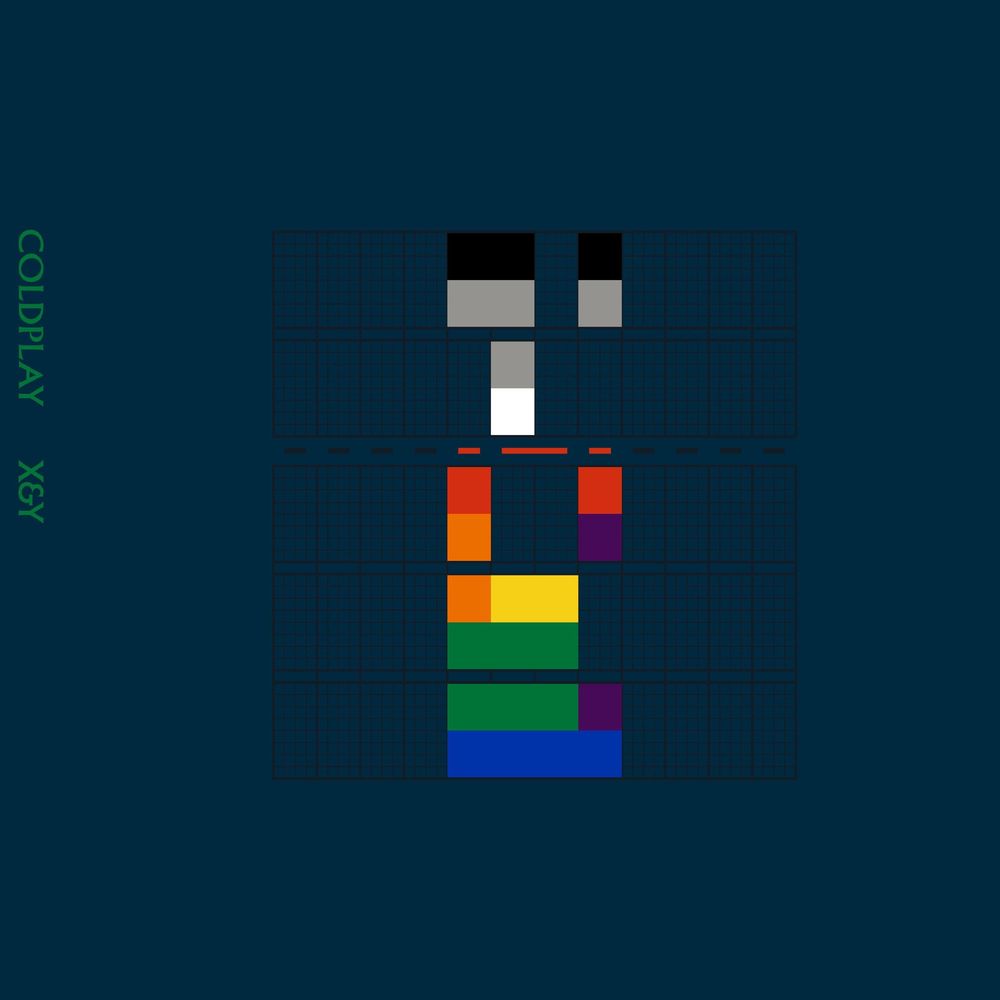
X&Y is the third studio album by the British rock band Coldplay. It was released on 6 June 2005 by Parlophone in the United Kingdom, and a day later by Capitol in the United States. Produced by Coldplay and producer Danton Supple, the album was recorded during a turbulent period for the band, during which their manager and creative director, Phil Harvey, briefly departed. Producer Ken Nelson was originally tasked with producing the record; however, many songs written during his sessions were discarded due to the band's dissatisfaction with them. The album's cover art combines colours and blocks to represent the title in Baudot code.
The album contains twelve tracks, divided into respective halves labeled "X" and "Y", and an additional hidden song, "Til Kingdom Come", which is listed as "+" on the disc label and inside the record's booklet. It was originally planned for American country star Johnny Cash to record it with lead singer Chris Martin, but Cash died before he was able to do so. At a runtime of 62 minutes and 30 seconds, it is Coldplay's longest studio album.
After facing high anticipation, X&Y received positive reviews and was a significant commercial success. The album reached number one in 32 countries upon release, with EMI shipping over 5 million copies in its first week worldwide. In the United Kingdom, the band earned the third-highest debut in history.
Background
Coldplay announced details about X&Y in March 2004 while the album was being recorded. Their initial plans were to stay out of the public eye throughout the year. Lead singer Chris Martin stated, "We really feel that we have to be away for a while and we certainly won't release anything this year, because I think people are a bit sick of us." This plan was not carried out, because of the pressure their second album A Rush of Blood to the Head had induced; but they were trying "to make the best thing that anyone has ever heard". Prior to the announcement, Martin, lead guitarist Jonny Buckland and British record producer Ken Nelson had started recording demos while in Chicago. The band then entered a London studio in January 2004.
Recording
The band spent all of 2004 producing X&Y. The released album is the third version the band had produced during the recording sessions, and some have even considered it as their fifth album due to constant changes in track lists and re-recordings. The band members were not satisfied with the output of their initial sessions with Nelson, who had produced the band's previous two albums, Parachutes (2000) and A Rush of Blood to the Head (2002). It also remains the only Coldplay album in which they had been through the creative process without Phil Harvey's "presence, influence and guidance".
The initial set release date was late 2004, but was later pushed back to January 2005. As the new target date was approaching, the band again discarded songs, which they deemed "flat" and "passionless". Sixty songs were written during these sessions, fifty-two of which were ditched.
Music
The music of X&Y consists of multi-layered production with heavy electronic influences, featuring the extensive use of synthesisers. Musical characteristics that contribute to the album's multi-layering and grandiosity include fast tempos (in contrast to the two previous albums), dynamic drum patterns, distorted guitar riffs, and driving basslines.
Coldplay have also cited various other influences in the album. That of German electronic music pioneers Kraftwerk is evident on the song "Talk", which borrows (with permission) its hook from 1981's "Computer Love", with the riff played on electric guitar instead of on a synthesiser. Also present is large electronic musical influences, from some of the likes of English musicians David Bowie and Brian Eno. Eno, who would later produce Viva la Vida or Death and All His Friends, played backing synthesiser on the track "Low". The first single, "Speed of Sound", also takes inspiration from the drumbeat of English singer-songwriter Kate Bush's song "Running Up that Hill".
Lyrics
Lyrically, X&Y made an apparent shift from its predecessors, with many lyrics focused on a questioning and philosophical view of the world. On their previous works, Martin sang mostly in the first person "I", but here moves to the second person "you". Accordingly, the songs on the album are a reflection of Martin's "doubts, fears, hopes, and loves" with lyrics that are "earnest and vague".
Artwork and packaging
The artwork for X&Y was designed by graphic design duo Tappin Gofton, formed by Mark Tappin and Simon Gofton; Mark Tappin had previously worked for Coldplay on the covers for Parachutes and its associated singles. The image, which is visualised through a combination of colours and blocks, is a graphical representation of the Baudot code, an early form of telegraph communication using a series of ones and zeros to communicate. The code was developed by Frenchman Émile Baudot in the 1870s, and was a widely used method of terrestrial and telegraph communication.
The alphabet of the code is presented in the liner notes of X&Y. The track listing, included on the booklet, CD, and back of the album, uses "X#" on tracks 1 to 6 and "Y#" on tracks 7 to 12, rather than the conventional track numbering system. Many pages in the booklet include photos of the band working on the album. The final page of the booklet contains the slogan "Make Trade Fair" in the Baudot code, a reference to the name of the international organisation which Chris Martin continues to support.
Release and promotion
X&Y was initially intended for a 2004 release, although early news reported it would not be released until 2005; because of personal preferences, songs recorded in several sessions were scrapped and doing so had pushed the expected release date to January 2005. However, the new date went by and the band had to decide on another schedule. By early 2005 the album, rumoured to be called Zero Theory, had a target release date between March and May 2005. By early April the band had finalised the track listing of the album. The album was finally released on 6 June 2005 in the United Kingdom via record label Parlophone. It was issued on 7 June in the United States by Capitol. It has been released with the Copy Control protection system in some regions. Capitol released a remastered version of the album in 2008, on two 180-gram vinyl records, as part of the "From the Capitol Vaults" series.
Around three months prior to the album release, Coldplay began performing several songs from X&Y during live performances.